

438
M. C. Moseki
3.1 Background and General Climatic Conditions
in Southern Africa with Implications
for the Orange-Senqu Basin
Even prior to consideration of potential global climate change impact, the natural
hydrological system of the southern Africa region is highly variable, with a highrisk hydro-climatic environment. The rainfall-to-runoff conversion of less than 5%
is very low, due to high aridity and highly seasonal rainfall (ORASECOM 2008).
Complexities and uncertainties in water resource management are a consequence of
inter-annual rainfall variability (the coefficient of variation in rainfall for southern
Africa is more than 40%). According to Schulze (2011), the intra-annual variability
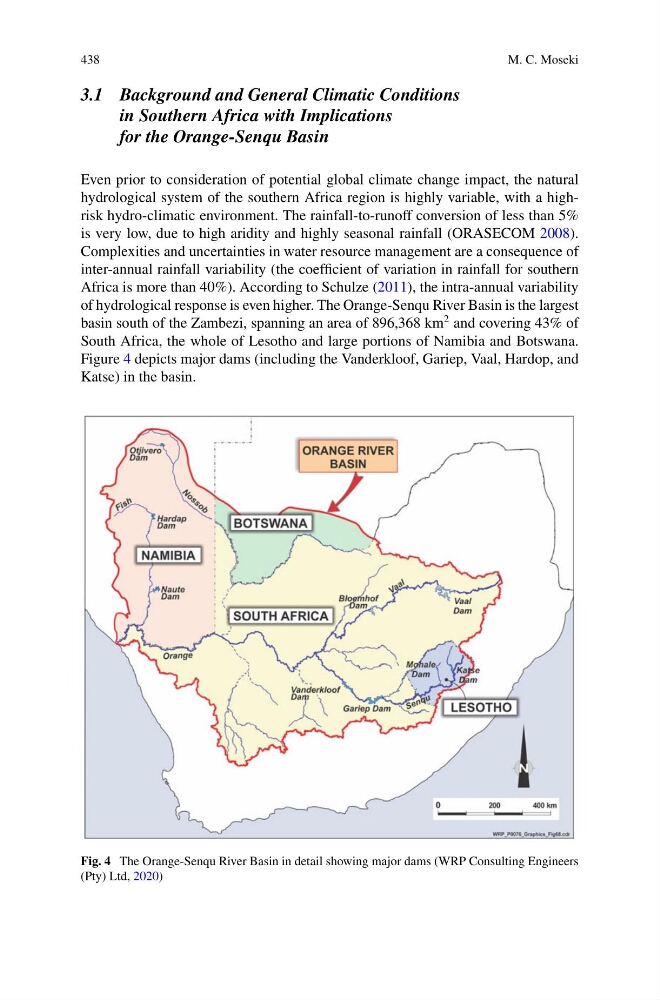
of hydrological response is even higher. The Orange-Senqu River Basin is the largest
basin south of the Zambezi, spanning an area of 896,368 km
2 and covering 43% of
South Africa, the whole of Lesotho and large portions of Namibia and Botswana.
Figure 4 depicts major dams (including the Vanderkloof, Gariep, Vaal, Hardop, and
Katse) in the basin.
Fig. 4 The Orange-Senqu River Basin in detail showing major dams (WRP Consulting Engineers
(Pty) Ltd, 2020)
M. C. Moseki
3.1 Background and General Climatic Conditions
in Southern Africa with Implications
for the Orange-Senqu Basin
Even prior to consideration of potential global climate change impact, the natural
hydrological system of the southern Africa region is highly variable, with a highrisk hydro-climatic environment. The rainfall-to-runoff conversion of less than 5%
is very low, due to high aridity and highly seasonal rainfall (ORASECOM 2008).
Complexities and uncertainties in water resource management are a consequence of
inter-annual rainfall variability (the coefficient of variation in rainfall for southern
Africa is more than 40%). According to Schulze (2011), the intra-annual variability
of hydrological response is even higher. The Orange-Senqu River Basin is the largest
basin south of the Zambezi, spanning an area of 896,368 km
2 and covering 43% of
South Africa, the whole of Lesotho and large portions of Namibia and Botswana.
Figure 4 depicts major dams (including the Vanderkloof, Gariep, Vaal, Hardop, and
Katse) in the basin.
Fig. 4 The Orange-Senqu River Basin in detail showing major dams (WRP Consulting Engineers
(Pty) Ltd, 2020)