

340
G. A. Manful and Y. Opoku-Ankomah
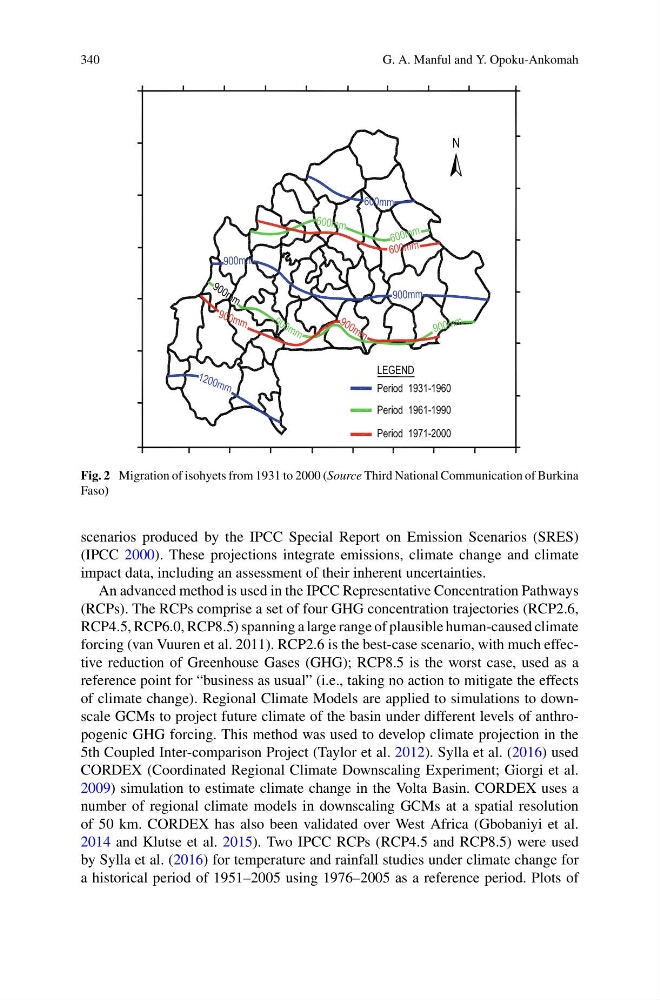
Fig. 2 Migration of isohyets from 1931 to 2000 (Source Third National Communication of Burkina
Faso)
scenarios produced by the IPCC Special Report on Emission Scenarios (SRES)
(IPCC 2000). These projections integrate emissions, climate change and climate
impact data, including an assessment of their inherent uncertainties.
An advanced method is used in the IPCC Representative Concentration Pathways
(RCPs). The RCPs comprise a set of four GHG concentration trajectories (RCP2.6,
RCP4.5, RCP6.0, RCP8.5) spanning a large range of plausible human-caused climate
forcing (van Vuuren et al. 2011). RCP2.6 is the best-case scenario, with much effective reduction of Greenhouse Gases (GHG); RCP8.5 is the worst case, used as a
reference point for “business as usual” (i.e., taking no action to mitigate the effects
of climate change). Regional Climate Models are applied to simulations to downscale GCMs to project future climate of the basin under different levels of anthropogenic GHG forcing. This method was used to develop climate projection in the
5th Coupled Inter-comparison Project (Taylor et al. 2012). Sylla et al. (2016) used
CORDEX (Coordinated Regional Climate Downscaling Experiment; Giorgi et al.
2009) simulation to estimate climate change in the Volta Basin. CORDEX uses a
number of regional climate models in downscaling GCMs at a spatial resolution
of 50 km. CORDEX has also been validated over West Africa (Gbobaniyi et al.
2014 and Klutse et al. 2015). Two IPCC RCPs (RCP4.5 and RCP8.5) were used
by Sylla et al. (2016) for temperature and rainfall studies under climate change for
a historical period of 1951–2005 using 1976–2005 as a reference period. Plots of
G. A. Manful and Y. Opoku-Ankomah
Fig. 2 Migration of isohyets from 1931 to 2000 (Source Third National Communication of Burkina
Faso)
scenarios produced by the IPCC Special Report on Emission Scenarios (SRES)
(IPCC 2000). These projections integrate emissions, climate change and climate
impact data, including an assessment of their inherent uncertainties.
An advanced method is used in the IPCC Representative Concentration Pathways
(RCPs). The RCPs comprise a set of four GHG concentration trajectories (RCP2.6,
RCP4.5, RCP6.0, RCP8.5) spanning a large range of plausible human-caused climate
forcing (van Vuuren et al. 2011). RCP2.6 is the best-case scenario, with much effective reduction of Greenhouse Gases (GHG); RCP8.5 is the worst case, used as a
reference point for “business as usual” (i.e., taking no action to mitigate the effects
of climate change). Regional Climate Models are applied to simulations to downscale GCMs to project future climate of the basin under different levels of anthropogenic GHG forcing. This method was used to develop climate projection in the
5th Coupled Inter-comparison Project (Taylor et al. 2012). Sylla et al. (2016) used
CORDEX (Coordinated Regional Climate Downscaling Experiment; Giorgi et al.
2009) simulation to estimate climate change in the Volta Basin. CORDEX uses a
number of regional climate models in downscaling GCMs at a spatial resolution
of 50 km. CORDEX has also been validated over West Africa (Gbobaniyi et al.
2014 and Klutse et al. 2015). Two IPCC RCPs (RCP4.5 and RCP8.5) were used
by Sylla et al. (2016) for temperature and rainfall studies under climate change for
a historical period of 1951–2005 using 1976–2005 as a reference period. Plots of