

270
C. Faye et al.
Table 5 Water policy laws relating to climate change
Enabling legislation
Objective of climate change policy
Decree No. 2013–1270 of September 23, 2013
on the attributions of the Minister of
Environment and Sustainable Development
– To establish the development of
environmental education;
– Manage a mechanism for monitoring trends
in climate change and changes in the state of
the environment;
– Participate in international technical
meetings dedicated to the protection of the
environment, sustainable development,
climate and biodiversity
Law No. 2001-01 of January 15, 2001 on the
Environment Code
– Adopt new strategic planning instruments;
– Put in place a national strategy for
implementing Framework Convention on
Climate Change;
– Addressing desertification (land degradation
in arid, semi-arid and dry sub-humid areas)
as a result of various factors, including
climatic variations and human activities;
– Establish sustainable development that meets
the needs of the present without
compromising the ability of future
generations to meet theirs;
– Conduct environmental impact studies, such
as effects on climate and atmosphere.
Law No. 81-13 of March 4, 1981 on the Water
Code
– Deal with harmful situations related to water
problems such as floods (and some floods)
and droughts that are increasing with climate
change
Law No. 2009-24 of July 8, 2009 bearing on
the Sanitation Code
– Provide pumping stations to transport
rainwater from their source to a treatment
plant or receiving natural environment;
– Develop a rainwater collection system that
allows, after a rain, the effective evacuation
of runoff water without causing the
inundation of other public or private places,
near or far
Law No. 96-06 of March 22, 1996 on the
Local Authorities Code
– To ensure prevention, by suitable
precautions, and intervention, by the
distribution of necessary help, in the event of
calamitous scourges, such as floods are
accentuated with Climatic Changes
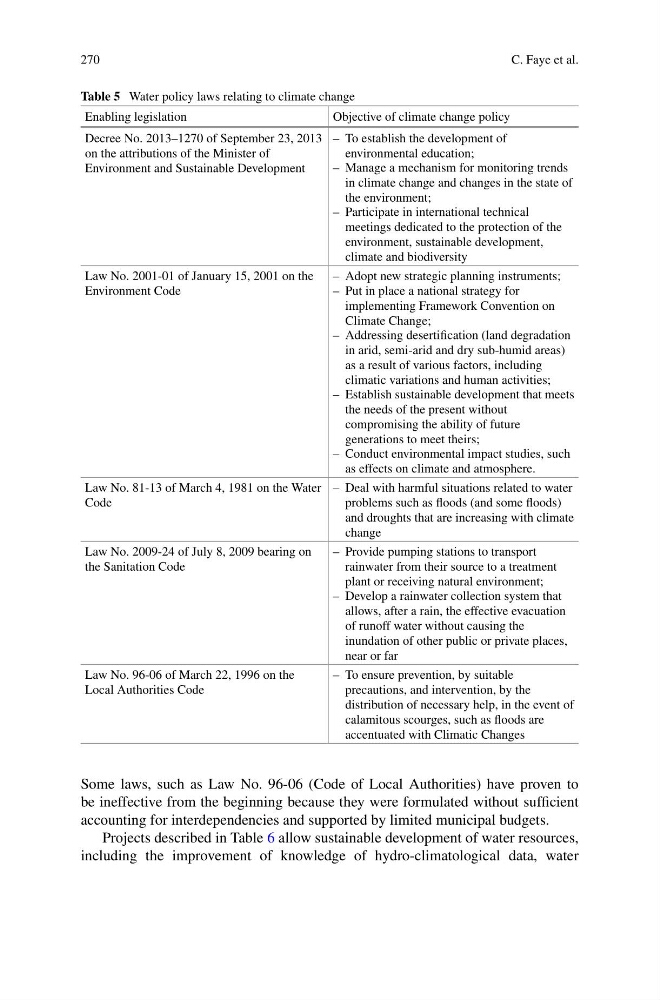
Some laws, such as Law No. 96-06 (Code of Local Authorities) have proven to
be ineffective from the beginning because they were formulated without sufficient
accounting for interdependencies and supported by limited municipal budgets.
Projects described in Table 6 allow sustainable development of water resources,
including the improvement of knowledge of hydro-climatological data, water
C. Faye et al.
Table 5 Water policy laws relating to climate change
Enabling legislation
Objective of climate change policy
Decree No. 2013–1270 of September 23, 2013
on the attributions of the Minister of
Environment and Sustainable Development
– To establish the development of
environmental education;
– Manage a mechanism for monitoring trends
in climate change and changes in the state of
the environment;
– Participate in international technical
meetings dedicated to the protection of the
environment, sustainable development,
climate and biodiversity
Law No. 2001-01 of January 15, 2001 on the
Environment Code
– Adopt new strategic planning instruments;
– Put in place a national strategy for
implementing Framework Convention on
Climate Change;
– Addressing desertification (land degradation
in arid, semi-arid and dry sub-humid areas)
as a result of various factors, including
climatic variations and human activities;
– Establish sustainable development that meets
the needs of the present without
compromising the ability of future
generations to meet theirs;
– Conduct environmental impact studies, such
as effects on climate and atmosphere.
Law No. 81-13 of March 4, 1981 on the Water
Code
– Deal with harmful situations related to water
problems such as floods (and some floods)
and droughts that are increasing with climate
change
Law No. 2009-24 of July 8, 2009 bearing on
the Sanitation Code
– Provide pumping stations to transport
rainwater from their source to a treatment
plant or receiving natural environment;
– Develop a rainwater collection system that
allows, after a rain, the effective evacuation
of runoff water without causing the
inundation of other public or private places,
near or far
Law No. 96-06 of March 22, 1996 on the
Local Authorities Code
– To ensure prevention, by suitable
precautions, and intervention, by the
distribution of necessary help, in the event of
calamitous scourges, such as floods are
accentuated with Climatic Changes
Some laws, such as Law No. 96-06 (Code of Local Authorities) have proven to
be ineffective from the beginning because they were formulated without sufficient
accounting for interdependencies and supported by limited municipal budgets.
Projects described in Table 6 allow sustainable development of water resources,
including the improvement of knowledge of hydro-climatological data, water