

12 Water Management Policy for Freshwater Security …
267
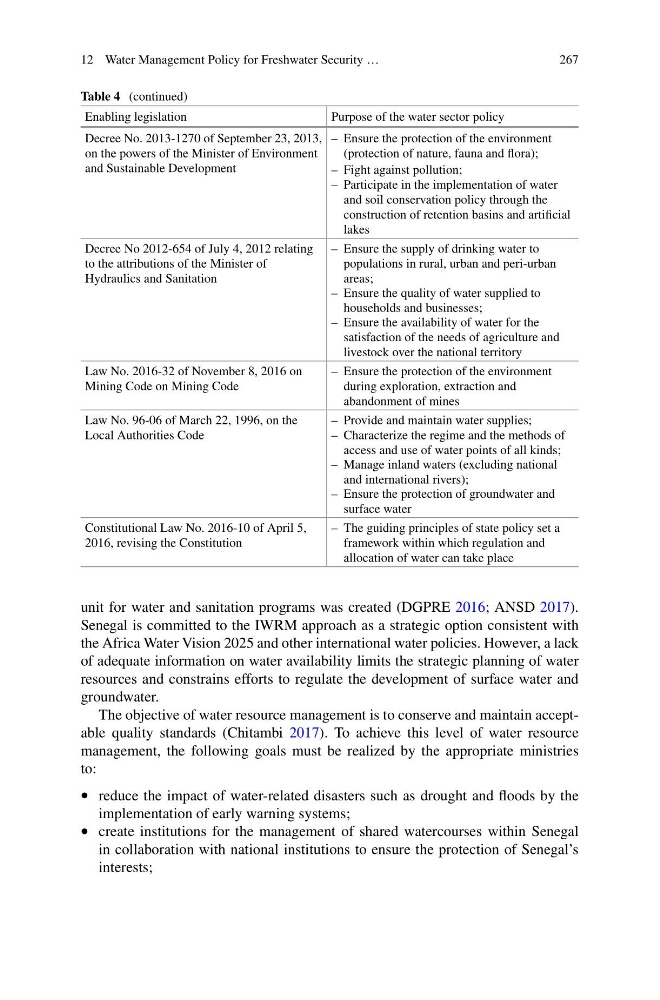
Table 4 (continued)
Enabling legislation
Purpose of the water sector policy
Decree No. 2013-1270 of September 23, 2013,
on the powers of the Minister of Environment
and Sustainable Development
– Ensure the protection of the environment
(protection of nature, fauna and flora);
– Fight against pollution;
– Participate in the implementation of water
and soil conservation policy through the
construction of retention basins and artificial
lakes
Decree No 2012-654 of July 4, 2012 relating
to the attributions of the Minister of
Hydraulics and Sanitation
– Ensure the supply of drinking water to
populations in rural, urban and peri-urban
areas;
– Ensure the quality of water supplied to
households and businesses;
– Ensure the availability of water for the
satisfaction of the needs of agriculture and
livestock over the national territory
Law No. 2016-32 of November 8, 2016 on
Mining Code on Mining Code
– Ensure the protection of the environment
during exploration, extraction and
abandonment of mines
Law No. 96-06 of March 22, 1996, on the
Local Authorities Code
– Provide and maintain water supplies;
– Characterize the regime and the methods of
access and use of water points of all kinds;
– Manage inland waters (excluding national
and international rivers);
– Ensure the protection of groundwater and
surface water
Constitutional Law No. 2016-10 of April 5,
2016, revising the Constitution
– The guiding principles of state policy set a
framework within which regulation and
allocation of water can take place
unit for water and sanitation programs was created (DGPRE 2016; ANSD 2017).
Senegal is committed to the IWRM approach as a strategic option consistent with
the Africa Water Vision 2025 and other international water policies. However, a lack
of adequate information on water availability limits the strategic planning of water
resources and constrains efforts to regulate the development of surface water and
groundwater.
The objective of water resource management is to conserve and maintain acceptable quality standards (Chitambi 2017). To achieve this level of water resource
management, the following goals must be realized by the appropriate ministries
to:
• reduce the impact of water-related disasters such as drought and floods by the
implementation of early warning systems;
• create institutions for the management of shared watercourses within Senegal
in collaboration with national institutions to ensure the protection of Senegal’s
interests;
267
Table 4 (continued)
Enabling legislation
Purpose of the water sector policy
Decree No. 2013-1270 of September 23, 2013,
on the powers of the Minister of Environment
and Sustainable Development
– Ensure the protection of the environment
(protection of nature, fauna and flora);
– Fight against pollution;
– Participate in the implementation of water
and soil conservation policy through the
construction of retention basins and artificial
lakes
Decree No 2012-654 of July 4, 2012 relating
to the attributions of the Minister of
Hydraulics and Sanitation
– Ensure the supply of drinking water to
populations in rural, urban and peri-urban
areas;
– Ensure the quality of water supplied to
households and businesses;
– Ensure the availability of water for the
satisfaction of the needs of agriculture and
livestock over the national territory
Law No. 2016-32 of November 8, 2016 on
Mining Code on Mining Code
– Ensure the protection of the environment
during exploration, extraction and
abandonment of mines
Law No. 96-06 of March 22, 1996, on the
Local Authorities Code
– Provide and maintain water supplies;
– Characterize the regime and the methods of
access and use of water points of all kinds;
– Manage inland waters (excluding national
and international rivers);
– Ensure the protection of groundwater and
surface water
Constitutional Law No. 2016-10 of April 5,
2016, revising the Constitution
– The guiding principles of state policy set a
framework within which regulation and
allocation of water can take place
unit for water and sanitation programs was created (DGPRE 2016; ANSD 2017).
Senegal is committed to the IWRM approach as a strategic option consistent with
the Africa Water Vision 2025 and other international water policies. However, a lack
of adequate information on water availability limits the strategic planning of water
resources and constrains efforts to regulate the development of surface water and
groundwater.
The objective of water resource management is to conserve and maintain acceptable quality standards (Chitambi 2017). To achieve this level of water resource
management, the following goals must be realized by the appropriate ministries
to:
• reduce the impact of water-related disasters such as drought and floods by the
implementation of early warning systems;
• create institutions for the management of shared watercourses within Senegal
in collaboration with national institutions to ensure the protection of Senegal’s
interests;