

246
M. Hadeid et al.
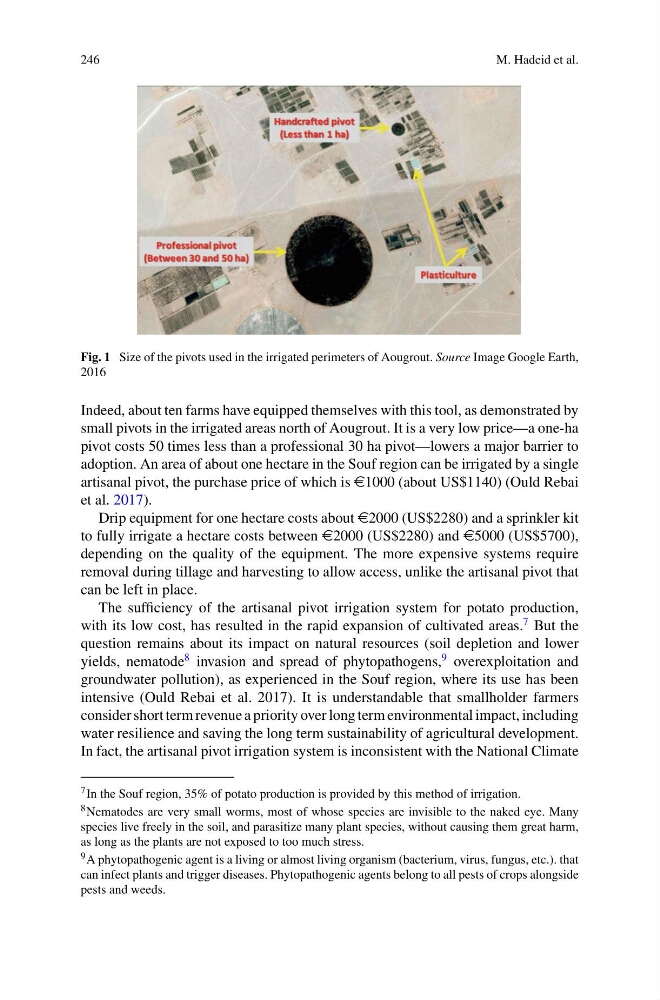
Fig. 1 Size of the pivots used in the irrigated perimeters of Aougrout. Source Image Google Earth,
2016
Indeed, about ten farms have equipped themselves with this tool, as demonstrated by
small pivots in the irrigated areas north of Aougrout. It is a very low price—a one-ha
pivot costs 50 times less than a professional 30 ha pivot—lowers a major barrier to
adoption. An area of about one hectare in the Souf region can be irrigated by a single
artisanal pivot, the purchase price of which is e1000 (about US$1140) (Ould Rebai
et al. 2017).
Drip equipment for one hectare costs about e2000 (US$2280) and a sprinkler kit
to fully irrigate a hectare costs between e2000 (US$2280) and e5000 (US$5700),
depending on the quality of the equipment. The more expensive systems require
removal during tillage and harvesting to allow access, unlike the artisanal pivot that
can be left in place.
The sufficiency of the artisanal pivot irrigation system for potato production,
with its low cost, has resulted in the rapid expansion of cultivated areas.
7 But the
question remains about its impact on natural resources (soil depletion and lower
yields, nematode
8 invasion and spread of phytopathogens,
9 overexploitation and
groundwater pollution), as experienced in the Souf region, where its use has been
intensive (Ould Rebai et al. 2017). It is understandable that smallholder farmers
consider short term revenue a priority over long term environmental impact, including
water resilience and saving the long term sustainability of agricultural development.
In fact, the artisanal pivot irrigation system is inconsistent with the National Climate
7 In the Souf region, 35% of potato production is provided by this method of irrigation.
8 Nematodes are very small worms, most of whose species are invisible to the naked eye. Many
species live freely in the soil, and parasitize many plant species, without causing them great harm,
as long as the plants are not exposed to too much stress.
9 A phytopathogenic agent is a living or almost living organism (bacterium, virus, fungus, etc.). that
can infect plants and trigger diseases. Phytopathogenic agents belong to all pests of crops alongside
pests and weeds.
M. Hadeid et al.
Fig. 1 Size of the pivots used in the irrigated perimeters of Aougrout. Source Image Google Earth,
2016
Indeed, about ten farms have equipped themselves with this tool, as demonstrated by
small pivots in the irrigated areas north of Aougrout. It is a very low price—a one-ha
pivot costs 50 times less than a professional 30 ha pivot—lowers a major barrier to
adoption. An area of about one hectare in the Souf region can be irrigated by a single
artisanal pivot, the purchase price of which is e1000 (about US$1140) (Ould Rebai
et al. 2017).
Drip equipment for one hectare costs about e2000 (US$2280) and a sprinkler kit
to fully irrigate a hectare costs between e2000 (US$2280) and e5000 (US$5700),
depending on the quality of the equipment. The more expensive systems require
removal during tillage and harvesting to allow access, unlike the artisanal pivot that
can be left in place.
The sufficiency of the artisanal pivot irrigation system for potato production,
with its low cost, has resulted in the rapid expansion of cultivated areas.
7 But the
question remains about its impact on natural resources (soil depletion and lower
yields, nematode
8 invasion and spread of phytopathogens,
9 overexploitation and
groundwater pollution), as experienced in the Souf region, where its use has been
intensive (Ould Rebai et al. 2017). It is understandable that smallholder farmers
consider short term revenue a priority over long term environmental impact, including
water resilience and saving the long term sustainability of agricultural development.
In fact, the artisanal pivot irrigation system is inconsistent with the National Climate
7 In the Souf region, 35% of potato production is provided by this method of irrigation.
8 Nematodes are very small worms, most of whose species are invisible to the naked eye. Many
species live freely in the soil, and parasitize many plant species, without causing them great harm,
as long as the plants are not exposed to too much stress.
9 A phytopathogenic agent is a living or almost living organism (bacterium, virus, fungus, etc.). that
can infect plants and trigger diseases. Phytopathogenic agents belong to all pests of crops alongside
pests and weeds.