

9 Lentic-Lotic Water System Response to Anthropogenic …
195
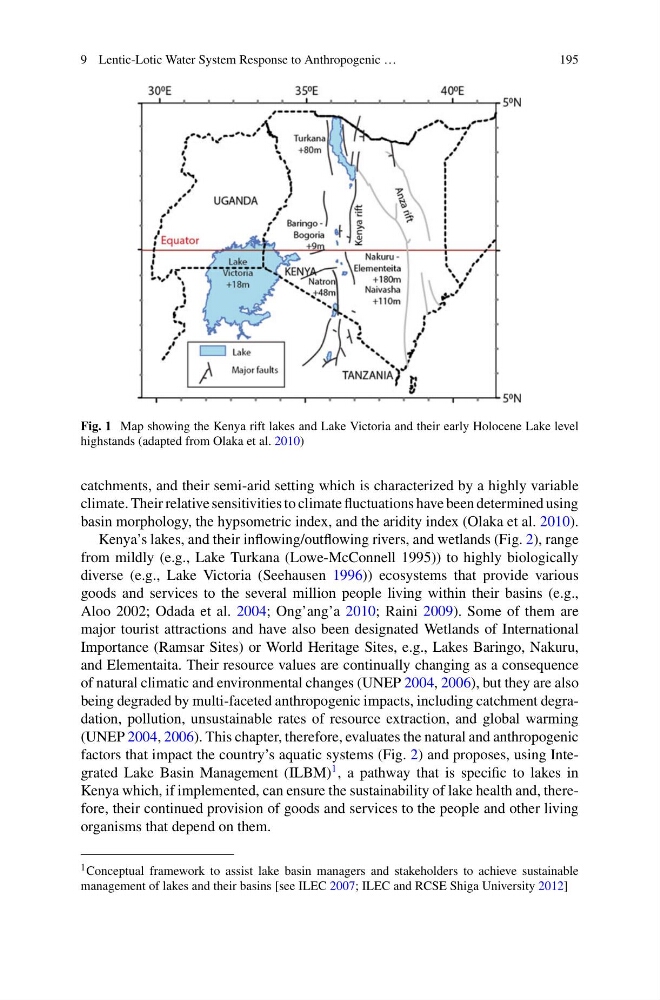
Fig. 1 Map showing the Kenya rift lakes and Lake Victoria and their early Holocene Lake level
highstands (adapted from Olaka et al. 2010)
catchments, and their semi-arid setting which is characterized by a highly variable
climate. Their relative sensitivities to climate fluctuations have been determined using
basin morphology, the hypsometric index, and the aridity index (Olaka et al. 2010).
Kenya’s lakes, and their inflowing/outflowing rivers, and wetlands (Fig. 2), range
from mildly (e.g., Lake Turkana (Lowe-McConnell 1995)) to highly biologically
diverse (e.g., Lake Victoria (Seehausen 1996)) ecosystems that provide various
goods and services to the several million people living within their basins (e.g.,
Aloo 2002; Odada et al. 2004; Ong’ang’a 2010; Raini 2009). Some of them are
major tourist attractions and have also been designated Wetlands of International
Importance (Ramsar Sites) or World Heritage Sites, e.g., Lakes Baringo, Nakuru,
and Elementaita. Their resource values are continually changing as a consequence
of natural climatic and environmental changes (UNEP 2004, 2006), but they are also
being degraded by multi-faceted anthropogenic impacts, including catchment degradation, pollution, unsustainable rates of resource extraction, and global warming
(UNEP 2004, 2006). This chapter, therefore, evaluates the natural and anthropogenic
factors that impact the country’s aquatic systems (Fig. 2) and proposes, using Integrated Lake Basin Management (ILBM)
1 , a pathway that is specific to lakes in
Kenya which, if implemented, can ensure the sustainability of lake health and, therefore, their continued provision of goods and services to the people and other living
organisms that depend on them.
1 Conceptual framework to assist lake basin managers and stakeholders to achieve sustainable
management of lakes and their basins [see ILEC 2007; ILEC and RCSE Shiga University 2012]
195
Fig. 1 Map showing the Kenya rift lakes and Lake Victoria and their early Holocene Lake level
highstands (adapted from Olaka et al. 2010)
catchments, and their semi-arid setting which is characterized by a highly variable
climate. Their relative sensitivities to climate fluctuations have been determined using
basin morphology, the hypsometric index, and the aridity index (Olaka et al. 2010).
Kenya’s lakes, and their inflowing/outflowing rivers, and wetlands (Fig. 2), range
from mildly (e.g., Lake Turkana (Lowe-McConnell 1995)) to highly biologically
diverse (e.g., Lake Victoria (Seehausen 1996)) ecosystems that provide various
goods and services to the several million people living within their basins (e.g.,
Aloo 2002; Odada et al. 2004; Ong’ang’a 2010; Raini 2009). Some of them are
major tourist attractions and have also been designated Wetlands of International
Importance (Ramsar Sites) or World Heritage Sites, e.g., Lakes Baringo, Nakuru,
and Elementaita. Their resource values are continually changing as a consequence
of natural climatic and environmental changes (UNEP 2004, 2006), but they are also
being degraded by multi-faceted anthropogenic impacts, including catchment degradation, pollution, unsustainable rates of resource extraction, and global warming
(UNEP 2004, 2006). This chapter, therefore, evaluates the natural and anthropogenic
factors that impact the country’s aquatic systems (Fig. 2) and proposes, using Integrated Lake Basin Management (ILBM)
1 , a pathway that is specific to lakes in
Kenya which, if implemented, can ensure the sustainability of lake health and, therefore, their continued provision of goods and services to the people and other living
organisms that depend on them.
1 Conceptual framework to assist lake basin managers and stakeholders to achieve sustainable
management of lakes and their basins [see ILEC 2007; ILEC and RCSE Shiga University 2012]