

7 A Framework for IWRM in the Water-Energy-Food …
161
In the framework of using sugar cane for energy production without first extracting
sugar, sugar is considered to be a fuel contained in biomass. This concept is new but
seems to be gaining traction in some environments and contexts even where the main
use of sugar cane is and will remain sugar production.
As indicated previously, this could be of interest to CSS in a Water-Energy-Food
nexus approach by promoting the production of energy from a local agricultural
product using local water and solar energy efficiently for photosynthesis. Reducing
the use of fossil energy for electricity production when bagasse stock is depleted
would allow the CSS to participate in reducing the use of fossil energy products (oil,
coal) in the current context of climate change.
Research has been conducted in this area with encouraging results. For example,
a five-year project in Guadeloupe, an island country in the Lesser Antilles, as part of
the REBECCA research and development project (‘REcherche Biomasses Energie
Canne à CApesterre’, Biomass for Energy Research from Cane in CApesterre) is
three years into a partnership with an industrial company (QUADRAN) already
producing electricity in Guadeloupe. The research was first conducted to identify
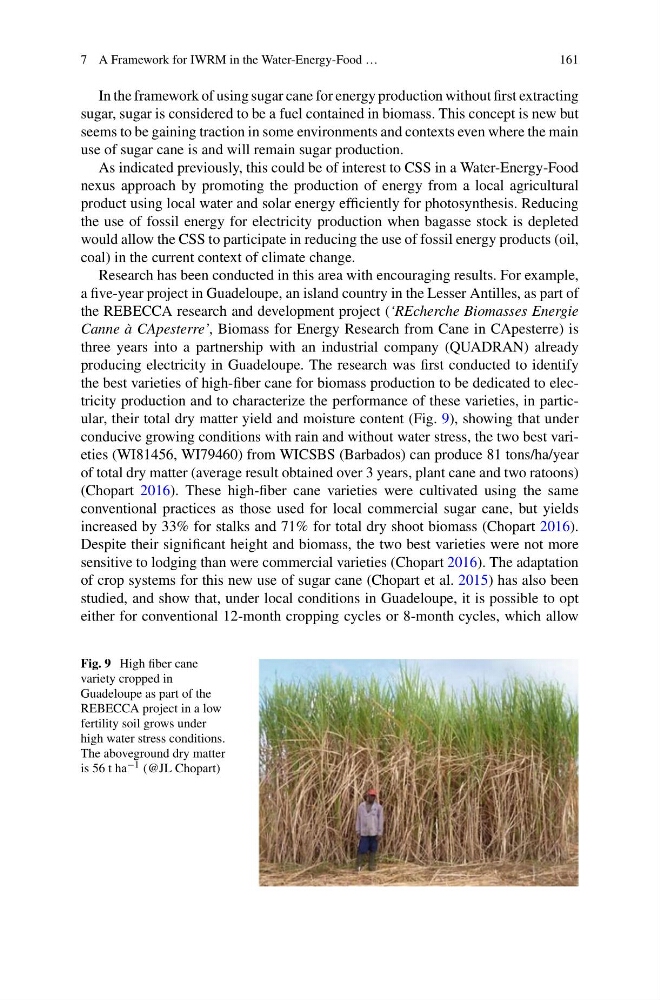
the best varieties of high-fiber cane for biomass production to be dedicated to electricity production and to characterize the performance of these varieties, in particular, their total dry matter yield and moisture content (Fig. 9), showing that under
conducive growing conditions with rain and without water stress, the two best varieties (WI81456, WI79460) from WICSBS (Barbados) can produce 81 tons/ha/year
of total dry matter (average result obtained over 3 years, plant cane and two ratoons)
(Chopart 2016). These high-fiber cane varieties were cultivated using the same
conventional practices as those used for local commercial sugar cane, but yields
increased by 33% for stalks and 71% for total dry shoot biomass (Chopart 2016).
Despite their significant height and biomass, the two best varieties were not more
sensitive to lodging than were commercial varieties (Chopart 2016). The adaptation
of crop systems for this new use of sugar cane (Chopart et al. 2015) has also been
studied, and show that, under local conditions in Guadeloupe, it is possible to opt
either for conventional 12-month cropping cycles or 8-month cycles, which allow
Fig. 9 High fiber cane
variety cropped in
Guadeloupe as part of the
REBECCA project in a low
fertility soil grows under
high water stress conditions.
The aboveground dry matter
is 56 t ha −1 (@JL Chopart)
161
In the framework of using sugar cane for energy production without first extracting
sugar, sugar is considered to be a fuel contained in biomass. This concept is new but
seems to be gaining traction in some environments and contexts even where the main
use of sugar cane is and will remain sugar production.
As indicated previously, this could be of interest to CSS in a Water-Energy-Food
nexus approach by promoting the production of energy from a local agricultural
product using local water and solar energy efficiently for photosynthesis. Reducing
the use of fossil energy for electricity production when bagasse stock is depleted
would allow the CSS to participate in reducing the use of fossil energy products (oil,
coal) in the current context of climate change.
Research has been conducted in this area with encouraging results. For example,
a five-year project in Guadeloupe, an island country in the Lesser Antilles, as part of
the REBECCA research and development project (‘REcherche Biomasses Energie
Canne à CApesterre’, Biomass for Energy Research from Cane in CApesterre) is
three years into a partnership with an industrial company (QUADRAN) already
producing electricity in Guadeloupe. The research was first conducted to identify
the best varieties of high-fiber cane for biomass production to be dedicated to electricity production and to characterize the performance of these varieties, in particular, their total dry matter yield and moisture content (Fig. 9), showing that under
conducive growing conditions with rain and without water stress, the two best varieties (WI81456, WI79460) from WICSBS (Barbados) can produce 81 tons/ha/year
of total dry matter (average result obtained over 3 years, plant cane and two ratoons)
(Chopart 2016). These high-fiber cane varieties were cultivated using the same
conventional practices as those used for local commercial sugar cane, but yields
increased by 33% for stalks and 71% for total dry shoot biomass (Chopart 2016).
Despite their significant height and biomass, the two best varieties were not more
sensitive to lodging than were commercial varieties (Chopart 2016). The adaptation
of crop systems for this new use of sugar cane (Chopart et al. 2015) has also been
studied, and show that, under local conditions in Guadeloupe, it is possible to opt
either for conventional 12-month cropping cycles or 8-month cycles, which allow
Fig. 9 High fiber cane
variety cropped in
Guadeloupe as part of the
REBECCA project in a low
fertility soil grows under
high water stress conditions.
The aboveground dry matter
is 56 t ha −1 (@JL Chopart)