

7 A Framework for IWRM in the Water-Energy-Food …
157
annual evaporation of 2,000 mm, very low rainfall) and the length of the cultivation
cycle (12 months). Annual production is around 1,400,000 tons of sugar cane for an
average gross yield of 134 TC/ha.
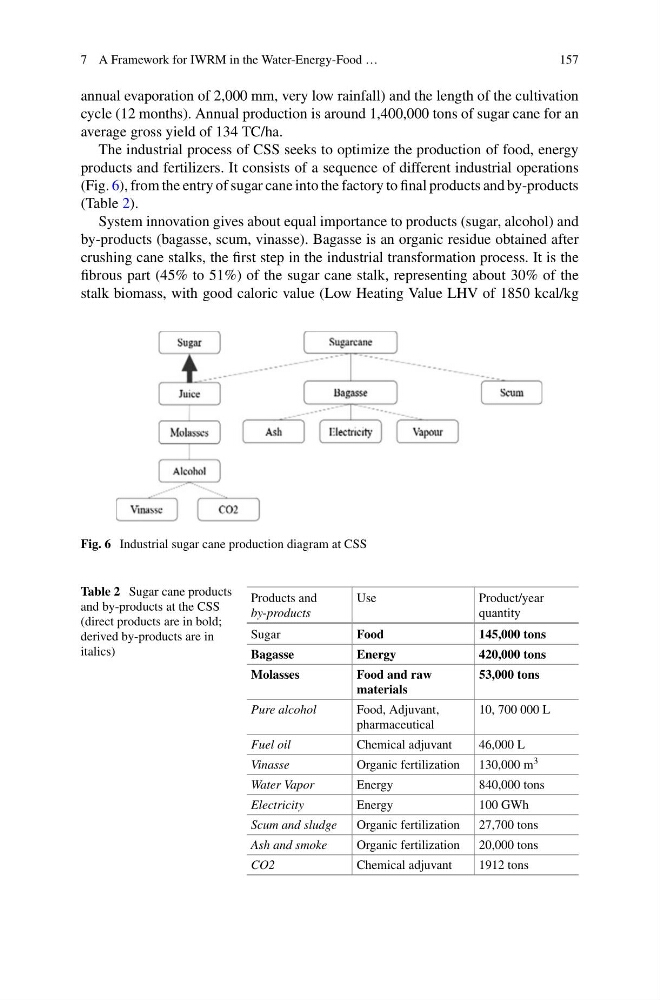
The industrial process of CSS seeks to optimize the production of food, energy
products and fertilizers. It consists of a sequence of different industrial operations
(Fig. 6), from the entry of sugar cane into the factory to final products and by-products
(Table 2).
System innovation gives about equal importance to products (sugar, alcohol) and
by-products (bagasse, scum, vinasse). Bagasse is an organic residue obtained after
crushing cane stalks, the first step in the industrial transformation process. It is the
fibrous part (45% to 51%) of the sugar cane stalk, representing about 30% of the
stalk biomass, with good caloric value (Low Heating Value LHV of 1850 kcal/kg
Fig. 6 Industrial sugar cane production diagram at CSS
Table 2 Sugar cane products
and by-products at the CSS
(direct products are in bold;
derived by-products are in
italics)
Products and
by-products
Use
Product/year
quantity
Sugar
Food
145,000 tons
Bagasse
Energy
420,000 tons
Molasses
Food and raw
materials
53,000 tons
Pure alcohol
Food, Adjuvant,
pharmaceutical
10, 700 000 L
Fuel oil
Chemical adjuvant
46,000 L
Vinasse
Organic fertilization 130,000 m 3
Water Vapor
Energy
840,000 tons
Electricity
Energy
100 GWh
Scum and sludge
Organic fertilization 27,700 tons
Ash and smoke
Organic fertilization 20,000 tons
CO2
Chemical adjuvant
1912 tons
157
annual evaporation of 2,000 mm, very low rainfall) and the length of the cultivation
cycle (12 months). Annual production is around 1,400,000 tons of sugar cane for an
average gross yield of 134 TC/ha.
The industrial process of CSS seeks to optimize the production of food, energy
products and fertilizers. It consists of a sequence of different industrial operations
(Fig. 6), from the entry of sugar cane into the factory to final products and by-products
(Table 2).
System innovation gives about equal importance to products (sugar, alcohol) and
by-products (bagasse, scum, vinasse). Bagasse is an organic residue obtained after
crushing cane stalks, the first step in the industrial transformation process. It is the
fibrous part (45% to 51%) of the sugar cane stalk, representing about 30% of the
stalk biomass, with good caloric value (Low Heating Value LHV of 1850 kcal/kg
Fig. 6 Industrial sugar cane production diagram at CSS
Table 2 Sugar cane products
and by-products at the CSS
(direct products are in bold;
derived by-products are in
italics)
Products and
by-products
Use
Product/year
quantity
Sugar
Food
145,000 tons
Bagasse
Energy
420,000 tons
Molasses
Food and raw
materials
53,000 tons
Pure alcohol
Food, Adjuvant,
pharmaceutical
10, 700 000 L
Fuel oil
Chemical adjuvant
46,000 L
Vinasse
Organic fertilization 130,000 m 3
Water Vapor
Energy
840,000 tons
Electricity
Energy
100 GWh
Scum and sludge
Organic fertilization 27,700 tons
Ash and smoke
Organic fertilization 20,000 tons
CO2
Chemical adjuvant
1912 tons