

50
cells, the vertebrate host was reptilian and Paleoleishmania proterus was considered
to be an ancestor of the genus Sauroleishmania that infects lizards and snakes today
(Poinar and Poinar 2004a, b).
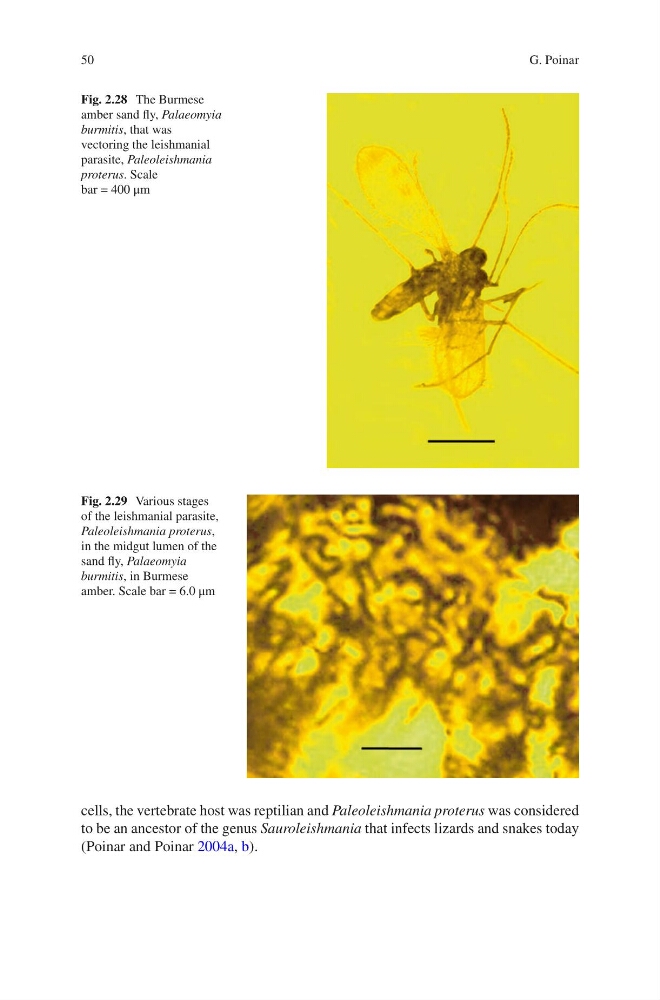
Fig. 2.28 The Burmese
amber sand fly, Palaeomyia
burmitis, that was
vectoring the leishmanial
parasite, Paleoleishmania
proterus. Scale
bar = 400 μm
Fig. 2.29 Various stages
of the leishmanial parasite,
Paleoleishmania proterus,
in the midgut lumen of the
sand fly, Palaeomyia
burmitis, in Burmese
amber. Scale bar = 6.0 μm
G. Poinar
cells, the vertebrate host was reptilian and Paleoleishmania proterus was considered
to be an ancestor of the genus Sauroleishmania that infects lizards and snakes today
(Poinar and Poinar 2004a, b).
Fig. 2.28 The Burmese
amber sand fly, Palaeomyia
burmitis, that was
vectoring the leishmanial
parasite, Paleoleishmania
proterus. Scale
bar = 400 μm
Fig. 2.29 Various stages
of the leishmanial parasite,
Paleoleishmania proterus,
in the midgut lumen of the
sand fly, Palaeomyia
burmitis, in Burmese
amber. Scale bar = 6.0 μm
G. Poinar