

48
2.3.2 Indirect Evidence of Fossil
Symbiotic-Pathogenic Bacteria
Indirect evidence of fossil pathogenic bacteria has been reported in the middle
Cambrian Burgess Shale onychophoran, Aysheaia pedunculata. Dark areas on the
body are thought to represent bacterial infections (Whittington 1985). Other indirect examples are fossil fish with luminescent organs occupied by luminescent bacteria in present day descendants, suggesting both a symbiotic and parasitic
association (Boucot and Poinar 2010).
Insects producing flatus in amber are an indication of alimentary tract bacteria,
some of which could be pathogenic (Poinar 2010a, b). There are numerous bacteria
in the alimentary tract of honeybees, some of which are symbiotic and others pathogenic. One pathogenic species that is a common member of the gut flora is Frischella
perrara that causes scabs on gut epithelium (Engel et al. 2016).
Gut bacteria also occur in stingless bees. A member of the extinct stingless bee
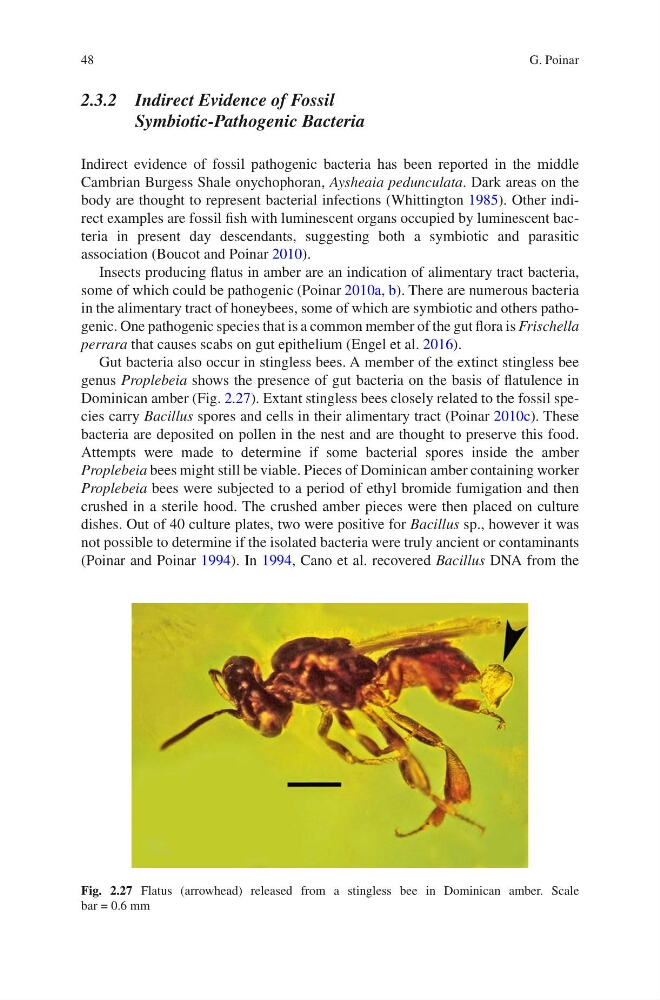
genus Proplebeia shows the presence of gut bacteria on the basis of flatulence in
Dominican amber (Fig. 2.27). Extant stingless bees closely related to the fossil species carry Bacillus spores and cells in their alimentary tract (Poinar 2010c). These
bacteria are deposited on pollen in the nest and are thought to preserve this food.
Attempts were made to determine if some bacterial spores inside the amber
Proplebeia bees might still be viable. Pieces of Dominican amber containing worker
Proplebeia bees were subjected to a period of ethyl bromide fumigation and then
crushed in a sterile hood. The crushed amber pieces were then placed on culture
dishes. Out of 40 culture plates, two were positive for Bacillus sp., however it was
not possible to determine if the isolated bacteria were truly ancient or contaminants
(Poinar and Poinar 1994). In 1994, Cano et al. recovered Bacillus DNA from the
Fig. 2.27 Flatus (arrowhead) released from a stingless bee in Dominican amber. Scale
bar = 0.6 mm
G. Poinar
2.3.2 Indirect Evidence of Fossil
Symbiotic-Pathogenic Bacteria
Indirect evidence of fossil pathogenic bacteria has been reported in the middle
Cambrian Burgess Shale onychophoran, Aysheaia pedunculata. Dark areas on the
body are thought to represent bacterial infections (Whittington 1985). Other indirect examples are fossil fish with luminescent organs occupied by luminescent bacteria in present day descendants, suggesting both a symbiotic and parasitic
association (Boucot and Poinar 2010).
Insects producing flatus in amber are an indication of alimentary tract bacteria,
some of which could be pathogenic (Poinar 2010a, b). There are numerous bacteria
in the alimentary tract of honeybees, some of which are symbiotic and others pathogenic. One pathogenic species that is a common member of the gut flora is Frischella
perrara that causes scabs on gut epithelium (Engel et al. 2016).
Gut bacteria also occur in stingless bees. A member of the extinct stingless bee
genus Proplebeia shows the presence of gut bacteria on the basis of flatulence in
Dominican amber (Fig. 2.27). Extant stingless bees closely related to the fossil species carry Bacillus spores and cells in their alimentary tract (Poinar 2010c). These
bacteria are deposited on pollen in the nest and are thought to preserve this food.
Attempts were made to determine if some bacterial spores inside the amber
Proplebeia bees might still be viable. Pieces of Dominican amber containing worker
Proplebeia bees were subjected to a period of ethyl bromide fumigation and then
crushed in a sterile hood. The crushed amber pieces were then placed on culture
dishes. Out of 40 culture plates, two were positive for Bacillus sp., however it was
not possible to determine if the isolated bacteria were truly ancient or contaminants
(Poinar and Poinar 1994). In 1994, Cano et al. recovered Bacillus DNA from the
Fig. 2.27 Flatus (arrowhead) released from a stingless bee in Dominican amber. Scale
bar = 0.6 mm
G. Poinar