

41
Other examples of direct evidence of fossil pathogenic bacteria are spirochetes
of Palaeoborrelia dominicana (Spirochaetales) infecting a larva Amblyomma sp.
tick (Ixodidae) in Dominican amber (Fig. 2.17). The size and shape of the fossil
spirochetes (Fig. 2.18) are similar to those of extant Borrelia species, including
Borrelia burgdorferi, the causal agent of Lyme disease (Poinar 2014a; Johnson
et al. 1984).
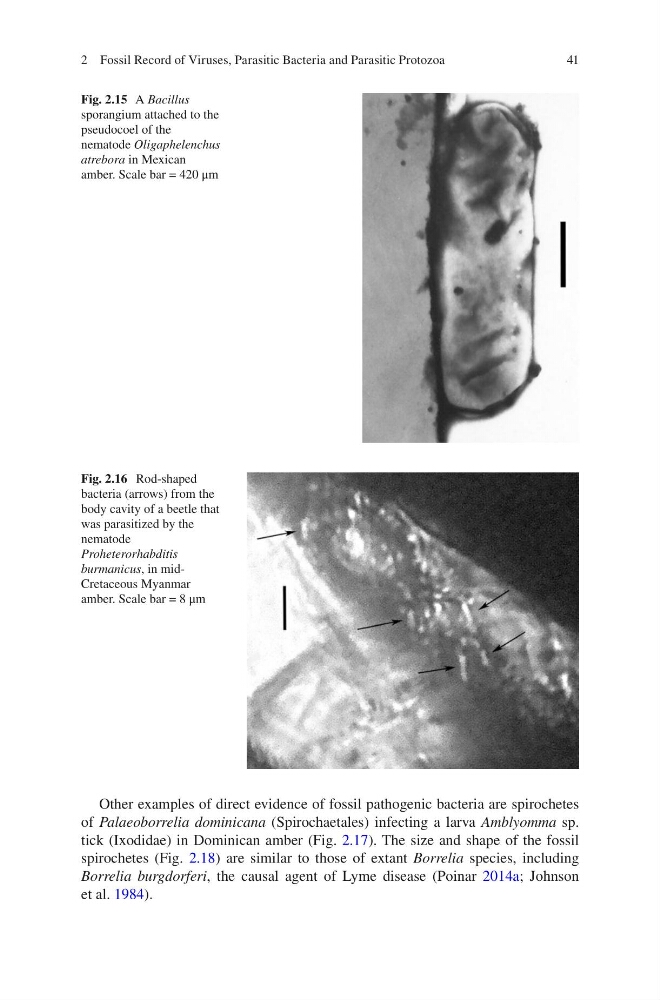
Fig. 2.15 A Bacillus
sporangium attached to the
pseudocoel of the
nematode Oligaphelenchus
atrebora in Mexican
amber. Scale bar = 420 μm
Fig. 2.16 Rod-shaped
bacteria (arrows) from the
body cavity of a beetle that
was parasitized by the
nematode
Proheterorhabditis
burmanicus, in midCretaceous Myanmar
amber. Scale bar = 8 μm
2 Fossil Record of Viruses, Parasitic Bacteria and Parasitic Protozoa
Other examples of direct evidence of fossil pathogenic bacteria are spirochetes
of Palaeoborrelia dominicana (Spirochaetales) infecting a larva Amblyomma sp.
tick (Ixodidae) in Dominican amber (Fig. 2.17). The size and shape of the fossil
spirochetes (Fig. 2.18) are similar to those of extant Borrelia species, including
Borrelia burgdorferi, the causal agent of Lyme disease (Poinar 2014a; Johnson
et al. 1984).
Fig. 2.15 A Bacillus
sporangium attached to the
pseudocoel of the
nematode Oligaphelenchus
atrebora in Mexican
amber. Scale bar = 420 μm
Fig. 2.16 Rod-shaped
bacteria (arrows) from the
body cavity of a beetle that
was parasitized by the
nematode
Proheterorhabditis
burmanicus, in midCretaceous Myanmar
amber. Scale bar = 8 μm
2 Fossil Record of Viruses, Parasitic Bacteria and Parasitic Protozoa