

472
modulated by the quality and quantity of the resource items for plants, such as
nutrients, minerals and sunlight (Bukovinszky et al. 2008). In the study, the particular plant type at the bottom of the food chain was either a wild or a domesticated
variety of Brussels sprouts, each variety of which differed considerably in secondary chemistry and morphology. These two varieties of plants affected two species of
herbivorous aphids, which were attacked and eventually killed (mummified) by five
species of primary parasitoid wasps. These primary parasitoid wasps in turn were
attacked and later killed (mummified) by ten species of secondary parasitoid wasps
(hyperparasitoids) that belonged to two feeding guilds that differ in how the primary
parasitoid host was attacked. The secondary parasitoids also left pupal mummies
after emergence from their primary parasitoid host.
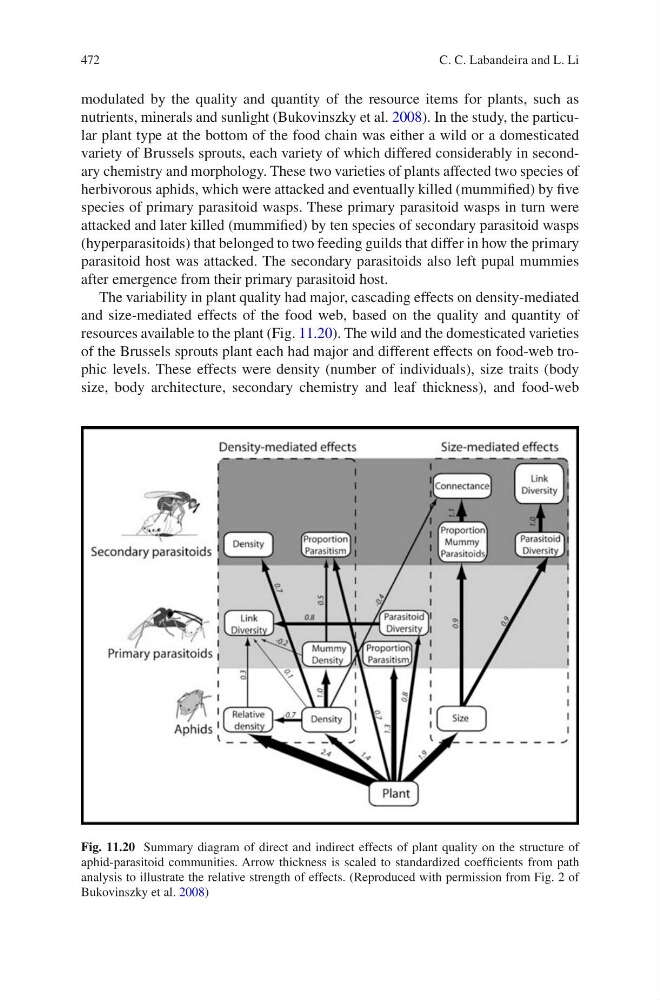
The variability in plant quality had major, cascading effects on density-mediated
and size-mediated effects of the food web, based on the quality and quantity of
resources available to the plant (Fig. 11.20). The wild and the domesticated varieties
of the Brussels sprouts plant each had major and different effects on food-web trophic levels. These effects were density (number of individuals), size traits (body
size, body architecture, secondary chemistry and leaf thickness), and food-web
Fig. 11.20 Summary diagram of direct and indirect effects of plant quality on the structure of
aphid-parasitoid communities. Arrow thickness is scaled to standardized coefficients from path
analysis to illustrate the relative strength of effects. (Reproduced with permission from Fig. 2 of
Bukovinszky et al. 2008)
C. C. Labandeira and L. Li
modulated by the quality and quantity of the resource items for plants, such as
nutrients, minerals and sunlight (Bukovinszky et al. 2008). In the study, the particular plant type at the bottom of the food chain was either a wild or a domesticated
variety of Brussels sprouts, each variety of which differed considerably in secondary chemistry and morphology. These two varieties of plants affected two species of
herbivorous aphids, which were attacked and eventually killed (mummified) by five
species of primary parasitoid wasps. These primary parasitoid wasps in turn were
attacked and later killed (mummified) by ten species of secondary parasitoid wasps
(hyperparasitoids) that belonged to two feeding guilds that differ in how the primary
parasitoid host was attacked. The secondary parasitoids also left pupal mummies
after emergence from their primary parasitoid host.
The variability in plant quality had major, cascading effects on density-mediated
and size-mediated effects of the food web, based on the quality and quantity of
resources available to the plant (Fig. 11.20). The wild and the domesticated varieties
of the Brussels sprouts plant each had major and different effects on food-web trophic levels. These effects were density (number of individuals), size traits (body
size, body architecture, secondary chemistry and leaf thickness), and food-web
Fig. 11.20 Summary diagram of direct and indirect effects of plant quality on the structure of
aphid-parasitoid communities. Arrow thickness is scaled to standardized coefficients from path
analysis to illustrate the relative strength of effects. (Reproduced with permission from Fig. 2 of
Bukovinszky et al. 2008)
C. C. Labandeira and L. Li