

457
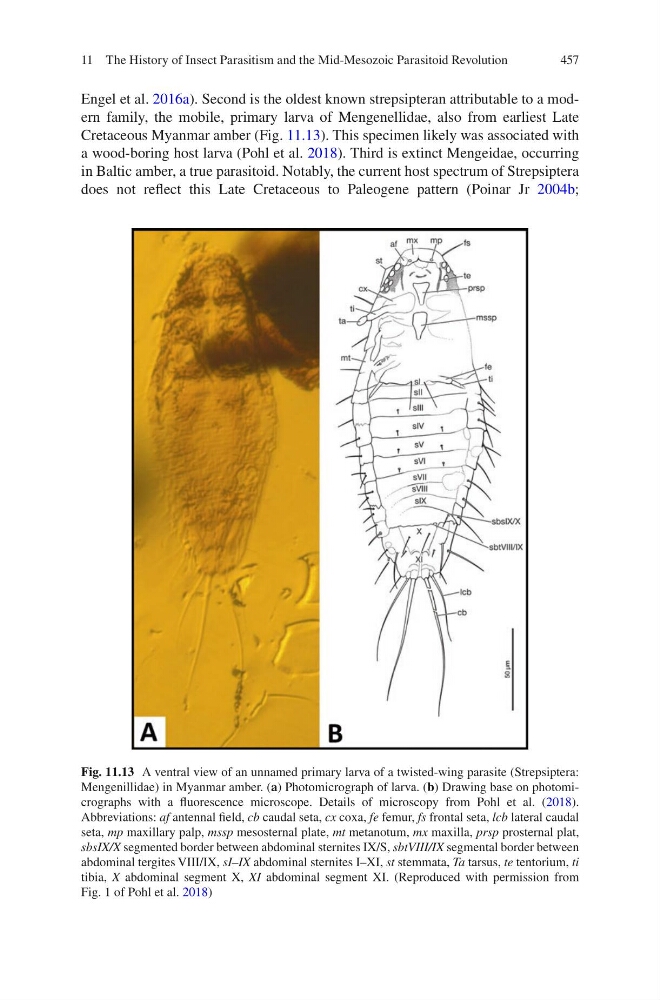
Engel et al. 2016a). Second is the oldest known strepsipteran attributable to a modern family, the mobile, primary larva of Mengenellidae, also from earliest Late
Cretaceous Myanmar amber (Fig. 11.13). This specimen likely was associated with
a wood-boring host larva (Pohl et al. 2018). Third is extinct Mengeidae, occurring
in Baltic amber, a true parasitoid. Notably, the current host spectrum of Strepsiptera
does not reflect this Late Cretaceous to Paleogene pattern (Poinar Jr 2004b;
Fig. 11.13 A ventral view of an unnamed primary larva of a twisted-wing parasite (Strepsiptera:
Mengenillidae) in Myanmar amber. (a) Photomicrograph of larva. (b) Drawing base on photomicrographs with a fluorescence microscope. Details of microscopy from Pohl et al. (2018).
Abbreviations: af antennal field, cb caudal seta, cx coxa, fe femur, fs frontal seta, lcb lateral caudal
seta, mp maxillary palp, mssp mesosternal plate, mt metanotum, mx maxilla, prsp prosternal plat,
sbsIX/X segmented border between abdominal sternites IX/S, sbtVIII/IX segmental border between
abdominal tergites VIII/IX, sI–IX abdominal sternites I–XI, st stemmata, Ta tarsus, te tentorium, ti
tibia, X abdominal segment X, XI abdominal segment XI. (Reproduced with permission from
Fig. 1 of Pohl et al. 2018)
11 The History of Insect Parasitism and the Mid-Mesozoic Parasitoid Revolution
Engel et al. 2016a). Second is the oldest known strepsipteran attributable to a modern family, the mobile, primary larva of Mengenellidae, also from earliest Late
Cretaceous Myanmar amber (Fig. 11.13). This specimen likely was associated with
a wood-boring host larva (Pohl et al. 2018). Third is extinct Mengeidae, occurring
in Baltic amber, a true parasitoid. Notably, the current host spectrum of Strepsiptera
does not reflect this Late Cretaceous to Paleogene pattern (Poinar Jr 2004b;
Fig. 11.13 A ventral view of an unnamed primary larva of a twisted-wing parasite (Strepsiptera:
Mengenillidae) in Myanmar amber. (a) Photomicrograph of larva. (b) Drawing base on photomicrographs with a fluorescence microscope. Details of microscopy from Pohl et al. (2018).
Abbreviations: af antennal field, cb caudal seta, cx coxa, fe femur, fs frontal seta, lcb lateral caudal
seta, mp maxillary palp, mssp mesosternal plate, mt metanotum, mx maxilla, prsp prosternal plat,
sbsIX/X segmented border between abdominal sternites IX/S, sbtVIII/IX segmental border between
abdominal tergites VIII/IX, sI–IX abdominal sternites I–XI, st stemmata, Ta tarsus, te tentorium, ti
tibia, X abdominal segment X, XI abdominal segment XI. (Reproduced with permission from
Fig. 1 of Pohl et al. 2018)
11 The History of Insect Parasitism and the Mid-Mesozoic Parasitoid Revolution