

454
transforms into a fat, fleshy grub that in turn results in an adult beetle (Bologna et al.
2010). The fossil history of Meloidae extends to the earliest Cenomanian at 99 million years ago, in Myanmar Amber (Poinar Jr and Brown 2014), and consists of a
distinctive, miniscule, triungulin larva attached to a jumping ground bug (Hemiptera:
Schizopteridae) in a seeming parasitoid association (Poinar Jr and Brown 2014).
This suggests that blister beetles and their parasitoid life cycle extend to the Early
Cretaceous.
Ripiphoridae (wedge-shaped beetles) are closely related to Meloidae and currently are all parasites or parasitoids. Ripiphorids are endoparasitoids of cockroach
adults; ectoparasites of the wood-boring larvae of longhorn beetles; and endoparasitoids, rarely ectoparasites, of aculeate hymenoptera larvae, especially bees
(Eggleton and Belshaw 1992). The eggs of ripiphorid adults typically are laid in the
host environment, with the triungulin larvae becoming phoretic, eventually finding
and immediately attacking their hosts (Askew 1971). A relevant, postulated fossil
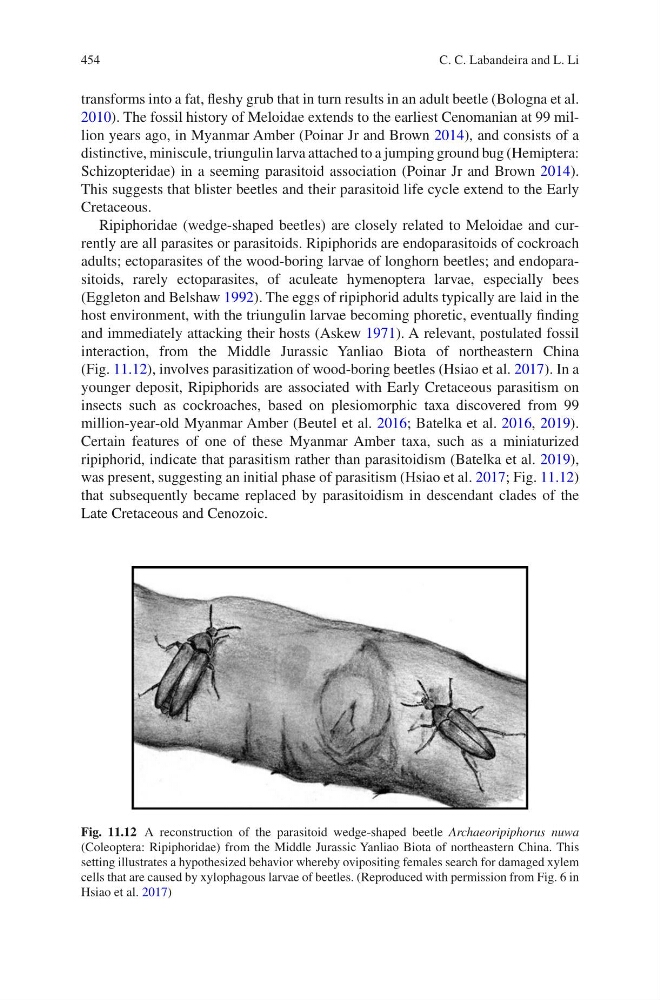
interaction, from the Middle Jurassic Yanliao Biota of northeastern China
(Fig. 11.12), involves parasitization of wood-boring beetles (Hsiao et al. 2017). In a
younger deposit, Ripiphorids are associated with Early Cretaceous parasitism on
insects such as cockroaches, based on plesiomorphic taxa discovered from 99
million- year-old Myanmar Amber (Beutel et al. 2016; Batelka et al. 2016, 2019).
Certain features of one of these Myanmar Amber taxa, such as a miniaturized
ripiphorid, indicate that parasitism rather than parasitoidism (Batelka et al. 2019),
was present, suggesting an initial phase of parasitism (Hsiao et al. 2017; Fig. 11.12)
that subsequently became replaced by parasitoidism in descendant clades of the
Late Cretaceous and Cenozoic.
Fig. 11.12 A reconstruction of the parasitoid wedge-shaped beetle Archaeoripiphorus nuwa
(Coleoptera: Ripiphoridae) from the Middle Jurassic Yanliao Biota of northeastern China. This
setting illustrates a hypothesized behavior whereby ovipositing females search for damaged xylem
cells that are caused by xylophagous larvae of beetles. (Reproduced with permission from Fig. 6 in
Hsiao et al. 2017)
C. C. Labandeira and L. Li
transforms into a fat, fleshy grub that in turn results in an adult beetle (Bologna et al.
2010). The fossil history of Meloidae extends to the earliest Cenomanian at 99 million years ago, in Myanmar Amber (Poinar Jr and Brown 2014), and consists of a
distinctive, miniscule, triungulin larva attached to a jumping ground bug (Hemiptera:
Schizopteridae) in a seeming parasitoid association (Poinar Jr and Brown 2014).
This suggests that blister beetles and their parasitoid life cycle extend to the Early
Cretaceous.
Ripiphoridae (wedge-shaped beetles) are closely related to Meloidae and currently are all parasites or parasitoids. Ripiphorids are endoparasitoids of cockroach
adults; ectoparasites of the wood-boring larvae of longhorn beetles; and endoparasitoids, rarely ectoparasites, of aculeate hymenoptera larvae, especially bees
(Eggleton and Belshaw 1992). The eggs of ripiphorid adults typically are laid in the
host environment, with the triungulin larvae becoming phoretic, eventually finding
and immediately attacking their hosts (Askew 1971). A relevant, postulated fossil
interaction, from the Middle Jurassic Yanliao Biota of northeastern China
(Fig. 11.12), involves parasitization of wood-boring beetles (Hsiao et al. 2017). In a
younger deposit, Ripiphorids are associated with Early Cretaceous parasitism on
insects such as cockroaches, based on plesiomorphic taxa discovered from 99
million- year-old Myanmar Amber (Beutel et al. 2016; Batelka et al. 2016, 2019).
Certain features of one of these Myanmar Amber taxa, such as a miniaturized
ripiphorid, indicate that parasitism rather than parasitoidism (Batelka et al. 2019),
was present, suggesting an initial phase of parasitism (Hsiao et al. 2017; Fig. 11.12)
that subsequently became replaced by parasitoidism in descendant clades of the
Late Cretaceous and Cenozoic.
Fig. 11.12 A reconstruction of the parasitoid wedge-shaped beetle Archaeoripiphorus nuwa
(Coleoptera: Ripiphoridae) from the Middle Jurassic Yanliao Biota of northeastern China. This
setting illustrates a hypothesized behavior whereby ovipositing females search for damaged xylem
cells that are caused by xylophagous larvae of beetles. (Reproduced with permission from Fig. 6 in
Hsiao et al. 2017)
C. C. Labandeira and L. Li