

411
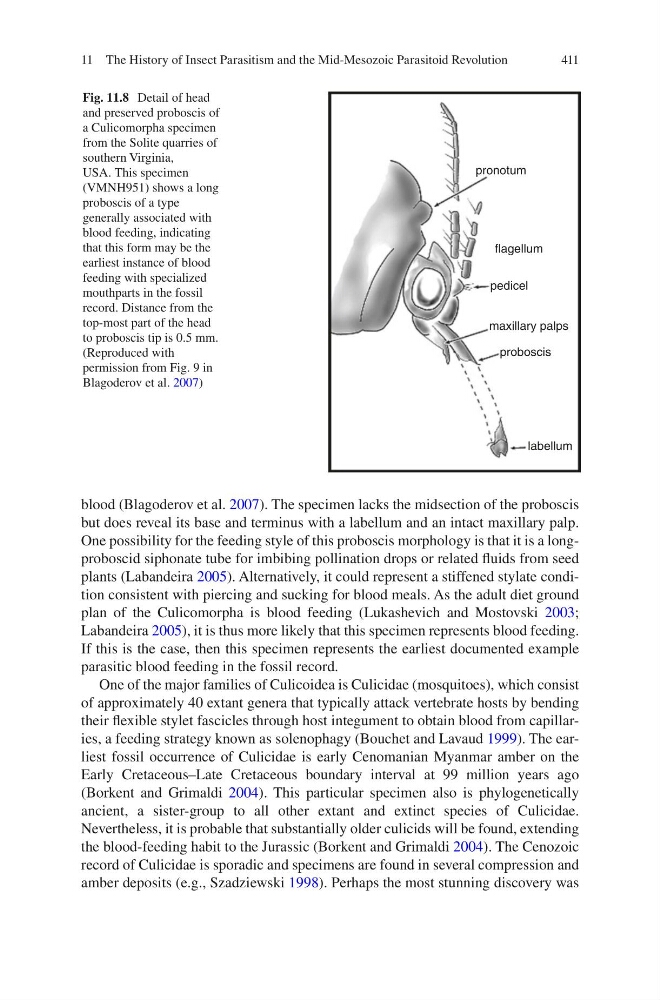
blood (Blagoderov et al. 2007). The specimen lacks the midsection of the proboscis
but does reveal its base and terminus with a labellum and an intact maxillary palp.
One possibility for the feeding style of this proboscis morphology is that it is a longproboscid siphonate tube for imbibing pollination drops or related fluids from seed
plants (Labandeira 2005). Alternatively, it could represent a stiffened stylate condition consistent with piercing and sucking for blood meals. As the adult diet ground
plan of the Culicomorpha is blood feeding (Lukashevich and Mostovski 2003;
Labandeira 2005), it is thus more likely that this specimen represents blood feeding.
If this is the case, then this specimen represents the earliest documented example
parasitic blood feeding in the fossil record.
One of the major families of Culicoidea is Culicidae (mosquitoes), which consist
of approximately 40 extant genera that typically attack vertebrate hosts by bending
their flexible stylet fascicles through host integument to obtain blood from capillaries, a feeding strategy known as solenophagy (Bouchet and Lavaud 1999). The earliest fossil occurrence of Culicidae is early Cenomanian Myanmar amber on the
Early Cretaceous–Late Cretaceous boundary interval at 99 million years ago
(Borkent and Grimaldi 2004). This particular specimen also is phylogenetically
ancient, a sister-group to all other extant and extinct species of Culicidae.
Nevertheless, it is probable that substantially older culicids will be found, extending
the blood-feeding habit to the Jurassic (Borkent and Grimaldi 2004). The Cenozoic
record of Culicidae is sporadic and specimens are found in several compression and
amber deposits (e.g., Szadziewski 1998). Perhaps the most stunning discovery was
pronotum
flagellum
pedicel
maxillary palps
proboscis
labellum
Fig. 11.8 Detail of head
and preserved proboscis of
a Culicomorpha specimen
from the Solite quarries of
southern Virginia,
USA. This specimen
(VMNH951) shows a long
proboscis of a type
generally associated with
blood feeding, indicating
that this form may be the
earliest instance of blood
feeding with specialized
mouthparts in the fossil
record. Distance from the
top-most part of the head
to proboscis tip is 0.5 mm.
(Reproduced with
permission from Fig. 9 in
Blagoderov et al. 2007)
11 The History of Insect Parasitism and the Mid-Mesozoic Parasitoid Revolution
blood (Blagoderov et al. 2007). The specimen lacks the midsection of the proboscis
but does reveal its base and terminus with a labellum and an intact maxillary palp.
One possibility for the feeding style of this proboscis morphology is that it is a longproboscid siphonate tube for imbibing pollination drops or related fluids from seed
plants (Labandeira 2005). Alternatively, it could represent a stiffened stylate condition consistent with piercing and sucking for blood meals. As the adult diet ground
plan of the Culicomorpha is blood feeding (Lukashevich and Mostovski 2003;
Labandeira 2005), it is thus more likely that this specimen represents blood feeding.
If this is the case, then this specimen represents the earliest documented example
parasitic blood feeding in the fossil record.
One of the major families of Culicoidea is Culicidae (mosquitoes), which consist
of approximately 40 extant genera that typically attack vertebrate hosts by bending
their flexible stylet fascicles through host integument to obtain blood from capillaries, a feeding strategy known as solenophagy (Bouchet and Lavaud 1999). The earliest fossil occurrence of Culicidae is early Cenomanian Myanmar amber on the
Early Cretaceous–Late Cretaceous boundary interval at 99 million years ago
(Borkent and Grimaldi 2004). This particular specimen also is phylogenetically
ancient, a sister-group to all other extant and extinct species of Culicidae.
Nevertheless, it is probable that substantially older culicids will be found, extending
the blood-feeding habit to the Jurassic (Borkent and Grimaldi 2004). The Cenozoic
record of Culicidae is sporadic and specimens are found in several compression and
amber deposits (e.g., Szadziewski 1998). Perhaps the most stunning discovery was
pronotum
flagellum
pedicel
maxillary palps
proboscis
labellum
Fig. 11.8 Detail of head
and preserved proboscis of
a Culicomorpha specimen
from the Solite quarries of
southern Virginia,
USA. This specimen
(VMNH951) shows a long
proboscis of a type
generally associated with
blood feeding, indicating
that this form may be the
earliest instance of blood
feeding with specialized
mouthparts in the fossil
record. Distance from the
top-most part of the head
to proboscis tip is 0.5 mm.
(Reproduced with
permission from Fig. 9 in
Blagoderov et al. 2007)
11 The History of Insect Parasitism and the Mid-Mesozoic Parasitoid Revolution