

395
(flies), display one or two originations of parasitism (Eggleton and Belshaw 1992;
Dowton and Austin 1995b). Nevertheless, it appears that parasitic lineages of insects
do not differ from their respective free-living confamilial lineages in the potential
for speciation.
In a separate study involving maximum likelihood reconstruction of the major
diets of hexapod families, it appears that the hypothesis of larval dietary substrates
shaping the major pattern of insect clade richness largely is not borne out (Rainford
and Mayhew 2015). An accumulation curve based on dietary originations through
geologic time indicated that dietary ecologies of fungivory, phytophagy, predation
and ectoparasitism appear early in clade history and display a steady, modest rate of
origination (Fig. 11.3). The exceptions were the ecologies of detritivory and especially parasitoidism, whose originations reflect an upward and marked trend during
the mid to late Mesozoic; the latter trend is attributable to the radiation of parasitoid
Hymenoptera during this interval. The origination data also indicate that the ecology of ectoparasitism behaves very different from that of parasitoidism, with the
former originating at a very low rate compared to the latter, indicating that ectoparasitism may not be a viable long-term evolutionary strategy. The evidence for solid
phylogenetic conservatism regarding a specialized ecology such as parasitoidism is
borne out by the 12 types of parasitoid guilds that ecologically characterize
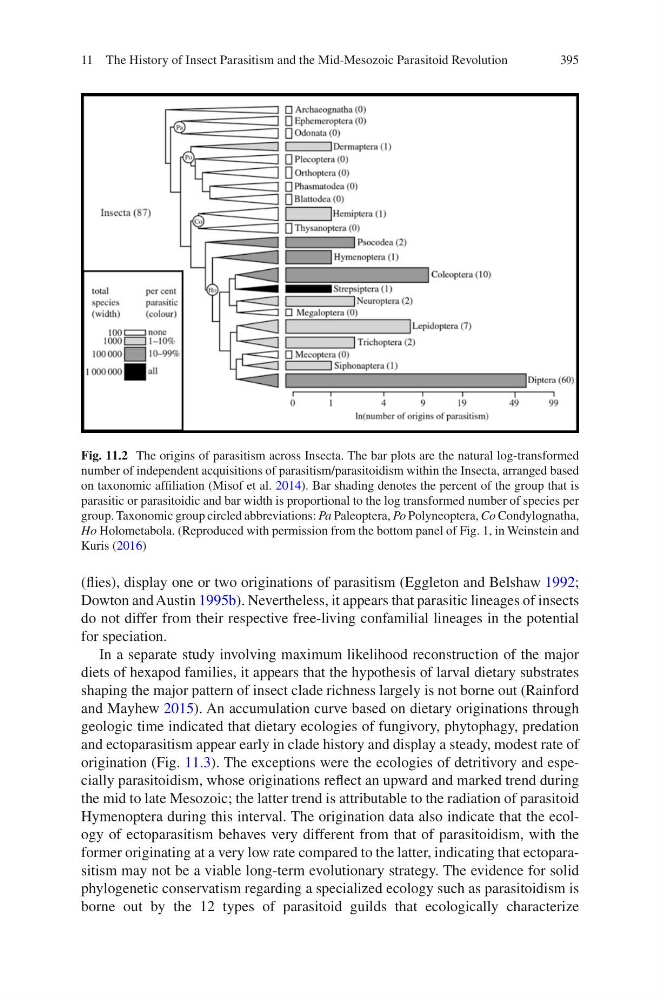
Fig. 11.2 The origins of parasitism across Insecta. The bar plots are the natural log-transformed
number of independent acquisitions of parasitism/parasitoidism within the Insecta, arranged based
on taxonomic affiliation (Misof et al. 2014). Bar shading denotes the percent of the group that is
parasitic or parasitoidic and bar width is proportional to the log transformed number of species per
group. Taxonomic group circled abbreviations: Pa Paleoptera, Po Polyneoptera, Co Condylognatha,
Ho Holometabola. (Reproduced with permission from the bottom panel of Fig. 1, in Weinstein and
Kuris (2016)
11 The History of Insect Parasitism and the Mid-Mesozoic Parasitoid Revolution
(flies), display one or two originations of parasitism (Eggleton and Belshaw 1992;
Dowton and Austin 1995b). Nevertheless, it appears that parasitic lineages of insects
do not differ from their respective free-living confamilial lineages in the potential
for speciation.
In a separate study involving maximum likelihood reconstruction of the major
diets of hexapod families, it appears that the hypothesis of larval dietary substrates
shaping the major pattern of insect clade richness largely is not borne out (Rainford
and Mayhew 2015). An accumulation curve based on dietary originations through
geologic time indicated that dietary ecologies of fungivory, phytophagy, predation
and ectoparasitism appear early in clade history and display a steady, modest rate of
origination (Fig. 11.3). The exceptions were the ecologies of detritivory and especially parasitoidism, whose originations reflect an upward and marked trend during
the mid to late Mesozoic; the latter trend is attributable to the radiation of parasitoid
Hymenoptera during this interval. The origination data also indicate that the ecology of ectoparasitism behaves very different from that of parasitoidism, with the
former originating at a very low rate compared to the latter, indicating that ectoparasitism may not be a viable long-term evolutionary strategy. The evidence for solid
phylogenetic conservatism regarding a specialized ecology such as parasitoidism is
borne out by the 12 types of parasitoid guilds that ecologically characterize
Fig. 11.2 The origins of parasitism across Insecta. The bar plots are the natural log-transformed
number of independent acquisitions of parasitism/parasitoidism within the Insecta, arranged based
on taxonomic affiliation (Misof et al. 2014). Bar shading denotes the percent of the group that is
parasitic or parasitoidic and bar width is proportional to the log transformed number of species per
group. Taxonomic group circled abbreviations: Pa Paleoptera, Po Polyneoptera, Co Condylognatha,
Ho Holometabola. (Reproduced with permission from the bottom panel of Fig. 1, in Weinstein and
Kuris (2016)
11 The History of Insect Parasitism and the Mid-Mesozoic Parasitoid Revolution