

366
many other groups discussed here, the ecological role of extant pentastomidans as
parasites of tetrapodans is unquestioned (e.g. Haugerud 1989; Christoffersen and
De Assis 2015). However, the relationship of Pentastomida to other arthropod
groups is more problematic, and will be discussed in detail below. Nevertheless,
pentastomidans are discussed here as some readers may expect them among the
crustaceans.
10.7.2 Phylogenetic Inference of Appearance and Molecular
Estimations of Early Evolution
Basically, there are two strongly opposing hypotheses concerning the phylogenetic
position of Pentastomida. Most morphological characters point to a position of
Pentastomida within Arthropoda sensu lato, but outside Arthropoda sensu stricto,
the group of sclerotised arthropodans (Waloszek et al. 2006; Castellani et al. 2011).
More precisely, Pentastomida is in this case interpreted as being closer related to
sclerotised arthropods than other unsclerotised forms, such as onychophorans
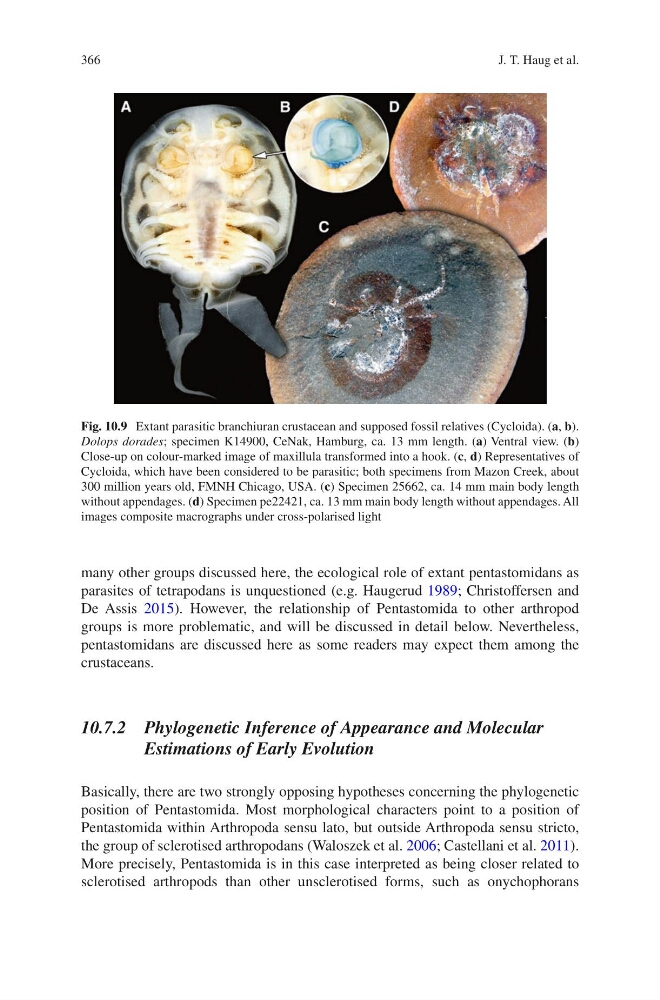
Fig. 10.9 Extant parasitic branchiuran crustacean and supposed fossil relatives (Cycloida). (a, b).
Dolops dorades; specimen K14900, CeNak, Hamburg, ca. 13 mm length. (a) Ventral view. (b)
Close-up on colour-marked image of maxillula transformed into a hook. (c, d) Representatives of
Cycloida, which have been considered to be parasitic; both specimens from Mazon Creek, about
300 million years old, FMNH Chicago, USA. (c) Specimen 25662, ca. 14 mm main body length
without appendages. (d) Specimen pe22421, ca. 13 mm main body length without appendages. All
images composite macrographs under cross-polarised light
J. T. Haug et al.
many other groups discussed here, the ecological role of extant pentastomidans as
parasites of tetrapodans is unquestioned (e.g. Haugerud 1989; Christoffersen and
De Assis 2015). However, the relationship of Pentastomida to other arthropod
groups is more problematic, and will be discussed in detail below. Nevertheless,
pentastomidans are discussed here as some readers may expect them among the
crustaceans.
10.7.2 Phylogenetic Inference of Appearance and Molecular
Estimations of Early Evolution
Basically, there are two strongly opposing hypotheses concerning the phylogenetic
position of Pentastomida. Most morphological characters point to a position of
Pentastomida within Arthropoda sensu lato, but outside Arthropoda sensu stricto,
the group of sclerotised arthropodans (Waloszek et al. 2006; Castellani et al. 2011).
More precisely, Pentastomida is in this case interpreted as being closer related to
sclerotised arthropods than other unsclerotised forms, such as onychophorans
Fig. 10.9 Extant parasitic branchiuran crustacean and supposed fossil relatives (Cycloida). (a, b).
Dolops dorades; specimen K14900, CeNak, Hamburg, ca. 13 mm length. (a) Ventral view. (b)
Close-up on colour-marked image of maxillula transformed into a hook. (c, d) Representatives of
Cycloida, which have been considered to be parasitic; both specimens from Mazon Creek, about
300 million years old, FMNH Chicago, USA. (c) Specimen 25662, ca. 14 mm main body length
without appendages. (d) Specimen pe22421, ca. 13 mm main body length without appendages. All
images composite macrographs under cross-polarised light
J. T. Haug et al.