

364
10.6.2 Phylogenetic Inference of Appearance and Molecular
Estimations of Early Evolution
Branchiura is a group difficult to interpret in a phylogenetic framework (e.g., Møller
2009), i.e. we do not really know the relationship to other groups (see also below
10.7.2).
10.6.3 Fossil Representatives
So far, no fossil fish louse has been found. It is possible that such fossils have been
overlooked on fossil fishes, as even larger parasites such as cymothoid isopods seem
to have been largely overlooked (see discussion in Nagler et al. 2016).
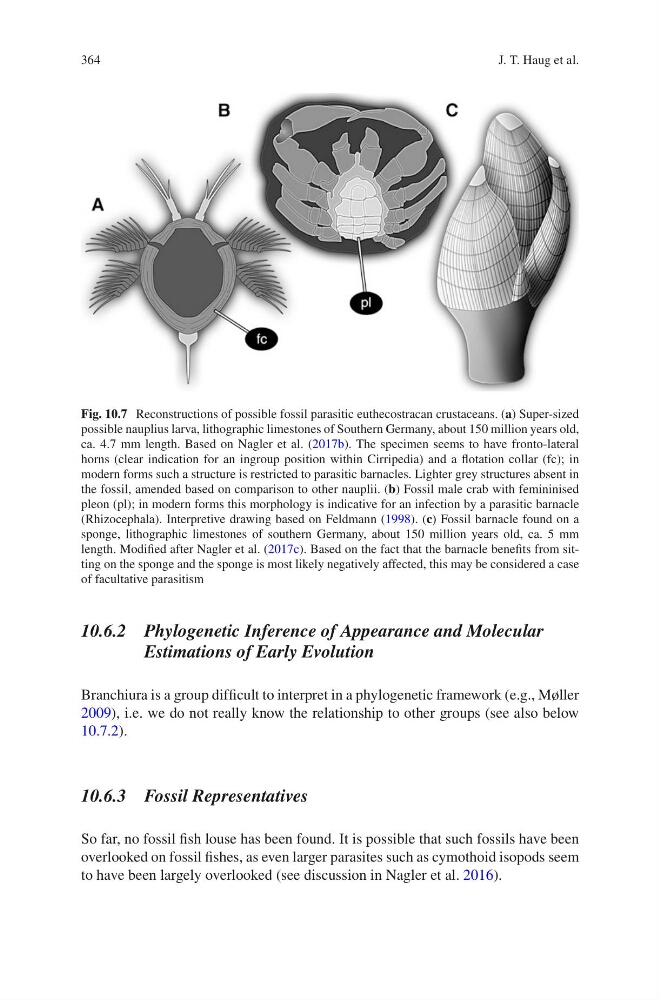
Fig. 10.7 Reconstructions of possible fossil parasitic euthecostracan crustaceans. (a) Super-sized
possible nauplius larva, lithographic limestones of Southern Germany, about 150 million years old,
ca. 4.7 mm length. Based on Nagler et al. (2017b). The specimen seems to have fronto-lateral
horns (clear indication for an ingroup position within Cirripedia) and a flotation collar (fc); in
modern forms such a structure is restricted to parasitic barnacles. Lighter grey structures absent in
the fossil, amended based on comparison to other nauplii. (b) Fossil male crab with femininised
pleon (pl); in modern forms this morphology is indicative for an infection by a parasitic barnacle
(Rhizocephala). Interpretive drawing based on Feldmann (1998). (c) Fossil barnacle found on a
sponge, lithographic limestones of southern Germany, about 150 million years old, ca. 5 mm
length. Modified after Nagler et al. (2017c). Based on the fact that the barnacle benefits from sitting on the sponge and the sponge is most likely negatively affected, this may be considered a case
of facultative parasitism
J. T. Haug et al.
10.6.2 Phylogenetic Inference of Appearance and Molecular
Estimations of Early Evolution
Branchiura is a group difficult to interpret in a phylogenetic framework (e.g., Møller
2009), i.e. we do not really know the relationship to other groups (see also below
10.7.2).
10.6.3 Fossil Representatives
So far, no fossil fish louse has been found. It is possible that such fossils have been
overlooked on fossil fishes, as even larger parasites such as cymothoid isopods seem
to have been largely overlooked (see discussion in Nagler et al. 2016).
Fig. 10.7 Reconstructions of possible fossil parasitic euthecostracan crustaceans. (a) Super-sized
possible nauplius larva, lithographic limestones of Southern Germany, about 150 million years old,
ca. 4.7 mm length. Based on Nagler et al. (2017b). The specimen seems to have fronto-lateral
horns (clear indication for an ingroup position within Cirripedia) and a flotation collar (fc); in
modern forms such a structure is restricted to parasitic barnacles. Lighter grey structures absent in
the fossil, amended based on comparison to other nauplii. (b) Fossil male crab with femininised
pleon (pl); in modern forms this morphology is indicative for an infection by a parasitic barnacle
(Rhizocephala). Interpretive drawing based on Feldmann (1998). (c) Fossil barnacle found on a
sponge, lithographic limestones of southern Germany, about 150 million years old, ca. 5 mm
length. Modified after Nagler et al. (2017c). Based on the fact that the barnacle benefits from sitting on the sponge and the sponge is most likely negatively affected, this may be considered a case
of facultative parasitism
J. T. Haug et al.