

360
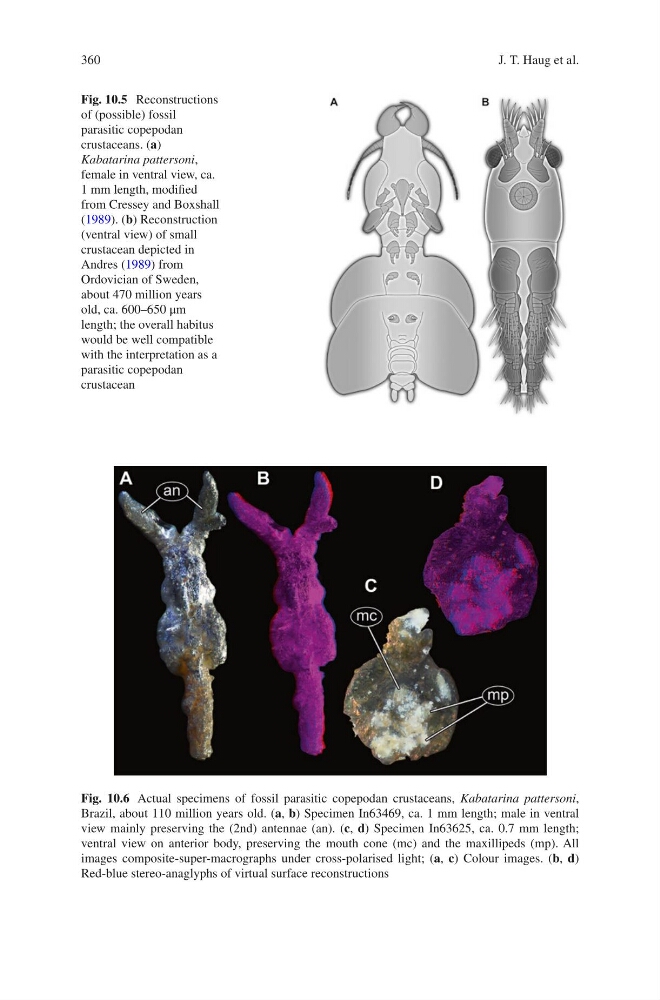
Fig. 10.6 Actual specimens of fossil parasitic copepodan crustaceans, Kabatarina pattersoni,
Brazil, about 110 million years old. (a, b) Specimen In63469, ca. 1 mm length; male in ventral
view mainly preserving the (2nd) antennae (an). (c, d) Specimen In63625, ca. 0.7 mm length;
ventral view on anterior body, preserving the mouth cone (mc) and the maxillipeds (mp). All
images composite-super-macrographs under cross-polarised light; (a, c) Colour images. (b, d)
Red-blue stereo-anaglyphs of virtual surface reconstructions
Fig. 10.5 Reconstructions
of (possible) fossil
parasitic copepodan
crustaceans. (a)
Kabatarina pattersoni,
female in ventral view, ca.
1 mm length, modified
from Cressey and Boxshall
(1989). (b) Reconstruction
(ventral view) of small
crustacean depicted in
Andres (1989) from
Ordovician of Sweden,
about 470 million years
old, ca. 600–650 μm
length; the overall habitus
would be well compatible
with the interpretation as a
parasitic copepodan
crustacean
J. T. Haug et al.
Fig. 10.6 Actual specimens of fossil parasitic copepodan crustaceans, Kabatarina pattersoni,
Brazil, about 110 million years old. (a, b) Specimen In63469, ca. 1 mm length; male in ventral
view mainly preserving the (2nd) antennae (an). (c, d) Specimen In63625, ca. 0.7 mm length;
ventral view on anterior body, preserving the mouth cone (mc) and the maxillipeds (mp). All
images composite-super-macrographs under cross-polarised light; (a, c) Colour images. (b, d)
Red-blue stereo-anaglyphs of virtual surface reconstructions
Fig. 10.5 Reconstructions
of (possible) fossil
parasitic copepodan
crustaceans. (a)
Kabatarina pattersoni,
female in ventral view, ca.
1 mm length, modified
from Cressey and Boxshall
(1989). (b) Reconstruction
(ventral view) of small
crustacean depicted in
Andres (1989) from
Ordovician of Sweden,
about 470 million years
old, ca. 600–650 μm
length; the overall habitus
would be well compatible
with the interpretation as a
parasitic copepodan
crustacean
J. T. Haug et al.