

358
feeding habits including, among others, predation and parasitism; probably about
one third of all copepodan species are parasitic (Humes 1994).
Parasitism evolved several times independently within Copepoda (Boxshall and
Halsey 2004). This might explain the vast diversity of hosts that range from sponges
and cnidarians to molluscs, other crustaceans, echinoderms, fishes and also mammals. Relatively few representatives of Copepoda are parasitic on Nemertea,
Platyhelminthes, Bryozoa, Phoronida, Echiura, Brachiopoda, Enteropneusta,
Hemichordata, Vestimentifera and Sipuncula (Boxshall and Halsey 2004).
Representatives of some copepodan groups, such as Mytilicolidae or
Siphonostomatoida, are parasitic on molluscs and fishes respectively and are major
pests in commercial bivalve cultures and fisheries (Pike and Wadsworth 1999;
Boxshall and Defaye 2006). Most parasitic representatives are ectoparasites, but
there are also some endoparasites, e.g., in the mesogloea of corals (Stock 1975;
1981), in the coelomic cavities of representatives of Sipunculida (Ho et al. 1981;
Schwabe and Maiorova 2015) or under the integument of gastropods (Anton and
Schrödl 2013 and references therein).
Parasitic copepods usually feed by rasping the surface of the host using their
mandibles, piercing the host tissues by an oral tube formed by the mandibles and,
subsequently, sucking body fluids out of the host (Boxshall 1990a; Boxshall et al.
2005). All parasitic copepods show a body organisation in which the body is divided
into a functional head (head + 1 segment) anterior trunk (5 segments with swimming appendages + genital segment) and posterior trunk (4 segments + telson)
(Boxshall et al. 2005). However, most representatives of parasitic groups within
Copepoda appear to lack some body subdivisions (conjoined segments, reduction
and loss of appendage elements and setation) up to an extreme “simplification” with
an almost amorphous body that lacks any segmentation and appendages (Kabata
1979; Huys and Boxshall 1991; Boxshall and Halsey 2004). Representatives of
some groups, such as Herpyllobiidae, Nicothoidae and Chitonophilidae, show an
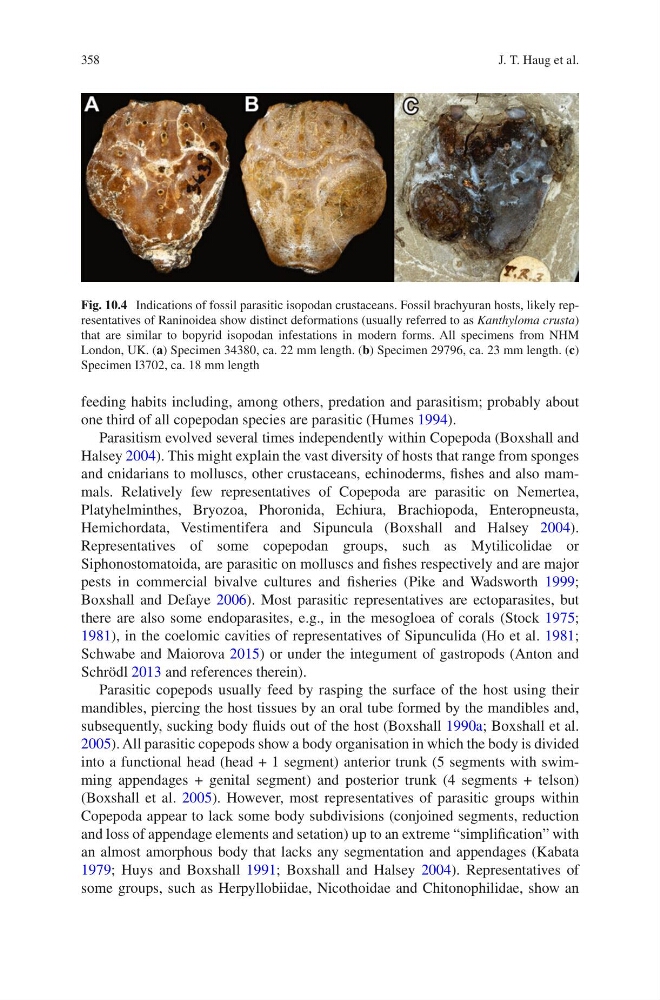
Fig. 10.4 Indications of fossil parasitic isopodan crustaceans. Fossil brachyuran hosts, likely representatives of Raninoidea show distinct deformations (usually referred to as Kanthyloma crusta)
that are similar to bopyrid isopodan infestations in modern forms. All specimens from NHM
London, UK. (a) Specimen 34380, ca. 22 mm length. (b) Specimen 29796, ca. 23 mm length. (c)
Specimen I3702, ca. 18 mm length
J. T. Haug et al.
feeding habits including, among others, predation and parasitism; probably about
one third of all copepodan species are parasitic (Humes 1994).
Parasitism evolved several times independently within Copepoda (Boxshall and
Halsey 2004). This might explain the vast diversity of hosts that range from sponges
and cnidarians to molluscs, other crustaceans, echinoderms, fishes and also mammals. Relatively few representatives of Copepoda are parasitic on Nemertea,
Platyhelminthes, Bryozoa, Phoronida, Echiura, Brachiopoda, Enteropneusta,
Hemichordata, Vestimentifera and Sipuncula (Boxshall and Halsey 2004).
Representatives of some copepodan groups, such as Mytilicolidae or
Siphonostomatoida, are parasitic on molluscs and fishes respectively and are major
pests in commercial bivalve cultures and fisheries (Pike and Wadsworth 1999;
Boxshall and Defaye 2006). Most parasitic representatives are ectoparasites, but
there are also some endoparasites, e.g., in the mesogloea of corals (Stock 1975;
1981), in the coelomic cavities of representatives of Sipunculida (Ho et al. 1981;
Schwabe and Maiorova 2015) or under the integument of gastropods (Anton and
Schrödl 2013 and references therein).
Parasitic copepods usually feed by rasping the surface of the host using their
mandibles, piercing the host tissues by an oral tube formed by the mandibles and,
subsequently, sucking body fluids out of the host (Boxshall 1990a; Boxshall et al.
2005). All parasitic copepods show a body organisation in which the body is divided
into a functional head (head + 1 segment) anterior trunk (5 segments with swimming appendages + genital segment) and posterior trunk (4 segments + telson)
(Boxshall et al. 2005). However, most representatives of parasitic groups within
Copepoda appear to lack some body subdivisions (conjoined segments, reduction
and loss of appendage elements and setation) up to an extreme “simplification” with
an almost amorphous body that lacks any segmentation and appendages (Kabata
1979; Huys and Boxshall 1991; Boxshall and Halsey 2004). Representatives of
some groups, such as Herpyllobiidae, Nicothoidae and Chitonophilidae, show an
Fig. 10.4 Indications of fossil parasitic isopodan crustaceans. Fossil brachyuran hosts, likely representatives of Raninoidea show distinct deformations (usually referred to as Kanthyloma crusta)
that are similar to bopyrid isopodan infestations in modern forms. All specimens from NHM
London, UK. (a) Specimen 34380, ca. 22 mm length. (b) Specimen 29796, ca. 23 mm length. (c)
Specimen I3702, ca. 18 mm length
J. T. Haug et al.