

353
10.3.2 Phylogenetic Inference of Appearance and Molecular
Estimations of Early Evolution
The first fossil isopodans date back to the Carboniferous (355 mya). Therefore,
Schram (1977, 1982) suggested an Early to Middle Devonian age (390 mya) for the
origin of Peracarida. This must have been followed by a quick radiation leading to
a high diversity and wide distribution in the late Palaeozoic (419–252 mya; Brusca
and Wilson 1991; Lins et al. 2012, 2017).
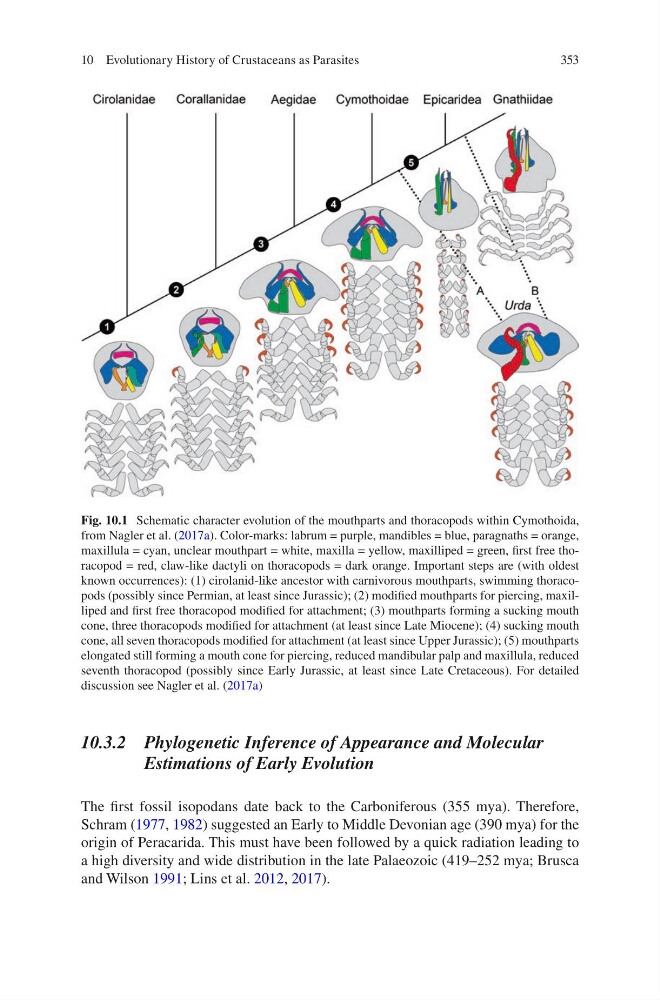
Fig. 10.1 Schematic character evolution of the mouthparts and thoracopods within Cymothoida,
from Nagler et al. (2017a). Color-marks: labrum = purple, mandibles = blue, paragnaths = orange,
maxillula = cyan, unclear mouthpart = white, maxilla = yellow, maxilliped = green, first free thoracopod = red, claw-like dactyli on thoracopods = dark orange. Important steps are (with oldest
known occurrences): (1) cirolanid-like ancestor with carnivorous mouthparts, swimming thoracopods (possibly since Permian, at least since Jurassic); (2) modified mouthparts for piercing, maxilliped and first free thoracopod modified for attachment; (3) mouthparts forming a sucking mouth
cone, three thoracopods modified for attachment (at least since Late Miocene); (4) sucking mouth
cone, all seven thoracopods modified for attachment (at least since Upper Jurassic); (5) mouthparts
elongated still forming a mouth cone for piercing, reduced mandibular palp and maxillula, reduced
seventh thoracopod (possibly since Early Jurassic, at least since Late Cretaceous). For detailed
discussion see Nagler et al. (2017a)
10 Evolutionary History of Crustaceans as Parasites
10.3.2 Phylogenetic Inference of Appearance and Molecular
Estimations of Early Evolution
The first fossil isopodans date back to the Carboniferous (355 mya). Therefore,
Schram (1977, 1982) suggested an Early to Middle Devonian age (390 mya) for the
origin of Peracarida. This must have been followed by a quick radiation leading to
a high diversity and wide distribution in the late Palaeozoic (419–252 mya; Brusca
and Wilson 1991; Lins et al. 2012, 2017).
Fig. 10.1 Schematic character evolution of the mouthparts and thoracopods within Cymothoida,
from Nagler et al. (2017a). Color-marks: labrum = purple, mandibles = blue, paragnaths = orange,
maxillula = cyan, unclear mouthpart = white, maxilla = yellow, maxilliped = green, first free thoracopod = red, claw-like dactyli on thoracopods = dark orange. Important steps are (with oldest
known occurrences): (1) cirolanid-like ancestor with carnivorous mouthparts, swimming thoracopods (possibly since Permian, at least since Jurassic); (2) modified mouthparts for piercing, maxilliped and first free thoracopod modified for attachment; (3) mouthparts forming a sucking mouth
cone, three thoracopods modified for attachment (at least since Late Miocene); (4) sucking mouth
cone, all seven thoracopods modified for attachment (at least since Upper Jurassic); (5) mouthparts
elongated still forming a mouth cone for piercing, reduced mandibular palp and maxillula, reduced
seventh thoracopod (possibly since Early Jurassic, at least since Late Cretaceous). For detailed
discussion see Nagler et al. (2017a)
10 Evolutionary History of Crustaceans as Parasites