

338
the trematode Microphallus limuli, which first infects a marine snail, before being
consumed by a horseshoe crab as an intermediate host (Stunkard 1951). The presence of the parasite may impair the crab’s righting behaviour during excursions onto
land, causing it to be more likely to be consumed by herring gulls, which are the
definitive host. Fossil examples of epibionts affecting horseshoe crabs are not
known to the author, although this may yet be discovered as it has been observed as
possible bacterial damage in fossil decapods (Klompmaker et al. 2016) and also in
trilobites (De Baets et al. 2021b; Kenneth de Baets, pers. comm. 2020).
9.6.1 Arachnid Parasites and Parasitoids
Spiders, and other arachnids, can fall victim to a range of parasites or parasitoids
(see e.g. van Helsdingen 2011) and occasionally these associations can be preserved
in the fossil record too (e.g. Nagler and Haug 2015). Several can potentially be
traced back to the Mesozoic, others are first recorded in Eocene ambers:
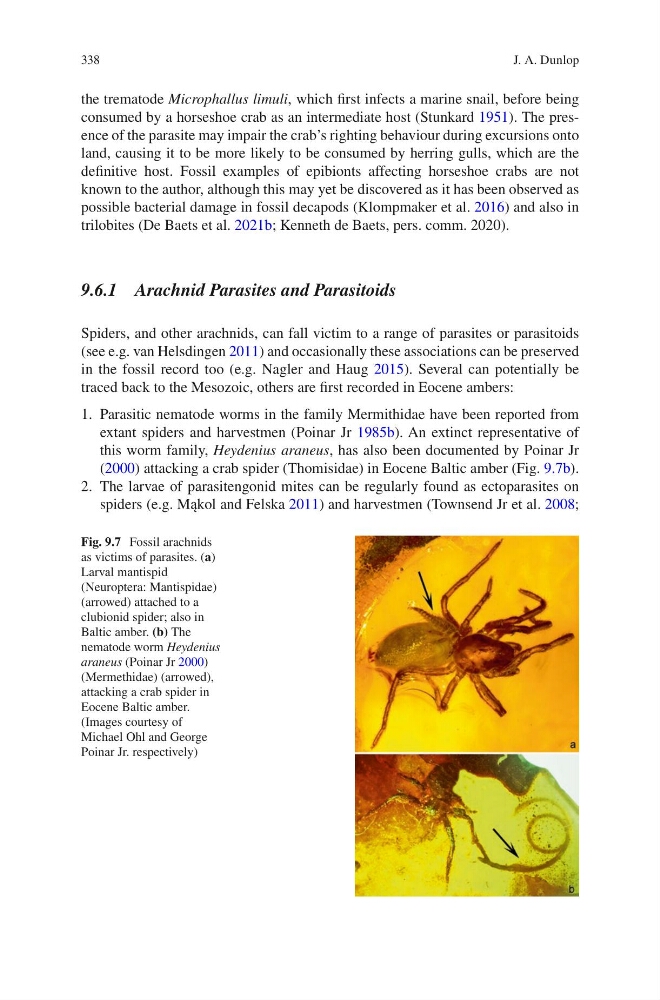
1. Parasitic nematode worms in the family Mermithidae have been reported from
extant spiders and harvestmen (Poinar Jr 1985b). An extinct representative of
this worm family, Heydenius araneus, has also been documented by Poinar Jr
(2000) attacking a crab spider (Thomisidae) in Eocene Baltic amber (Fig. 9.7b).
2. The larvae of parasitengonid mites can be regularly found as ectoparasites on
spiders (e.g. Mąkol and Felska 2011) and harvestmen (Townsend Jr et al. 2008;
Fig. 9.7 Fossil arachnids
as victims of parasites. (a)
Larval mantispid
(Neuroptera: Mantispidae)
(arrowed) attached to a
clubionid spider; also in
Baltic amber. (b) The
nematode worm Heydenius
araneus (Poinar Jr 2000)
(Mermethidae) (arrowed),
attacking a crab spider in
Eocene Baltic amber.
(Images courtesy of
Michael Ohl and George
Poinar Jr. respectively)
J. A. Dunlop
the trematode Microphallus limuli, which first infects a marine snail, before being
consumed by a horseshoe crab as an intermediate host (Stunkard 1951). The presence of the parasite may impair the crab’s righting behaviour during excursions onto
land, causing it to be more likely to be consumed by herring gulls, which are the
definitive host. Fossil examples of epibionts affecting horseshoe crabs are not
known to the author, although this may yet be discovered as it has been observed as
possible bacterial damage in fossil decapods (Klompmaker et al. 2016) and also in
trilobites (De Baets et al. 2021b; Kenneth de Baets, pers. comm. 2020).
9.6.1 Arachnid Parasites and Parasitoids
Spiders, and other arachnids, can fall victim to a range of parasites or parasitoids
(see e.g. van Helsdingen 2011) and occasionally these associations can be preserved
in the fossil record too (e.g. Nagler and Haug 2015). Several can potentially be
traced back to the Mesozoic, others are first recorded in Eocene ambers:
1. Parasitic nematode worms in the family Mermithidae have been reported from
extant spiders and harvestmen (Poinar Jr 1985b). An extinct representative of
this worm family, Heydenius araneus, has also been documented by Poinar Jr
(2000) attacking a crab spider (Thomisidae) in Eocene Baltic amber (Fig. 9.7b).
2. The larvae of parasitengonid mites can be regularly found as ectoparasites on
spiders (e.g. Mąkol and Felska 2011) and harvestmen (Townsend Jr et al. 2008;
Fig. 9.7 Fossil arachnids
as victims of parasites. (a)
Larval mantispid
(Neuroptera: Mantispidae)
(arrowed) attached to a
clubionid spider; also in
Baltic amber. (b) The
nematode worm Heydenius
araneus (Poinar Jr 2000)
(Mermethidae) (arrowed),
attacking a crab spider in
Eocene Baltic amber.
(Images courtesy of
Michael Ohl and George
Poinar Jr. respectively)
J. A. Dunlop