

334
(Beck 2008) and are also of note as potential vectors for pathogens such as
Rickettsia (Reeves et al. 2007)
12. Dermanyssidae are another substantial group that are ectoparasites of birds
(e.g. the red poultry mite Dermanyssus gallinae), or rodents. Again humans can
be affected (Diaz 2010) through, e.g., dermatitis in poultry workers or via
Rickettsia from mites associated with rodents.
13. Halarachnidae, sometimes referred to as nasal mites, generally infect the respiratory tract of a range of terrestrial (Furman 1954) and marine (Konishi and
Shimazaki 1998) mammals. Their presence can induce excessive mucus production, rhinitis and sinusitis. One subfamily parasitises the ear instead.
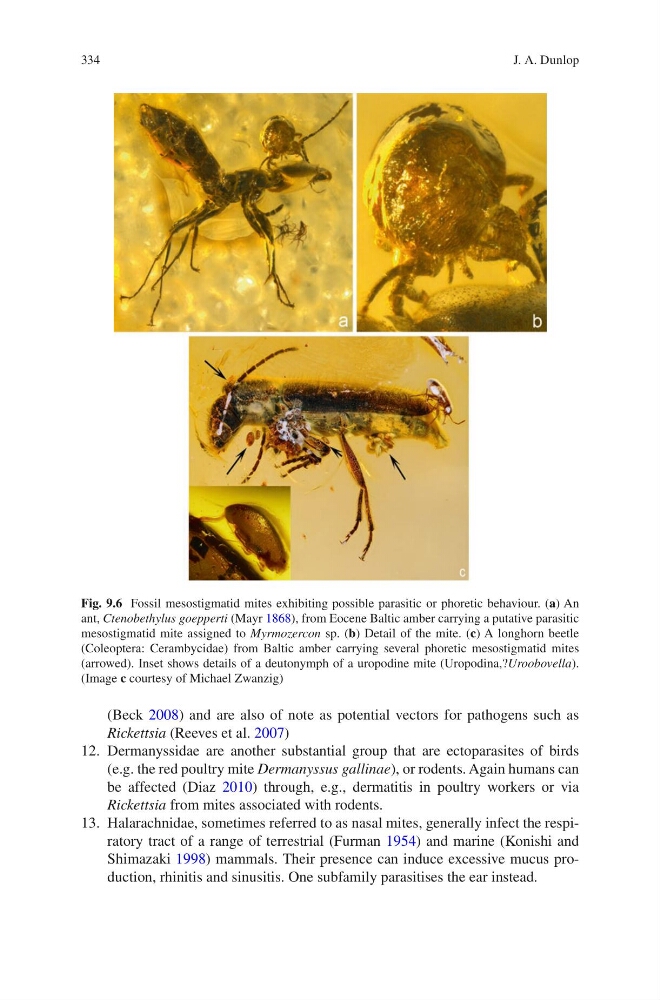
Fig. 9.6 Fossil mesostigmatid mites exhibiting possible parasitic or phoretic behaviour. (a) An
ant, Ctenobethylus goepperti (Mayr 1868), from Eocene Baltic amber carrying a putative parasitic
mesostigmatid mite assigned to Myrmozercon sp. (b) Detail of the mite. (c) A longhorn beetle
(Coleoptera: Cerambycidae) from Baltic amber carrying several phoretic mesostigmatid mites
(arrowed). Inset shows details of a deutonymph of a uropodine mite (Uropodina,?Uroobovella).
(Image c courtesy of Michael Zwanzig)
J. A. Dunlop
(Beck 2008) and are also of note as potential vectors for pathogens such as
Rickettsia (Reeves et al. 2007)
12. Dermanyssidae are another substantial group that are ectoparasites of birds
(e.g. the red poultry mite Dermanyssus gallinae), or rodents. Again humans can
be affected (Diaz 2010) through, e.g., dermatitis in poultry workers or via
Rickettsia from mites associated with rodents.
13. Halarachnidae, sometimes referred to as nasal mites, generally infect the respiratory tract of a range of terrestrial (Furman 1954) and marine (Konishi and
Shimazaki 1998) mammals. Their presence can induce excessive mucus production, rhinitis and sinusitis. One subfamily parasitises the ear instead.
Fig. 9.6 Fossil mesostigmatid mites exhibiting possible parasitic or phoretic behaviour. (a) An
ant, Ctenobethylus goepperti (Mayr 1868), from Eocene Baltic amber carrying a putative parasitic
mesostigmatid mite assigned to Myrmozercon sp. (b) Detail of the mite. (c) A longhorn beetle
(Coleoptera: Cerambycidae) from Baltic amber carrying several phoretic mesostigmatid mites
(arrowed). Inset shows details of a deutonymph of a uropodine mite (Uropodina,?Uroobovella).
(Image c courtesy of Michael Zwanzig)
J. A. Dunlop