

325
are all parasitic on reptiles, birds and mammals. They can infect areas such as
feather quills, the upper skin layers or hair follicles, and induce diseases such
as ‘sheep itch’. The human face mite Demodex folliculorum belongs to this
group and may be a causative factor in acne. Other members of this superfamily
are found in the cloaca of turtles and closely related forms in the respiratory
tract of birds; these may indicate an origin in deep time back to early reptiles.
Free-living Cheyletidae are known from the Cretaceous (Cockerell 1917), but
the six purely parasitic families lack a fossil record.
7. Scutacaroidea, in the cohort Heterostigmata includes two families, and they are
often associated with other arthropods. Members of one family (Microdispidae)
are thought to be parasites or parasitoids on cockroaches and ants. There is no
fossil record.
8. Pyemotoidea, also in Heterostigmata, includes four families, the adult females
of which are usually parasitoids of the eggs and larvae of a range of insects.
Some species paralyse their prey with a toxin and these mites are sometimes
found in stored food products where they have been implicated in human dermatitis, or ‘grain itch’. The family Resinacaridae is known from Cretaceous
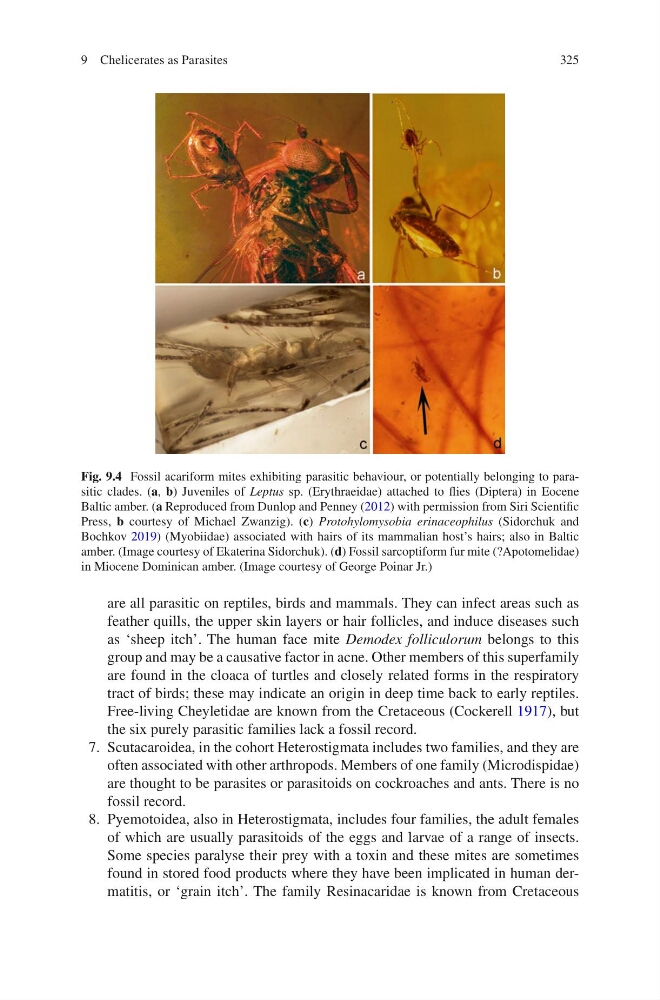
Fig. 9.4 Fossil acariform mites exhibiting parasitic behaviour, or potentially belonging to parasitic clades. (a, b) Juveniles of Leptus sp. (Erythraeidae) attached to flies (Diptera) in Eocene
Baltic amber. (a Reproduced from Dunlop and Penney (2012) with permission from Siri Scientific
Press, b courtesy of Michael Zwanzig). (c) Protohylomysobia erinaceophilus (Sidorchuk and
Bochkov 2019) (Myobiidae) associated with hairs of its mammalian host’s hairs; also in Baltic
amber. (Image courtesy of Ekaterina Sidorchuk). (d) Fossil sarcoptiform fur mite (?Apotomelidae)
in Miocene Dominican amber. (Image courtesy of George Poinar Jr.)
9 Chelicerates as Parasites
are all parasitic on reptiles, birds and mammals. They can infect areas such as
feather quills, the upper skin layers or hair follicles, and induce diseases such
as ‘sheep itch’. The human face mite Demodex folliculorum belongs to this
group and may be a causative factor in acne. Other members of this superfamily
are found in the cloaca of turtles and closely related forms in the respiratory
tract of birds; these may indicate an origin in deep time back to early reptiles.
Free-living Cheyletidae are known from the Cretaceous (Cockerell 1917), but
the six purely parasitic families lack a fossil record.
7. Scutacaroidea, in the cohort Heterostigmata includes two families, and they are
often associated with other arthropods. Members of one family (Microdispidae)
are thought to be parasites or parasitoids on cockroaches and ants. There is no
fossil record.
8. Pyemotoidea, also in Heterostigmata, includes four families, the adult females
of which are usually parasitoids of the eggs and larvae of a range of insects.
Some species paralyse their prey with a toxin and these mites are sometimes
found in stored food products where they have been implicated in human dermatitis, or ‘grain itch’. The family Resinacaridae is known from Cretaceous
Fig. 9.4 Fossil acariform mites exhibiting parasitic behaviour, or potentially belonging to parasitic clades. (a, b) Juveniles of Leptus sp. (Erythraeidae) attached to flies (Diptera) in Eocene
Baltic amber. (a Reproduced from Dunlop and Penney (2012) with permission from Siri Scientific
Press, b courtesy of Michael Zwanzig). (c) Protohylomysobia erinaceophilus (Sidorchuk and
Bochkov 2019) (Myobiidae) associated with hairs of its mammalian host’s hairs; also in Baltic
amber. (Image courtesy of Ekaterina Sidorchuk). (d) Fossil sarcoptiform fur mite (?Apotomelidae)
in Miocene Dominican amber. (Image courtesy of George Poinar Jr.)
9 Chelicerates as Parasites