

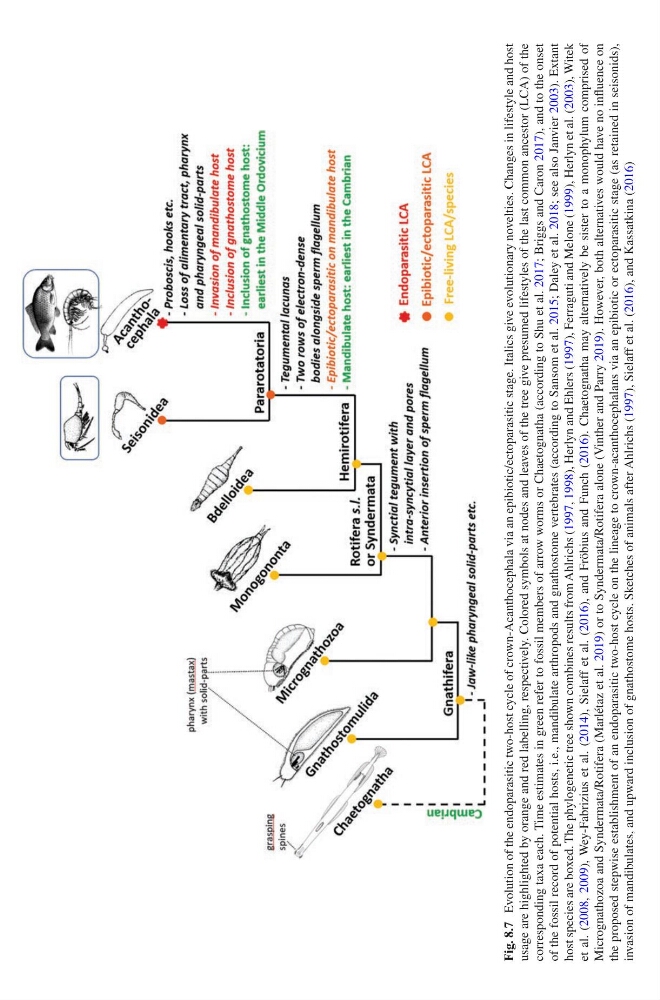
Fig. 8.7 Evolution of the endoparasitic two-host cycle of crown-Acanthocephala via an epibiotic/ectoparasitic stage. Italics give evolutionary novelties. Changes in lifestyle and host
usage are highlighted by orange and red labelling, respectively. Colored symbols at nodes and leaves of the tree give presumed lifestyles of the last common ancestor (LCA) of the
corresponding taxa each. Time estimates in green refer to fossil members of arrow worms or Chaetognatha (according to Shu et al. 2017; Briggs and Caron 2017), and to the onset
of the fossil record of potential hosts, i.e., mandibulate arthropods and gnathostome vertebrates (according to Sansom et al. 2015; Daley et al. 2018; see also Janvier 2003). Extant
host species are boxed. The phylogenetic tree shown combines results from Ahlrichs (1997, 1998), Herlyn and Ehlers (1997), Ferraguti and Melone (1999), Herlyn et al. (2003), Witek
et al. (2008, 2009), Wey-Fabrizius et al. (2014), Sielaff et al. (2016), and Fröbius and Funch (2016). Chaetognatha may alternatively be sister to a monophylum comprised of
Micrognathozoa and Syndermata/Rotifera (Marlétaz et al. 2019) or to Syndermata/Rotifera alone (Vinther and Parry 2019). However, both alternatives would have no influence on
the proposed stepwise establishment of an endoparasitic two-host cycle on the lineage to crown- acanthocephalans via an epibiotic or ectoparasitic stage (as retained in seisonids),
invasion of mandibulates, and upward inclusion of gnathostome hosts. Sketches of animals after Ahlrichs (1997), Sielaff et al. (2016), and Kassatkina (2016)
usage are highlighted by orange and red labelling, respectively. Colored symbols at nodes and leaves of the tree give presumed lifestyles of the last common ancestor (LCA) of the
corresponding taxa each. Time estimates in green refer to fossil members of arrow worms or Chaetognatha (according to Shu et al. 2017; Briggs and Caron 2017), and to the onset
of the fossil record of potential hosts, i.e., mandibulate arthropods and gnathostome vertebrates (according to Sansom et al. 2015; Daley et al. 2018; see also Janvier 2003). Extant
host species are boxed. The phylogenetic tree shown combines results from Ahlrichs (1997, 1998), Herlyn and Ehlers (1997), Ferraguti and Melone (1999), Herlyn et al. (2003), Witek
et al. (2008, 2009), Wey-Fabrizius et al. (2014), Sielaff et al. (2016), and Fröbius and Funch (2016). Chaetognatha may alternatively be sister to a monophylum comprised of
Micrognathozoa and Syndermata/Rotifera (Marlétaz et al. 2019) or to Syndermata/Rotifera alone (Vinther and Parry 2019). However, both alternatives would have no influence on
the proposed stepwise establishment of an endoparasitic two-host cycle on the lineage to crown- acanthocephalans via an epibiotic or ectoparasitic stage (as retained in seisonids),
invasion of mandibulates, and upward inclusion of gnathostome hosts. Sketches of animals after Ahlrichs (1997), Sielaff et al. (2016), and Kassatkina (2016)