

282
Archiacanthocephalan taxon Probable origin of coprolites
Archeological site
Age or comment
Reference
Unspecified
C; human
Clyde’s Cavern/Utah; Black Mesa/
Arizona; Glen Canyon/Utah; all
USA
460 AD
to
1,500 AD
Table 2 in
Reinhard (1990)
Unspecified
C; human?
Boqueirão Soberbo/Minas Gerais,
Brazil
4,905 ± 85 BP
to
1,325 ± 60 BP
Gonçalves et al.
(2003)
Unspecified
C; human?
Gentio Cave/Minas Gerais, Brazil
3,490 ± 120 BP
to
430 ± 70 BP
Gonçalves et al.
(2003)
Unspecified
C, Crocodiloformes
Santo Anastácio Municipality,
Southwestern São Paulo State,
Brazil
Bauru Group, Upper Cretaceous
from the Paraná Basin
Cardia et al.
(2019)
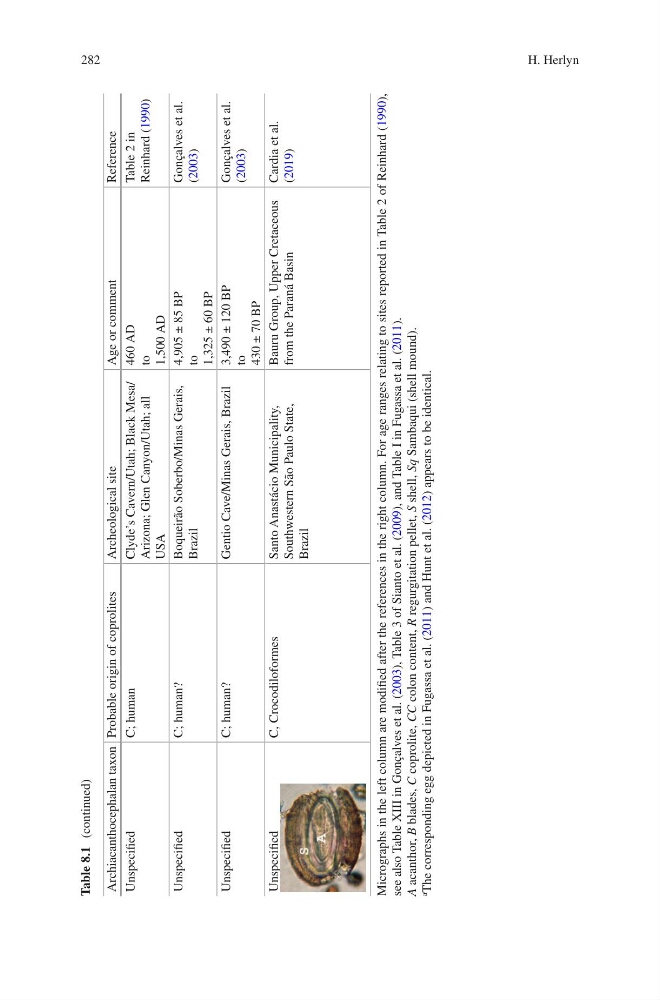
Micrographs in the left column are modified after the references in the right column. For age ranges relating to sites reported in Table 2 of Reinhard (1990),
see also Table XIII in Gonçalves et al. (2003), Table 3 of Sianto et al. (2009), and Table I in Fugassa et al. (2011).
A
acanthor, B
blades, C
coprolite, CC
colon content, R
regurgitation pellet, S
shell, Sq
Sambaqui (shell mound).
a
The corresponding egg depicted in Fugassa et al. (2011) and Hunt et al. (2012) appears to be identical.
Table 8.1 (continued)
H. Herlyn
Archiacanthocephalan taxon Probable origin of coprolites
Archeological site
Age or comment
Reference
Unspecified
C; human
Clyde’s Cavern/Utah; Black Mesa/
Arizona; Glen Canyon/Utah; all
USA
460 AD
to
1,500 AD
Table 2 in
Reinhard (1990)
Unspecified
C; human?
Boqueirão Soberbo/Minas Gerais,
Brazil
4,905 ± 85 BP
to
1,325 ± 60 BP
Gonçalves et al.
(2003)
Unspecified
C; human?
Gentio Cave/Minas Gerais, Brazil
3,490 ± 120 BP
to
430 ± 70 BP
Gonçalves et al.
(2003)
Unspecified
C, Crocodiloformes
Santo Anastácio Municipality,
Southwestern São Paulo State,
Brazil
Bauru Group, Upper Cretaceous
from the Paraná Basin
Cardia et al.
(2019)
Micrographs in the left column are modified after the references in the right column. For age ranges relating to sites reported in Table 2 of Reinhard (1990),
see also Table XIII in Gonçalves et al. (2003), Table 3 of Sianto et al. (2009), and Table I in Fugassa et al. (2011).
A
acanthor, B
blades, C
coprolite, CC
colon content, R
regurgitation pellet, S
shell, Sq
Sambaqui (shell mound).
a
The corresponding egg depicted in Fugassa et al. (2011) and Hunt et al. (2012) appears to be identical.
Table 8.1 (continued)
H. Herlyn