

258
Phylogenetic justification. No formal phylogenetic analysis was performed, but
egg size, their elliptical shape and structures wrapped by three concentric, thick
shells suggests their identification as acanthocephalan eggs containing remains
of acanthor larvae (Cardia et al. 2018). These thick-shelled eggs are most similar
in size and morphology to other described Archiacanthocephala eggs from
younger subfossil remains and lack a fourth layer present in extant forms (Herlyn
2021). The latter might however be a preservational artefact as this layer is usually poorly present or absent in ancient remains (compare Herlyn 2021).
Hard minimum. 69.9 Ma. The coprolites derive from the Adamantina Formation.
The age of the Adamantina Formation is still debated (Castro et al. 2018). The
youngest analyses place it formation between 87.7 in the Coniacian (Castro et al.
2018) to early Maastrichtian (Gobbo-Rodrigues et al. 1999) yielding a minimum
age of 69.9 Ma according to GTS 2016 (Ogg et al. 2016).
7.5 Discussion
In some cases, confidently identified fossil remains of free-living relatives are more
ancient (e.g., annelids) than those of parasitic representatives. In other cases,
remains of parasitic helminths are considerably older than those confidently attributable to their closest free-living relatives. Putative free-living Ordovician nematodes have been reported (Muir et al. 2014; Knaust and Desrochers 2019), but
confident assignment to Nematoda is unclear. Helminth eggs seems to be more
readily preserved in the coprolites of sharks (Dentzien-Dias et al. 2013; De Baets
et al. 2015), archosaurs (Poinar and Boucot 2006) or synapsids (Da Silva et al.
2014; Hugot et al. 2014) with age depending on the clade investigated.
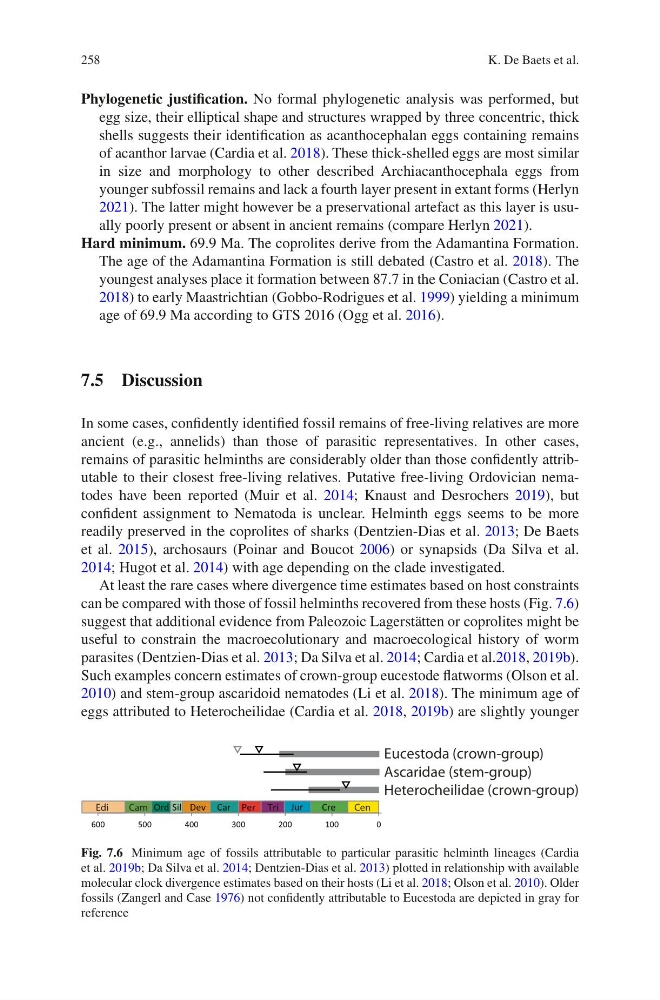
At least the rare cases where divergence time estimates based on host constraints
can be compared with those of fossil helminths recovered from these hosts (Fig. 7.6)
suggest that additional evidence from Paleozoic Lagerstätten or coprolites might be
useful to constrain the macroecolutionary and macroecological history of worm
parasites (Dentzien-Dias et al. 2013; Da Silva et al. 2014; Cardia et al.2018, 2019b).
Such examples concern estimates of crown-group eucestode flatworms (Olson et al.
2010) and stem-group ascaridoid nematodes (Li et al. 2018). The minimum age of
eggs attributed to Heterocheilidae (Cardia et al. 2018, 2019b) are slightly younger
0
100
200
300
400
500
600
Cam
C en
Ord Sil Dev Car Per Tri Jur
Cre
Ascaridae (stem-group)
Heterocheilidae (crown-group)
Eucestoda (crown-group)
Edi
Fig. 7.6 Minimum age of fossils attributable to particular parasitic helminth lineages (Cardia
et al. 2019b; Da Silva et al. 2014; Dentzien-Dias et al. 2013) plotted in relationship with available
molecular clock divergence estimates based on their hosts (Li et al. 2018; Olson et al. 2010). Older
fossils (Zangerl and Case 1976) not confidently attributable to Eucestoda are depicted in gray for
reference
K. De Baets et al.
Phylogenetic justification. No formal phylogenetic analysis was performed, but
egg size, their elliptical shape and structures wrapped by three concentric, thick
shells suggests their identification as acanthocephalan eggs containing remains
of acanthor larvae (Cardia et al. 2018). These thick-shelled eggs are most similar
in size and morphology to other described Archiacanthocephala eggs from
younger subfossil remains and lack a fourth layer present in extant forms (Herlyn
2021). The latter might however be a preservational artefact as this layer is usually poorly present or absent in ancient remains (compare Herlyn 2021).
Hard minimum. 69.9 Ma. The coprolites derive from the Adamantina Formation.
The age of the Adamantina Formation is still debated (Castro et al. 2018). The
youngest analyses place it formation between 87.7 in the Coniacian (Castro et al.
2018) to early Maastrichtian (Gobbo-Rodrigues et al. 1999) yielding a minimum
age of 69.9 Ma according to GTS 2016 (Ogg et al. 2016).
7.5 Discussion
In some cases, confidently identified fossil remains of free-living relatives are more
ancient (e.g., annelids) than those of parasitic representatives. In other cases,
remains of parasitic helminths are considerably older than those confidently attributable to their closest free-living relatives. Putative free-living Ordovician nematodes have been reported (Muir et al. 2014; Knaust and Desrochers 2019), but
confident assignment to Nematoda is unclear. Helminth eggs seems to be more
readily preserved in the coprolites of sharks (Dentzien-Dias et al. 2013; De Baets
et al. 2015), archosaurs (Poinar and Boucot 2006) or synapsids (Da Silva et al.
2014; Hugot et al. 2014) with age depending on the clade investigated.
At least the rare cases where divergence time estimates based on host constraints
can be compared with those of fossil helminths recovered from these hosts (Fig. 7.6)
suggest that additional evidence from Paleozoic Lagerstätten or coprolites might be
useful to constrain the macroecolutionary and macroecological history of worm
parasites (Dentzien-Dias et al. 2013; Da Silva et al. 2014; Cardia et al.2018, 2019b).
Such examples concern estimates of crown-group eucestode flatworms (Olson et al.
2010) and stem-group ascaridoid nematodes (Li et al. 2018). The minimum age of
eggs attributed to Heterocheilidae (Cardia et al. 2018, 2019b) are slightly younger
0
100
200
300
400
500
600
Cam
C en
Ord Sil Dev Car Per Tri Jur
Cre
Ascaridae (stem-group)
Heterocheilidae (crown-group)
Eucestoda (crown-group)
Edi
Fig. 7.6 Minimum age of fossils attributable to particular parasitic helminth lineages (Cardia
et al. 2019b; Da Silva et al. 2014; Dentzien-Dias et al. 2013) plotted in relationship with available
molecular clock divergence estimates based on their hosts (Li et al. 2018; Olson et al. 2010). Older
fossils (Zangerl and Case 1976) not confidently attributable to Eucestoda are depicted in gray for
reference
K. De Baets et al.