

238
soft-maximum of 636.1 Ma (Condon et al. 2005) time constraint on the origin of
free-living eumetazoan clades may be inferred. As parasitism is a derived condition
within the various eumetazoan lineages discussed herein, so the origins of parasitic
helminths could only arise after the first appearance of Eumetazoa.
Eumetazoan origins considerably predate putative nematoid remains (Muir et al.
2014), with possible traces from the Ediacaran to Ordovician (Balinski et al. 2013)
or borings found in Cambrian-Ordovician trilobites (Babcock 2007) reminiscent of
possible nematode borings in foraminifers (Sliter 1971; Hope and Tchesunov 1999).
These traces even predate the Ediacaran fossils where Dickinsonia has occasionally
been superficially compared with the annelid Spinther (Wade 1972; Conway Morris
1981) associated as ectoparasites or commensals with modern sponges (Rouse and
Pleijel 2003; Rouse 2005). However, Dickinsonia shows no annelid characters and
is now mostly considered a more early diverging metazoan if indeed a metazoan at
all (Brasier and Antcliffe 2008; Sperling and Vinther 2010; Bobrovskiy et al. 2018).
Considering its comparatively large size it is also difficult to consider it parasitic as
no larger-sized suitable host has so far been found (De Baets and Littlewood 2015).
More importantly, Dickinsonia has been found associated with trace fossils attesting
to its free-living mode of life (e.g., Sperling and Vinther 2010).
In the following, we discuss possible time constraints on the origin of particular
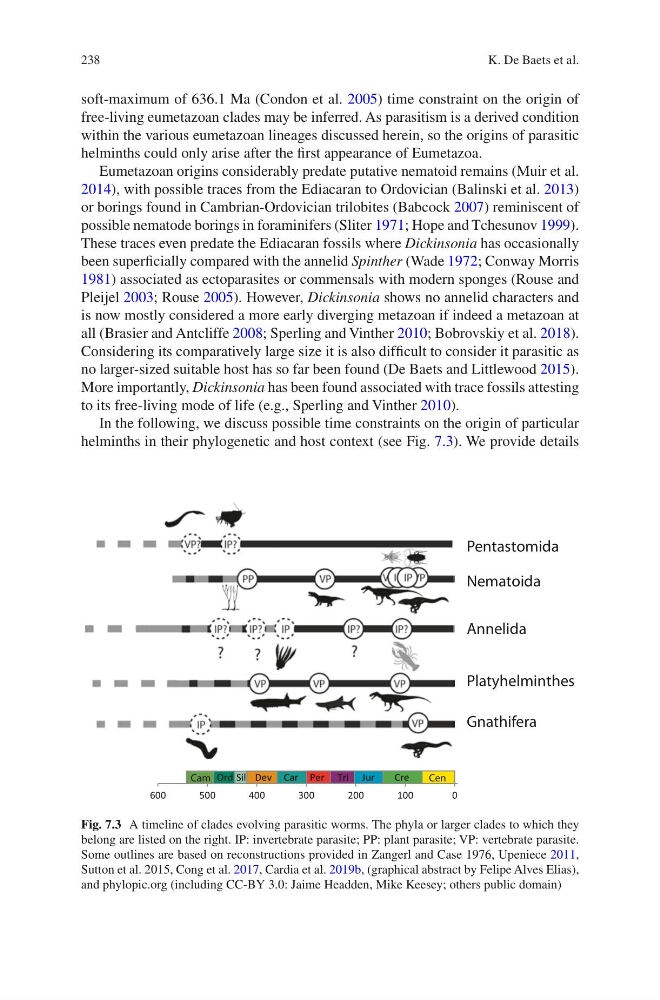
helminths in their phylogenetic and host context (see Fig. 7.3). We provide details
Pentastomida
Platyhelminthes
Gnathifera
Nematoida
Annelida
0
100
200
300
400
500
600
Cam
Cen
Ord Sil Dev Car Per Tri Jur
Cre
Fig. 7.3 A timeline of clades evolving parasitic worms. The phyla or larger clades to which they
belong are listed on the right. IP: invertebrate parasite; PP: plant parasite; VP: vertebrate parasite.
Some outlines are based on reconstructions provided in Zangerl and Case 1976, Upeniece 2011,
Sutton et al. 2015, Cong et al. 2017, Cardia et al. 2019b, (graphical abstract by Felipe Alves Elias),
and phylopic.org (including CC-BY 3.0: Jaime Headden, Mike Keesey; others public domain)
K. De Baets et al.
soft-maximum of 636.1 Ma (Condon et al. 2005) time constraint on the origin of
free-living eumetazoan clades may be inferred. As parasitism is a derived condition
within the various eumetazoan lineages discussed herein, so the origins of parasitic
helminths could only arise after the first appearance of Eumetazoa.
Eumetazoan origins considerably predate putative nematoid remains (Muir et al.
2014), with possible traces from the Ediacaran to Ordovician (Balinski et al. 2013)
or borings found in Cambrian-Ordovician trilobites (Babcock 2007) reminiscent of
possible nematode borings in foraminifers (Sliter 1971; Hope and Tchesunov 1999).
These traces even predate the Ediacaran fossils where Dickinsonia has occasionally
been superficially compared with the annelid Spinther (Wade 1972; Conway Morris
1981) associated as ectoparasites or commensals with modern sponges (Rouse and
Pleijel 2003; Rouse 2005). However, Dickinsonia shows no annelid characters and
is now mostly considered a more early diverging metazoan if indeed a metazoan at
all (Brasier and Antcliffe 2008; Sperling and Vinther 2010; Bobrovskiy et al. 2018).
Considering its comparatively large size it is also difficult to consider it parasitic as
no larger-sized suitable host has so far been found (De Baets and Littlewood 2015).
More importantly, Dickinsonia has been found associated with trace fossils attesting
to its free-living mode of life (e.g., Sperling and Vinther 2010).
In the following, we discuss possible time constraints on the origin of particular
helminths in their phylogenetic and host context (see Fig. 7.3). We provide details
Pentastomida
Platyhelminthes
Gnathifera
Nematoida
Annelida
0
100
200
300
400
500
600
Cam
Cen
Ord Sil Dev Car Per Tri Jur
Cre
Fig. 7.3 A timeline of clades evolving parasitic worms. The phyla or larger clades to which they
belong are listed on the right. IP: invertebrate parasite; PP: plant parasite; VP: vertebrate parasite.
Some outlines are based on reconstructions provided in Zangerl and Case 1976, Upeniece 2011,
Sutton et al. 2015, Cong et al. 2017, Cardia et al. 2019b, (graphical abstract by Felipe Alves Elias),
and phylopic.org (including CC-BY 3.0: Jaime Headden, Mike Keesey; others public domain)
K. De Baets et al.