

224
6.2.4 Analogy Based on Associated Phenomena
Taxonomic uniformitarianism fails if gastropod families are extinct, have a relatively high geological age and if the closest living relatives are unknown. Most
extant parasitic and carnivorous grazer gastropods are ectosymbiotic and do not
leave fossil traces. If, for instance, Pyramidellidae were an extinct Mesozoic or
Paleozoic group, their parasitic life style would have remained unrecognized
because there is no fossil evidence for it and their preferred host polychaetes have a
relatively poor fossil record. The same is true for Triphoridae and Cerithiopsidae.
On the other hand, it seems to be unlikely (though not impossible) that a parasitic or
similar life style was only present in the mentioned extant highly diverse gastropod
families whereas this life style was largely absent or rare in the Palaeozoic and Early
Mesozoic. As mentioned, extant families exhibit several traits and if these traits can
be found in fossil gastropods, a parasitic life style can be hypothesized by analogy.
These traits are as follows:
• belonging to Caenogastropoda or Heterobranchia (Apogastropoda)
• high within family diversity
• low shell disparity within families
• mostly small
• mostly high-spired
Needless to say that the above-mentioned traits are also present in some noncarnivorous or non-parasitic gastropod families (for instance Rissoiidae) and therefore do not represent unequivocal evidence but they do offer the possibility that
certain extinct families which display them were parasitic. Potentially, discoveries
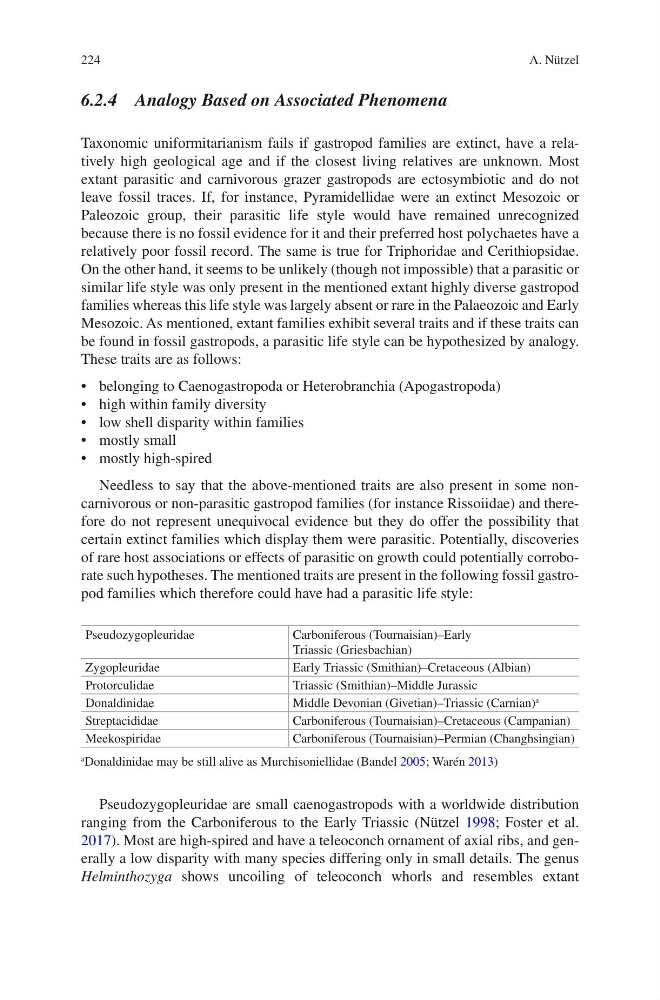
of rare host associations or effects of parasitic on growth could potentially corroborate such hypotheses. The mentioned traits are present in the following fossil gastropod families which therefore could have had a parasitic life style:
Pseudozygopleuridae
Carboniferous (Tournaisian)–Early
Triassic (Griesbachian)
Zygopleuridae
Early Triassic (Smithian)–Cretaceous (Albian)
Protorculidae
Triassic (Smithian)–Middle Jurassic
Donaldinidae
Middle Devonian (Givetian)–Triassic (Carnian)
a
Streptacididae
Carboniferous (Tournaisian)–Cretaceous (Campanian)
Meekospiridae
Carboniferous (Tournaisian)–Permian (Changhsingian)
a
Donaldinidae may be still alive as Murchisoniellidae (Bandel 2005; Warén 2013)
Pseudozygopleuridae are small caenogastropods with a worldwide distribution
ranging from the Carboniferous to the Early Triassic (Nützel 1998; Foster et al.
2017). Most are high-spired and have a teleoconch ornament of axial ribs, and generally a low disparity with many species differing only in small details. The genus
Helminthozyga shows uncoiling of teleoconch whorls and resembles extant
A. Nützel
6.2.4 Analogy Based on Associated Phenomena
Taxonomic uniformitarianism fails if gastropod families are extinct, have a relatively high geological age and if the closest living relatives are unknown. Most
extant parasitic and carnivorous grazer gastropods are ectosymbiotic and do not
leave fossil traces. If, for instance, Pyramidellidae were an extinct Mesozoic or
Paleozoic group, their parasitic life style would have remained unrecognized
because there is no fossil evidence for it and their preferred host polychaetes have a
relatively poor fossil record. The same is true for Triphoridae and Cerithiopsidae.
On the other hand, it seems to be unlikely (though not impossible) that a parasitic or
similar life style was only present in the mentioned extant highly diverse gastropod
families whereas this life style was largely absent or rare in the Palaeozoic and Early
Mesozoic. As mentioned, extant families exhibit several traits and if these traits can
be found in fossil gastropods, a parasitic life style can be hypothesized by analogy.
These traits are as follows:
• belonging to Caenogastropoda or Heterobranchia (Apogastropoda)
• high within family diversity
• low shell disparity within families
• mostly small
• mostly high-spired
Needless to say that the above-mentioned traits are also present in some noncarnivorous or non-parasitic gastropod families (for instance Rissoiidae) and therefore do not represent unequivocal evidence but they do offer the possibility that
certain extinct families which display them were parasitic. Potentially, discoveries
of rare host associations or effects of parasitic on growth could potentially corroborate such hypotheses. The mentioned traits are present in the following fossil gastropod families which therefore could have had a parasitic life style:
Pseudozygopleuridae
Carboniferous (Tournaisian)–Early
Triassic (Griesbachian)
Zygopleuridae
Early Triassic (Smithian)–Cretaceous (Albian)
Protorculidae
Triassic (Smithian)–Middle Jurassic
Donaldinidae
Middle Devonian (Givetian)–Triassic (Carnian)
a
Streptacididae
Carboniferous (Tournaisian)–Cretaceous (Campanian)
Meekospiridae
Carboniferous (Tournaisian)–Permian (Changhsingian)
a
Donaldinidae may be still alive as Murchisoniellidae (Bandel 2005; Warén 2013)
Pseudozygopleuridae are small caenogastropods with a worldwide distribution
ranging from the Carboniferous to the Early Triassic (Nützel 1998; Foster et al.
2017). Most are high-spired and have a teleoconch ornament of axial ribs, and generally a low disparity with many species differing only in small details. The genus
Helminthozyga shows uncoiling of teleoconch whorls and resembles extant
A. Nützel