

215
In the following the most important parasitic families (or those having a similar
lifestyle) are mentioned including their host and fossil record as currently known.
This account is not meant to be complete but covers the most diverse groups.
6.2.2.1 Eulimidae
Eulimidae (Caenogastropoda) are mostly ectoparasites that feed on echinoderms
(holothurians, sea urchins, sea stars). They are attached to their host with their proboscis or snout more or less permanently (Warén 1983) and can be embedded in the
tissue of their host (endoparasitic). Many eulimids have reduced the radula (Aglossa)
as result of their parasitic life style. Those eulimids that possess a radula have
needle- shaped teeth (Warén 1983) and hence resemble the ptenoglossate radula of
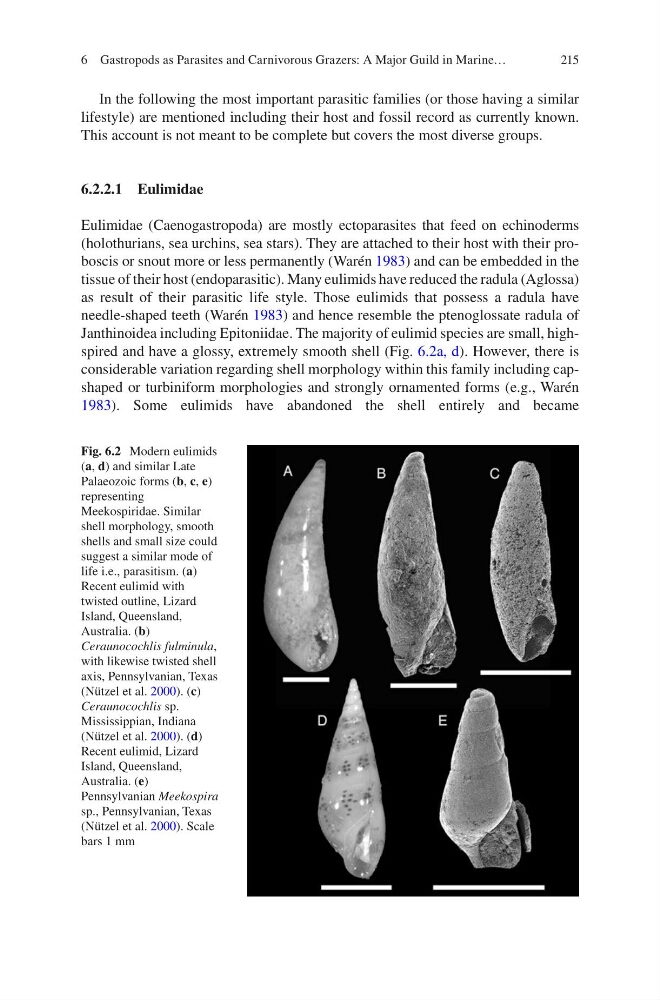
Janthinoidea including Epitoniidae. The majority of eulimid species are small, highspired and have a glossy, extremely smooth shell (Fig. 6.2a, d). However, there is
considerable variation regarding shell morphology within this family including capshaped or turbiniform morphologies and strongly ornamented forms (e.g., Warén
1983). Some eulimids have abandoned the shell entirely and became
Fig. 6.2 Modern eulimids
(a, d) and similar Late
Palaeozoic forms (b, c, e)
representing
Meekospiridae. Similar
shell morphology, smooth
shells and small size could
suggest a similar mode of
life i.e., parasitism. (a)
Recent eulimid with
twisted outline, Lizard
Island, Queensland,
Australia. (b)
Ceraunocochlis fulminula,
with likewise twisted shell
axis, Pennsylvanian, Texas
(Nützel et al. 2000). (c)
Ceraunocochlis sp.
Mississippian, Indiana
(Nützel et al. 2000). (d)
Recent eulimid, Lizard
Island, Queensland,
Australia. (e)
Pennsylvanian Meekospira
sp., Pennsylvanian, Texas
(Nützel et al. 2000). Scale
bars 1 mm
6 Gastropods as Parasites and Carnivorous Grazers: A Major Guild in Marine…
In the following the most important parasitic families (or those having a similar
lifestyle) are mentioned including their host and fossil record as currently known.
This account is not meant to be complete but covers the most diverse groups.
6.2.2.1 Eulimidae
Eulimidae (Caenogastropoda) are mostly ectoparasites that feed on echinoderms
(holothurians, sea urchins, sea stars). They are attached to their host with their proboscis or snout more or less permanently (Warén 1983) and can be embedded in the
tissue of their host (endoparasitic). Many eulimids have reduced the radula (Aglossa)
as result of their parasitic life style. Those eulimids that possess a radula have
needle- shaped teeth (Warén 1983) and hence resemble the ptenoglossate radula of
Janthinoidea including Epitoniidae. The majority of eulimid species are small, highspired and have a glossy, extremely smooth shell (Fig. 6.2a, d). However, there is
considerable variation regarding shell morphology within this family including capshaped or turbiniform morphologies and strongly ornamented forms (e.g., Warén
1983). Some eulimids have abandoned the shell entirely and became
Fig. 6.2 Modern eulimids
(a, d) and similar Late
Palaeozoic forms (b, c, e)
representing
Meekospiridae. Similar
shell morphology, smooth
shells and small size could
suggest a similar mode of
life i.e., parasitism. (a)
Recent eulimid with
twisted outline, Lizard
Island, Queensland,
Australia. (b)
Ceraunocochlis fulminula,
with likewise twisted shell
axis, Pennsylvanian, Texas
(Nützel et al. 2000). (c)
Ceraunocochlis sp.
Mississippian, Indiana
(Nützel et al. 2000). (d)
Recent eulimid, Lizard
Island, Queensland,
Australia. (e)
Pennsylvanian Meekospira
sp., Pennsylvanian, Texas
(Nützel et al. 2000). Scale
bars 1 mm
6 Gastropods as Parasites and Carnivorous Grazers: A Major Guild in Marine…