

213
interaction of platyceratid (respectively orthonychiid) gastropods and crinoids (e.g.,
Bowsher 1955; Boucot 1990; Webster and Donovan 2012; Baumiller and Gahn
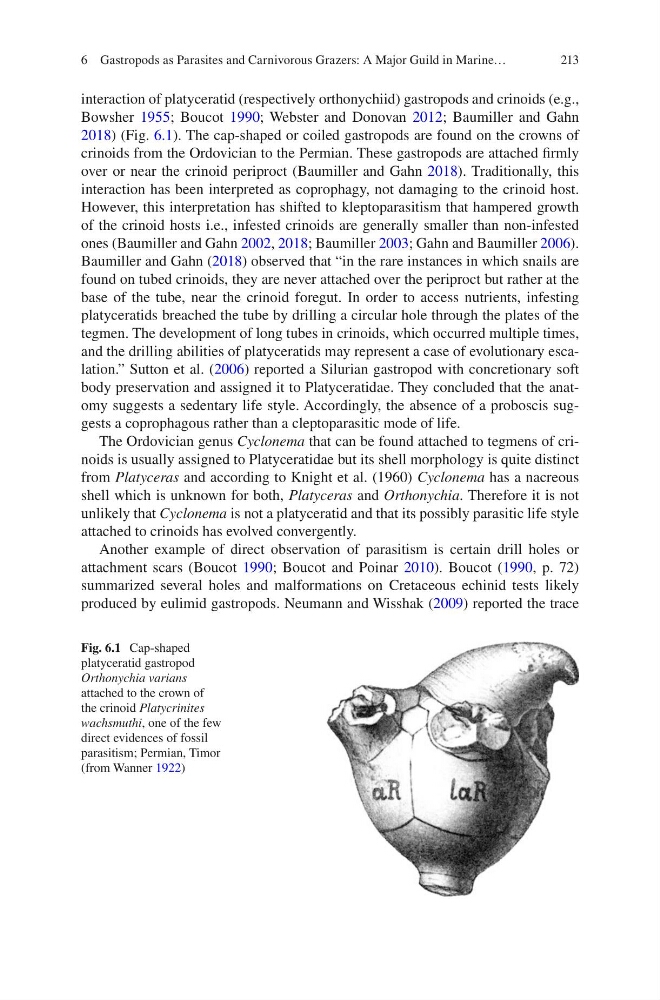
2018) (Fig. 6.1). The cap-shaped or coiled gastropods are found on the crowns of
crinoids from the Ordovician to the Permian. These gastropods are attached firmly
over or near the crinoid periproct (Baumiller and Gahn 2018). Traditionally, this
interaction has been interpreted as coprophagy, not damaging to the crinoid host.
However, this interpretation has shifted to kleptoparasitism that hampered growth
of the crinoid hosts i.e., infested crinoids are generally smaller than non-infested
ones (Baumiller and Gahn 2002, 2018; Baumiller 2003; Gahn and Baumiller 2006).
Baumiller and Gahn (2018) observed that “in the rare instances in which snails are
found on tubed crinoids, they are never attached over the periproct but rather at the
base of the tube, near the crinoid foregut. In order to access nutrients, infesting
platyceratids breached the tube by drilling a circular hole through the plates of the
tegmen. The development of long tubes in crinoids, which occurred multiple times,
and the drilling abilities of platyceratids may represent a case of evolutionary escalation.” Sutton et al. (2006) reported a Silurian gastropod with concretionary soft
body preservation and assigned it to Platyceratidae. They concluded that the anatomy suggests a sedentary life style. Accordingly, the absence of a proboscis suggests a coprophagous rather than a cleptoparasitic mode of life.
The Ordovician genus Cyclonema that can be found attached to tegmens of crinoids is usually assigned to Platyceratidae but its shell morphology is quite distinct
from Platyceras and according to Knight et al. (1960) Cyclonema has a nacreous
shell which is unknown for both, Platyceras and Orthonychia. Therefore it is not
unlikely that Cyclonema is not a platyceratid and that its possibly parasitic life style
attached to crinoids has evolved convergently.
Another example of direct observation of parasitism is certain drill holes or
attachment scars (Boucot 1990; Boucot and Poinar 2010). Boucot (1990, p. 72)
summarized several holes and malformations on Cretaceous echinid tests likely
produced by eulimid gastropods. Neumann and Wisshak (2009) reported the trace
Fig. 6.1 Cap-shaped
platyceratid gastropod
Orthonychia varians
attached to the crown of
the crinoid Platycrinites
wachsmuthi, one of the few
direct evidences of fossil
parasitism; Permian, Timor
(from Wanner 1922)
6 Gastropods as Parasites and Carnivorous Grazers: A Major Guild in Marine…
interaction of platyceratid (respectively orthonychiid) gastropods and crinoids (e.g.,
Bowsher 1955; Boucot 1990; Webster and Donovan 2012; Baumiller and Gahn
2018) (Fig. 6.1). The cap-shaped or coiled gastropods are found on the crowns of
crinoids from the Ordovician to the Permian. These gastropods are attached firmly
over or near the crinoid periproct (Baumiller and Gahn 2018). Traditionally, this
interaction has been interpreted as coprophagy, not damaging to the crinoid host.
However, this interpretation has shifted to kleptoparasitism that hampered growth
of the crinoid hosts i.e., infested crinoids are generally smaller than non-infested
ones (Baumiller and Gahn 2002, 2018; Baumiller 2003; Gahn and Baumiller 2006).
Baumiller and Gahn (2018) observed that “in the rare instances in which snails are
found on tubed crinoids, they are never attached over the periproct but rather at the
base of the tube, near the crinoid foregut. In order to access nutrients, infesting
platyceratids breached the tube by drilling a circular hole through the plates of the
tegmen. The development of long tubes in crinoids, which occurred multiple times,
and the drilling abilities of platyceratids may represent a case of evolutionary escalation.” Sutton et al. (2006) reported a Silurian gastropod with concretionary soft
body preservation and assigned it to Platyceratidae. They concluded that the anatomy suggests a sedentary life style. Accordingly, the absence of a proboscis suggests a coprophagous rather than a cleptoparasitic mode of life.
The Ordovician genus Cyclonema that can be found attached to tegmens of crinoids is usually assigned to Platyceratidae but its shell morphology is quite distinct
from Platyceras and according to Knight et al. (1960) Cyclonema has a nacreous
shell which is unknown for both, Platyceras and Orthonychia. Therefore it is not
unlikely that Cyclonema is not a platyceratid and that its possibly parasitic life style
attached to crinoids has evolved convergently.
Another example of direct observation of parasitism is certain drill holes or
attachment scars (Boucot 1990; Boucot and Poinar 2010). Boucot (1990, p. 72)
summarized several holes and malformations on Cretaceous echinid tests likely
produced by eulimid gastropods. Neumann and Wisshak (2009) reported the trace
Fig. 6.1 Cap-shaped
platyceratid gastropod
Orthonychia varians
attached to the crown of
the crinoid Platycrinites
wachsmuthi, one of the few
direct evidences of fossil
parasitism; Permian, Timor
(from Wanner 1922)
6 Gastropods as Parasites and Carnivorous Grazers: A Major Guild in Marine…