

187
(reviewed by Strayer 2008). Although the fossil record of the modern teleostei range
back to the Late Cretaceous (Benton 2005; Broughton et al. 2013; Betancur-R et al.
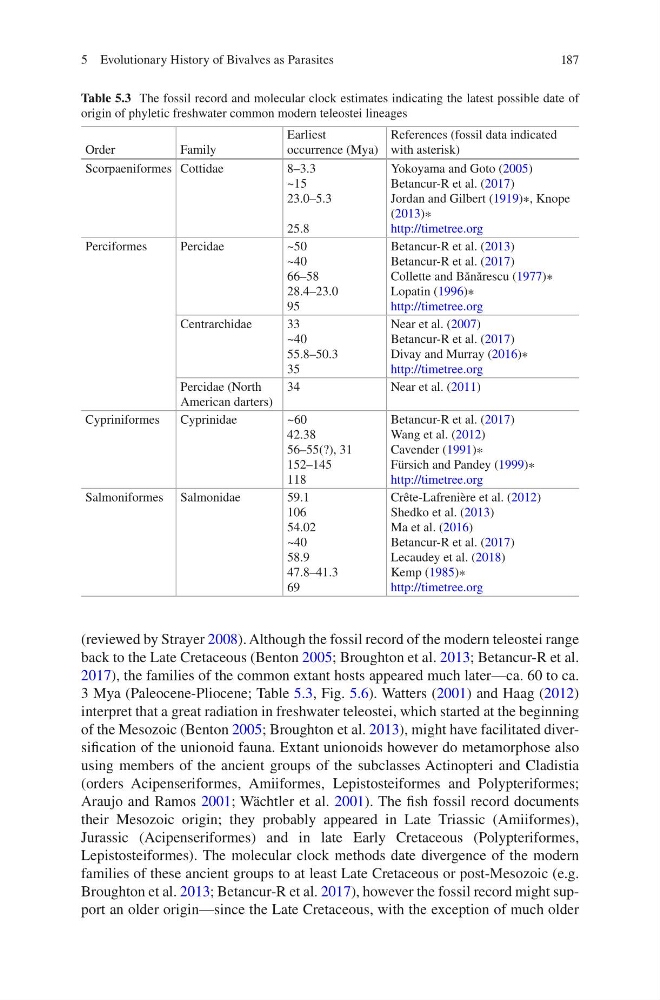
2017), the families of the common extant hosts appeared much later—ca. 60 to ca.
3 Mya (Paleocene-Pliocene; Table 5.3, Fig. 5.6). Watters (2001) and Haag (2012)
interpret that a great radiation in freshwater teleostei, which started at the beginning
of the Mesozoic (Benton 2005; Broughton et al. 2013), might have facilitated diversification of the unionoid fauna. Extant unionoids however do metamorphose also
using members of the ancient groups of the subclasses Actinopteri and Cladistia
(orders Acipenseriformes, Amiiformes, Lepistosteiformes and Polypteriformes;
Araujo and Ramos 2001; Wächtler et al. 2001). The fish fossil record documents
their Mesozoic origin; they probably appeared in Late Triassic (Amiiformes),
Jurassic (Acipenseriformes) and in late Early Cretaceous (Polypteriformes,
Lepistosteiformes). The molecular clock methods date divergence of the modern
families of these ancient groups to at least Late Cretaceous or post-Mesozoic (e.g.
Broughton et al. 2013; Betancur-R et al. 2017), however the fossil record might support an older origin—since the Late Cretaceous, with the exception of much older
Table 5.3 The fossil record and molecular clock estimates indicating the latest possible date of
origin of phyletic freshwater common modern teleostei lineages
Order
Family
Earliest
occurrence (Mya)
References (fossil data indicated
with asterisk)
Scorpaeniformes Cottidae
8–3.3
~15
23.0–5.3
25.8
Yokoyama and Goto (2005)
Betancur-R et al. (2017)
Jordan and Gilbert (1919)∗, Knope
(2013)∗
http://timetree.org
Perciformes
Percidae
~50
~40
66–58
28.4–23.0
95
Betancur-R et al. (2013)
Betancur-R et al. (2017)
Collette and Bănărescu (1977)∗
Lopatin (1996)∗
http://timetree.org
Centrarchidae
33
~40
55.8–50.3
35
Near et al. (2007)
Betancur-R et al. (2017)
Divay and Murray (2016)∗
http://timetree.org
Percidae (North
American darters)
34
Near et al. (2011)
Cypriniformes
Cyprinidae
~60
42.38
56–55(?), 31
152–145
118
Betancur-R et al. (2017)
Wang et al. (2012)
Cavender (1991)∗
Fürsich and Pandey (1999)∗
http://timetree.org
Salmoniformes Salmonidae
59.1
106
54.02
~40
58.9
47.8–41.3
69
Crête-Lafrenière et al. (2012)
Shedko et al. (2013)
Ma et al. (2016)
Betancur-R et al. (2017)
Lecaudey et al. (2018)
Kemp (1985)∗
http://timetree.org
5 Evolutionary History of Bivalves as Parasites
(reviewed by Strayer 2008). Although the fossil record of the modern teleostei range
back to the Late Cretaceous (Benton 2005; Broughton et al. 2013; Betancur-R et al.
2017), the families of the common extant hosts appeared much later—ca. 60 to ca.
3 Mya (Paleocene-Pliocene; Table 5.3, Fig. 5.6). Watters (2001) and Haag (2012)
interpret that a great radiation in freshwater teleostei, which started at the beginning
of the Mesozoic (Benton 2005; Broughton et al. 2013), might have facilitated diversification of the unionoid fauna. Extant unionoids however do metamorphose also
using members of the ancient groups of the subclasses Actinopteri and Cladistia
(orders Acipenseriformes, Amiiformes, Lepistosteiformes and Polypteriformes;
Araujo and Ramos 2001; Wächtler et al. 2001). The fish fossil record documents
their Mesozoic origin; they probably appeared in Late Triassic (Amiiformes),
Jurassic (Acipenseriformes) and in late Early Cretaceous (Polypteriformes,
Lepistosteiformes). The molecular clock methods date divergence of the modern
families of these ancient groups to at least Late Cretaceous or post-Mesozoic (e.g.
Broughton et al. 2013; Betancur-R et al. 2017), however the fossil record might support an older origin—since the Late Cretaceous, with the exception of much older
Table 5.3 The fossil record and molecular clock estimates indicating the latest possible date of
origin of phyletic freshwater common modern teleostei lineages
Order
Family
Earliest
occurrence (Mya)
References (fossil data indicated
with asterisk)
Scorpaeniformes Cottidae
8–3.3
~15
23.0–5.3
25.8
Yokoyama and Goto (2005)
Betancur-R et al. (2017)
Jordan and Gilbert (1919)∗, Knope
(2013)∗
http://timetree.org
Perciformes
Percidae
~50
~40
66–58
28.4–23.0
95
Betancur-R et al. (2013)
Betancur-R et al. (2017)
Collette and Bănărescu (1977)∗
Lopatin (1996)∗
http://timetree.org
Centrarchidae
33
~40
55.8–50.3
35
Near et al. (2007)
Betancur-R et al. (2017)
Divay and Murray (2016)∗
http://timetree.org
Percidae (North
American darters)
34
Near et al. (2011)
Cypriniformes
Cyprinidae
~60
42.38
56–55(?), 31
152–145
118
Betancur-R et al. (2017)
Wang et al. (2012)
Cavender (1991)∗
Fürsich and Pandey (1999)∗
http://timetree.org
Salmoniformes Salmonidae
59.1
106
54.02
~40
58.9
47.8–41.3
69
Crête-Lafrenière et al. (2012)
Shedko et al. (2013)
Ma et al. (2016)
Betancur-R et al. (2017)
Lecaudey et al. (2018)
Kemp (1985)∗
http://timetree.org
5 Evolutionary History of Bivalves as Parasites