

170
After fertilization in females’ suprabranchial chamber, females brood the larvae
within marsupia of the modified gills—filled marsupia are more swollen thus in
several species sexual dimorphism occurs in shape of the shell (e.g. Epioblasma
obliquata obliquata; Patterson 2018). The duration of brooding period is short
(weeks to several months) in tachytictic species (short-term brooders), or long
(months, usually overwinter, with supplying larvae with nutrients) in bradytictic
species (long-term brooders, considered a derived character; Wood 1974a; Graf and
O’Foighil 2000; Bauer 2001b; Wächtler et al. 2001; Gascho Landis and Stoeckel
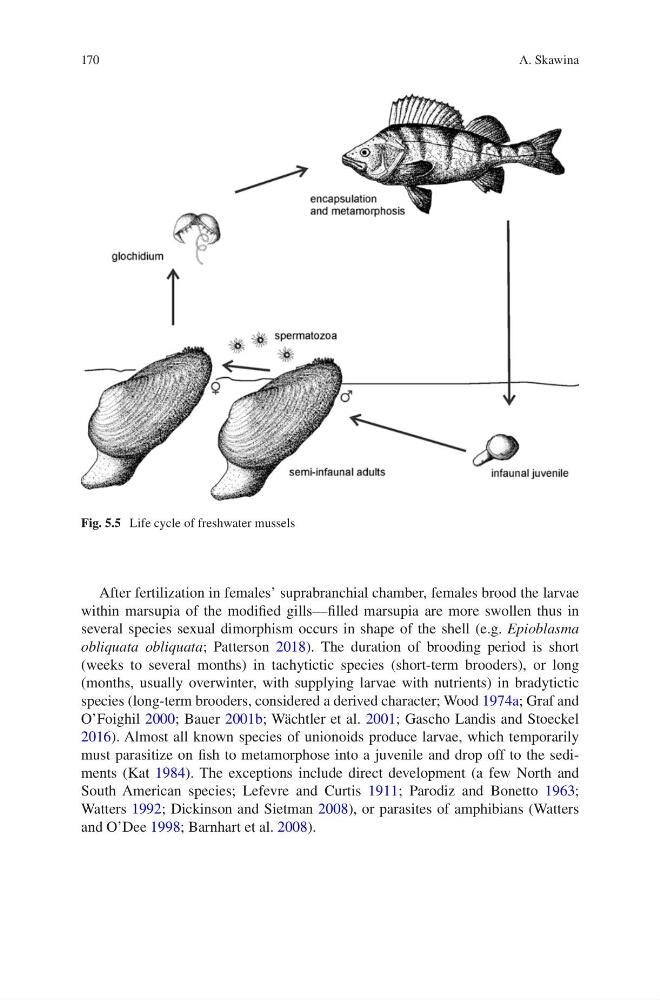
2016). Almost all known species of unionoids produce larvae, which temporarily
must parasitize on fish to metamorphose into a juvenile and drop off to the sediments (Kat 1984). The exceptions include direct development (a few North and
South American species; Lefevre and Curtis 1911; Parodiz and Bonetto 1963;
Watters 1992; Dickinson and Sietman 2008), or parasites of amphibians (Watters
and O’Dee 1998; Barnhart et al. 2008).
Fig. 5.5 Life cycle of freshwater mussels
A. Skawina
After fertilization in females’ suprabranchial chamber, females brood the larvae
within marsupia of the modified gills—filled marsupia are more swollen thus in
several species sexual dimorphism occurs in shape of the shell (e.g. Epioblasma
obliquata obliquata; Patterson 2018). The duration of brooding period is short
(weeks to several months) in tachytictic species (short-term brooders), or long
(months, usually overwinter, with supplying larvae with nutrients) in bradytictic
species (long-term brooders, considered a derived character; Wood 1974a; Graf and
O’Foighil 2000; Bauer 2001b; Wächtler et al. 2001; Gascho Landis and Stoeckel
2016). Almost all known species of unionoids produce larvae, which temporarily
must parasitize on fish to metamorphose into a juvenile and drop off to the sediments (Kat 1984). The exceptions include direct development (a few North and
South American species; Lefevre and Curtis 1911; Parodiz and Bonetto 1963;
Watters 1992; Dickinson and Sietman 2008), or parasites of amphibians (Watters
and O’Dee 1998; Barnhart et al. 2008).
Fig. 5.5 Life cycle of freshwater mussels
A. Skawina