

167
extend to the base of the inner demibranchs and are responsible for closing the shell
valves (McElwain and Bullard 2014).
The large anterior and posterior adductors are responsible for closing the shell.
Other muscles attached to the shell are: anterior and posterior pedal retractors
(which retract the foot), pedal protractor attached at the anterior area of the shell,
and a set of tiny umbonal muscles playing role of a pedal elevator, attached within
the umbonal cavity of the shell (Cox 1969b; Graf and Cummings 2006; Skawina
and Dzik 2011; Carter et al. 2012).
5.2.2 Larvae
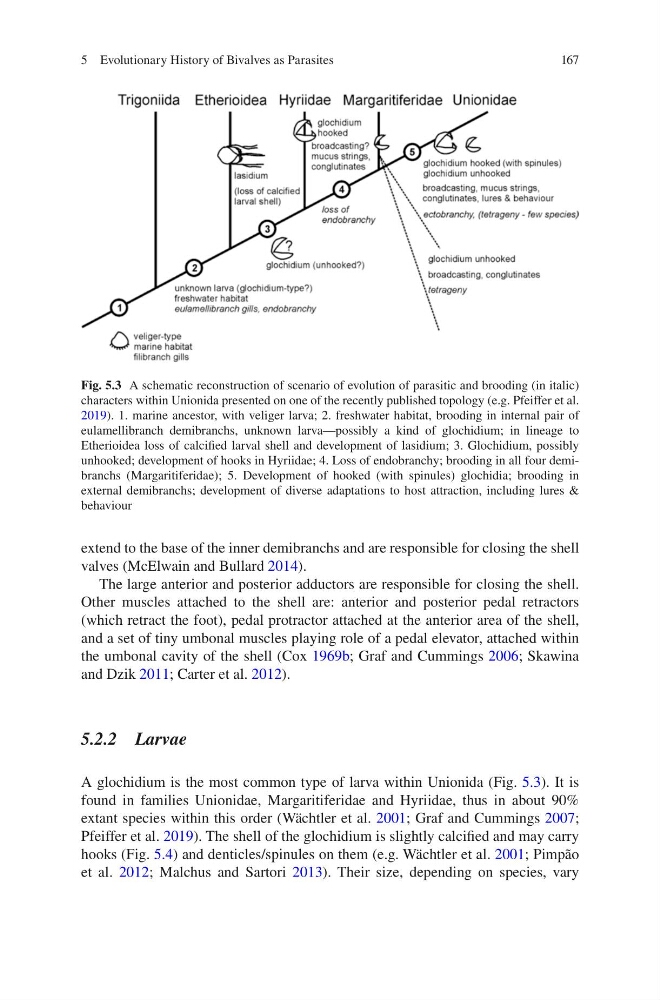
A glochidium is the most common type of larva within Unionida (Fig. 5.3). It is
found in families Unionidae, Margaritiferidae and Hyriidae, thus in about 90%
extant species within this order (Wächtler et al. 2001; Graf and Cummings 2007;
Pfeiffer et al. 2019). The shell of the glochidium is slightly calcified and may carry
hooks (Fig. 5.4) and denticles/spinules on them (e.g. Wächtler et al. 2001; Pimpão
et al. 2012; Malchus and Sartori 2013). Their size, depending on species, vary
Fig. 5.3 A schematic reconstruction of scenario of evolution of parasitic and brooding (in italic)
characters within Unionida presented on one of the recently published topology (e.g. Pfeiffer et al.
2019). 1. marine ancestor, with veliger larva; 2. freshwater habitat, brooding in internal pair of
eulamellibranch demibranchs, unknown larva—possibly a kind of glochidium; in lineage to
Etherioidea loss of calcified larval shell and development of lasidium; 3. Glochidium, possibly
unhooked; development of hooks in Hyriidae; 4. Loss of endobranchy; brooding in all four demibranchs (Margaritiferidae); 5. Development of hooked (with spinules) glochidia; brooding in
external demibranchs; development of diverse adaptations to host attraction, including lures &
behaviour
5 Evolutionary History of Bivalves as Parasites
extend to the base of the inner demibranchs and are responsible for closing the shell
valves (McElwain and Bullard 2014).
The large anterior and posterior adductors are responsible for closing the shell.
Other muscles attached to the shell are: anterior and posterior pedal retractors
(which retract the foot), pedal protractor attached at the anterior area of the shell,
and a set of tiny umbonal muscles playing role of a pedal elevator, attached within
the umbonal cavity of the shell (Cox 1969b; Graf and Cummings 2006; Skawina
and Dzik 2011; Carter et al. 2012).
5.2.2 Larvae
A glochidium is the most common type of larva within Unionida (Fig. 5.3). It is
found in families Unionidae, Margaritiferidae and Hyriidae, thus in about 90%
extant species within this order (Wächtler et al. 2001; Graf and Cummings 2007;
Pfeiffer et al. 2019). The shell of the glochidium is slightly calcified and may carry
hooks (Fig. 5.4) and denticles/spinules on them (e.g. Wächtler et al. 2001; Pimpão
et al. 2012; Malchus and Sartori 2013). Their size, depending on species, vary
Fig. 5.3 A schematic reconstruction of scenario of evolution of parasitic and brooding (in italic)
characters within Unionida presented on one of the recently published topology (e.g. Pfeiffer et al.
2019). 1. marine ancestor, with veliger larva; 2. freshwater habitat, brooding in internal pair of
eulamellibranch demibranchs, unknown larva—possibly a kind of glochidium; in lineage to
Etherioidea loss of calcified larval shell and development of lasidium; 3. Glochidium, possibly
unhooked; development of hooks in Hyriidae; 4. Loss of endobranchy; brooding in all four demibranchs (Margaritiferidae); 5. Development of hooked (with spinules) glochidia; brooding in
external demibranchs; development of diverse adaptations to host attraction, including lures &
behaviour
5 Evolutionary History of Bivalves as Parasites