

165
from a few days to weeks; e.g. Murphy 1942; Jansen et al. 2001 and works there
cited). Nevertheless their successful infection of the host commonly depends on the
time of suspension in the water column, as sedimentation on bottom deposits limits
their chances of host attachment (glochidia do not actively swim; Paling 1968). This
is the most critical period in the life of unionids. Contact with fish tissue results in
larval attachment and quick encapsulation by host tissues (in a few, up to a dozen
hours; Lefevre and Curtis 1910b; Nezlin et al. 1994; Rogers- Lowery and Dimock
2006). In most species larvae are not growing on their host, however they do feed
and produce storage granules (Wächtler et al. 2001). After some time (days to
months) larvae metamorphose and actively detach from their host to start a juvenile
period of life as fairly mobile deposit to filter feeding infaunal bivalves (Yeager
et al. 1994; Jansen et al. 2001; Reis et al. 2014; Araujo et al. 2018). Later (months
to years) juveniles emerge to the depositional surface, mature and spend the rest of
their life as adult filter feeding semi-infaunal burrowers (Bauer 2001c).
5.2 Functional Anatomy of Adult Mussels and the Larvae
5.2.1 Adults
Adult unionoids usually produce a thick pearly shell. The thin mantle underlies it
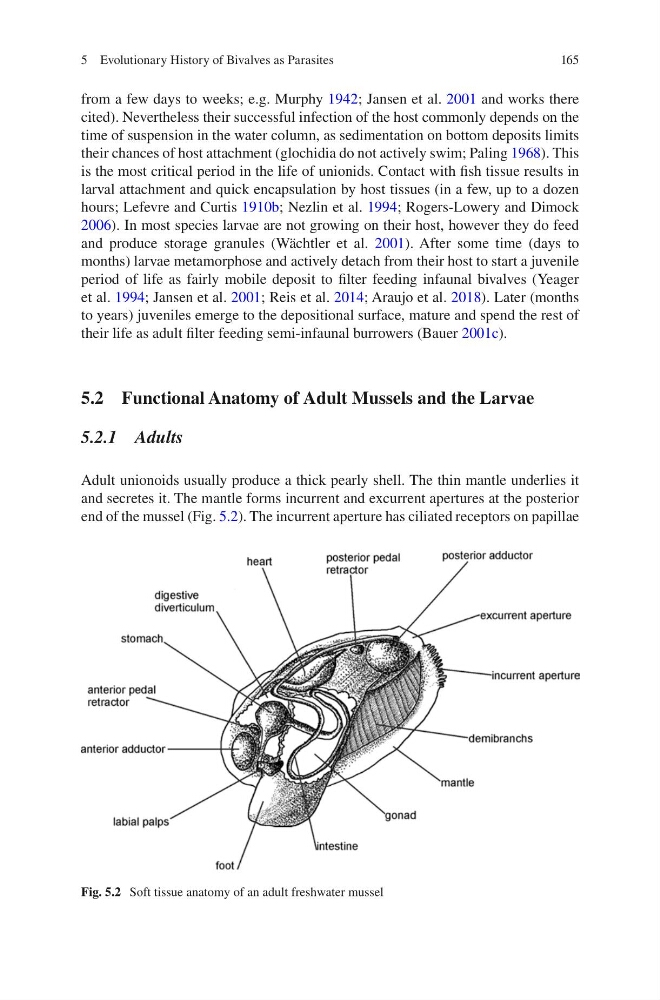
and secretes it. The mantle forms incurrent and excurrent apertures at the posterior
end of the mussel (Fig. 5.2). The incurrent aperture has ciliated receptors on papillae
Fig. 5.2 Soft tissue anatomy of an adult freshwater mussel
5 Evolutionary History of Bivalves as Parasites
from a few days to weeks; e.g. Murphy 1942; Jansen et al. 2001 and works there
cited). Nevertheless their successful infection of the host commonly depends on the
time of suspension in the water column, as sedimentation on bottom deposits limits
their chances of host attachment (glochidia do not actively swim; Paling 1968). This
is the most critical period in the life of unionids. Contact with fish tissue results in
larval attachment and quick encapsulation by host tissues (in a few, up to a dozen
hours; Lefevre and Curtis 1910b; Nezlin et al. 1994; Rogers- Lowery and Dimock
2006). In most species larvae are not growing on their host, however they do feed
and produce storage granules (Wächtler et al. 2001). After some time (days to
months) larvae metamorphose and actively detach from their host to start a juvenile
period of life as fairly mobile deposit to filter feeding infaunal bivalves (Yeager
et al. 1994; Jansen et al. 2001; Reis et al. 2014; Araujo et al. 2018). Later (months
to years) juveniles emerge to the depositional surface, mature and spend the rest of
their life as adult filter feeding semi-infaunal burrowers (Bauer 2001c).
5.2 Functional Anatomy of Adult Mussels and the Larvae
5.2.1 Adults
Adult unionoids usually produce a thick pearly shell. The thin mantle underlies it
and secretes it. The mantle forms incurrent and excurrent apertures at the posterior
end of the mussel (Fig. 5.2). The incurrent aperture has ciliated receptors on papillae
Fig. 5.2 Soft tissue anatomy of an adult freshwater mussel
5 Evolutionary History of Bivalves as Parasites