

132
4.6.1 The Process of Host Acquisition
Adoption of a parasitic life style would have required frequent proximity of future
hosts and parasites leading to enhanced fitness of parasite precursors. Transitions to
parasitism could be based on precursors depending on future hosts for e.g. food or
dispersal. Alternatively, precursors may have been regularly ingested by future
hosts (Poulin 2007; Schmid-Hempel 2011). Precursor pre-adaptations may have
facilitated benefitting from such an association (Poulin 2007). For example, as outlined above, cnidarian traits such as uptake of dissolved organic matter across relatively extensive epithelial surfaces, the ability to persist as dormant stages,
regeneration, and nematocysts may have variously facilitated host exploitation, survival in adverse host environments and attachment to hosts.
Exploitation of fish hosts by both Polypodium and myxozoans along with their
sister relationship status suggest that their common ancestor could have exploited
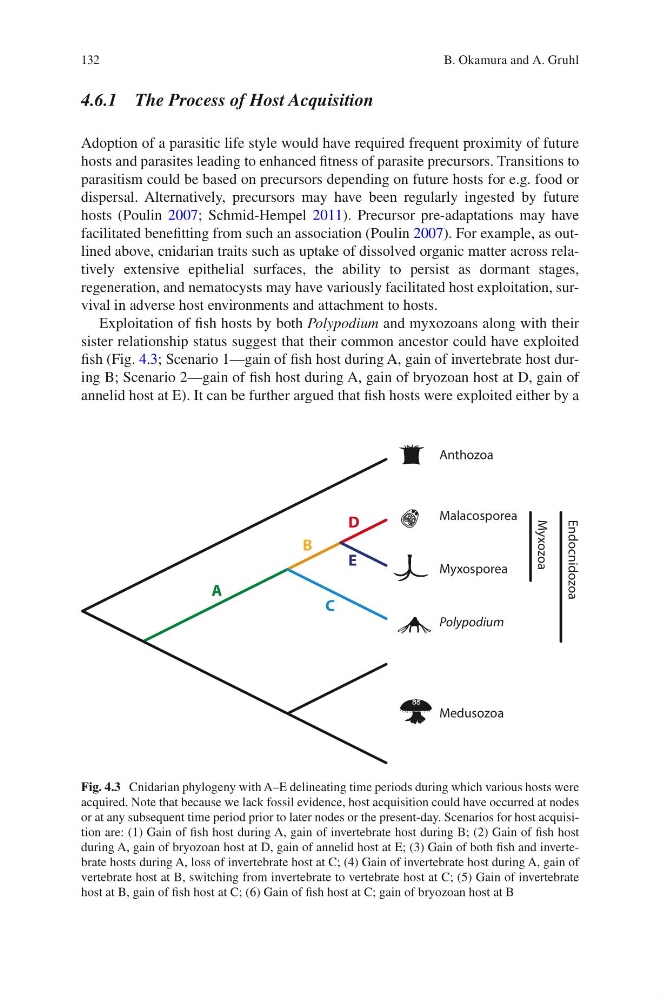
fish (Fig. 4.3; Scenario 1—gain of fish host during A, gain of invertebrate host during B; Scenario 2—gain of fish host during A, gain of bryozoan host at D, gain of
annelid host at E). It can be further argued that fish hosts were exploited either by a
A
B
D
E
C
Myxosporea
Malacosporea
Myxozoa
Endocnidozoa
Anthozoa
Polypodium
Medusozoa
Fig. 4.3 Cnidarian phylogeny with A–E delineating time periods during which various hosts were
acquired. Note that because we lack fossil evidence, host acquisition could have occurred at nodes
or at any subsequent time period prior to later nodes or the present-day. Scenarios for host acquisition are: (1) Gain of fish host during A, gain of invertebrate host during B; (2) Gain of fish host
during A, gain of bryozoan host at D, gain of annelid host at E; (3) Gain of both fish and invertebrate hosts during A, loss of invertebrate host at C; (4) Gain of invertebrate host during A, gain of
vertebrate host at B, switching from invertebrate to vertebrate host at C; (5) Gain of invertebrate
host at B, gain of fish host at C; (6) Gain of fish host at C; gain of bryozoan host at B
B. Okamura and A. Gruhl
4.6.1 The Process of Host Acquisition
Adoption of a parasitic life style would have required frequent proximity of future
hosts and parasites leading to enhanced fitness of parasite precursors. Transitions to
parasitism could be based on precursors depending on future hosts for e.g. food or
dispersal. Alternatively, precursors may have been regularly ingested by future
hosts (Poulin 2007; Schmid-Hempel 2011). Precursor pre-adaptations may have
facilitated benefitting from such an association (Poulin 2007). For example, as outlined above, cnidarian traits such as uptake of dissolved organic matter across relatively extensive epithelial surfaces, the ability to persist as dormant stages,
regeneration, and nematocysts may have variously facilitated host exploitation, survival in adverse host environments and attachment to hosts.
Exploitation of fish hosts by both Polypodium and myxozoans along with their
sister relationship status suggest that their common ancestor could have exploited
fish (Fig. 4.3; Scenario 1—gain of fish host during A, gain of invertebrate host during B; Scenario 2—gain of fish host during A, gain of bryozoan host at D, gain of
annelid host at E). It can be further argued that fish hosts were exploited either by a
A
B
D
E
C
Myxosporea
Malacosporea
Myxozoa
Endocnidozoa
Anthozoa
Polypodium
Medusozoa
Fig. 4.3 Cnidarian phylogeny with A–E delineating time periods during which various hosts were
acquired. Note that because we lack fossil evidence, host acquisition could have occurred at nodes
or at any subsequent time period prior to later nodes or the present-day. Scenarios for host acquisition are: (1) Gain of fish host during A, gain of invertebrate host during B; (2) Gain of fish host
during A, gain of bryozoan host at D, gain of annelid host at E; (3) Gain of both fish and invertebrate hosts during A, loss of invertebrate host at C; (4) Gain of invertebrate host during A, gain of
vertebrate host at B, switching from invertebrate to vertebrate host at C; (5) Gain of invertebrate
host at B, gain of fish host at C; (6) Gain of fish host at C; gain of bryozoan host at B
B. Okamura and A. Gruhl