

115
a
b
c
d
Benthic polyp
Pelagic medusa
Pathways for
medusa
development
Free-swimming planula
larva
Release of
infectious
spores
Release of
infectious
spores
Release of
infectious
spores
Release of
infectious
spores
Infection of invertebrate
(annelid) host as
pansporocyst
Infection of invertebrate
(bryozoan) host as sacs
or worms
Infection of vertebrate
(fish) host as plasmodia
or pseudoplasmodia
Infection of vertebrate
(fish) host as plasmodia
or pseudoplasmodia
Malacosporea
Myxosporea
Polypodium hydriforme
Medusozoa
Release of
binucleate
stages
Growth of parasitic
stolon
Budding of free-living
stage
Emergence of
inverted stolon
Infection of
fish host,
formation of
trophamnion stage
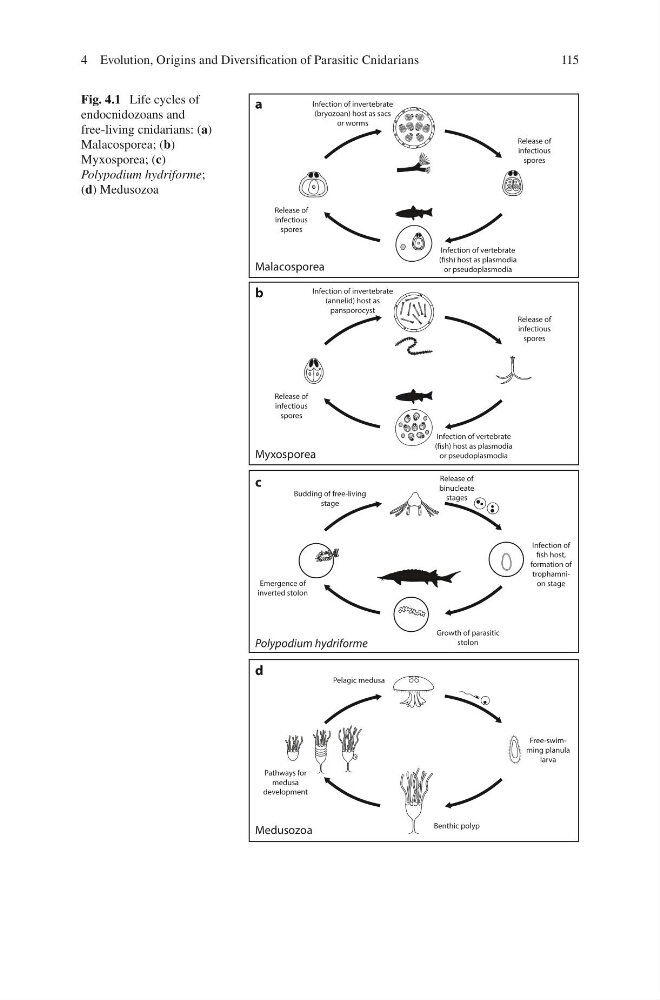
Fig. 4.1 Life cycles of
endocnidozoans and
free-living cnidarians: (a)
Malacosporea; (b)
Myxosporea; (c)
Polypodium hydriforme;
(d) Medusozoa
4 Evolution, Origins and Diversification of Parasitic Cnidarians
a
b
c
d
Benthic polyp
Pelagic medusa
Pathways for
medusa
development
Free-swimming planula
larva
Release of
infectious
spores
Release of
infectious
spores
Release of
infectious
spores
Release of
infectious
spores
Infection of invertebrate
(annelid) host as
pansporocyst
Infection of invertebrate
(bryozoan) host as sacs
or worms
Infection of vertebrate
(fish) host as plasmodia
or pseudoplasmodia
Infection of vertebrate
(fish) host as plasmodia
or pseudoplasmodia
Malacosporea
Myxosporea
Polypodium hydriforme
Medusozoa
Release of
binucleate
stages
Growth of parasitic
stolon
Budding of free-living
stage
Emergence of
inverted stolon
Infection of
fish host,
formation of
trophamnion stage
Fig. 4.1 Life cycles of
endocnidozoans and
free-living cnidarians: (a)
Malacosporea; (b)
Myxosporea; (c)
Polypodium hydriforme;
(d) Medusozoa
4 Evolution, Origins and Diversification of Parasitic Cnidarians