

5 Design and Development of a Concentrated Solar …
73
absorptivity. The storage tank is also an insulated tank to minimize the heat loss to
the ambient. The experiment is carried out from 4:05 p.m. to 5:15 p.m. in the month
of April at IIT Jodhpur and the DNI data at the time of experiment is obtained from
the DNI measuring station at IIT Jodhpur. The experiments are performed manually
by aligning the dish at an interval of 15 min following the shadow of receiver at the
center of dish. The day time was selected in view of clear sky, low wind speed and low
dust condition. Further, experiments at different times of day will be conducted in
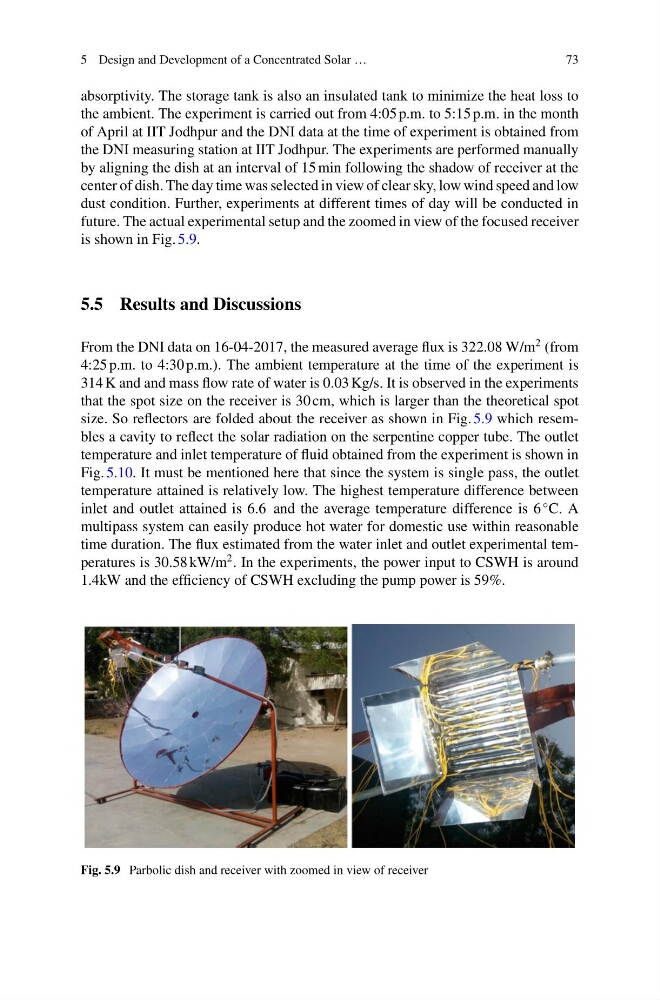
future. The actual experimental setup and the zoomed in view of the focused receiver
is shown in Fig. 5.9.
5.5 Results and Discussions
From the DNI data on 16-04-2017, the measured average flux is 322.08 W/m
2 (from
4:25 p.m. to 4:30 p.m.). The ambient temperature at the time of the experiment is
314 K and and mass flow rate of water is 0.03 Kg/s. It is observed in the experiments
that the spot size on the receiver is 30 cm, which is larger than the theoretical spot
size. So reflectors are folded about the receiver as shown in Fig. 5.9 which resembles a cavity to reflect the solar radiation on the serpentine copper tube. The outlet
temperature and inlet temperature of fluid obtained from the experiment is shown in
Fig. 5.10. It must be mentioned here that since the system is single pass, the outlet
temperature attained is relatively low. The highest temperature difference between
inlet and outlet attained is 6.6 and the average temperature difference is 6
◦ C. A
multipass system can easily produce hot water for domestic use within reasonable
time duration. The flux estimated from the water inlet and outlet experimental temperatures is 30.58 kW/m
2 . In the experiments, the power input to CSWH is around
1.4kW and the efficiency of CSWH excluding the pump power is 59%.
Fig. 5.9 Parbolic dish and receiver with zoomed in view of receiver
73
absorptivity. The storage tank is also an insulated tank to minimize the heat loss to
the ambient. The experiment is carried out from 4:05 p.m. to 5:15 p.m. in the month
of April at IIT Jodhpur and the DNI data at the time of experiment is obtained from
the DNI measuring station at IIT Jodhpur. The experiments are performed manually
by aligning the dish at an interval of 15 min following the shadow of receiver at the
center of dish. The day time was selected in view of clear sky, low wind speed and low
dust condition. Further, experiments at different times of day will be conducted in
future. The actual experimental setup and the zoomed in view of the focused receiver
is shown in Fig. 5.9.
5.5 Results and Discussions
From the DNI data on 16-04-2017, the measured average flux is 322.08 W/m
2 (from
4:25 p.m. to 4:30 p.m.). The ambient temperature at the time of the experiment is
314 K and and mass flow rate of water is 0.03 Kg/s. It is observed in the experiments
that the spot size on the receiver is 30 cm, which is larger than the theoretical spot
size. So reflectors are folded about the receiver as shown in Fig. 5.9 which resembles a cavity to reflect the solar radiation on the serpentine copper tube. The outlet
temperature and inlet temperature of fluid obtained from the experiment is shown in
Fig. 5.10. It must be mentioned here that since the system is single pass, the outlet
temperature attained is relatively low. The highest temperature difference between
inlet and outlet attained is 6.6 and the average temperature difference is 6
◦ C. A
multipass system can easily produce hot water for domestic use within reasonable
time duration. The flux estimated from the water inlet and outlet experimental temperatures is 30.58 kW/m
2 . In the experiments, the power input to CSWH is around
1.4kW and the efficiency of CSWH excluding the pump power is 59%.
Fig. 5.9 Parbolic dish and receiver with zoomed in view of receiver