

50
S. F. Ali and D. Rakshit
feeling dissatisfied with their thermal environment, since during the winter season,
people tend to opt for warmer indoor spaces.
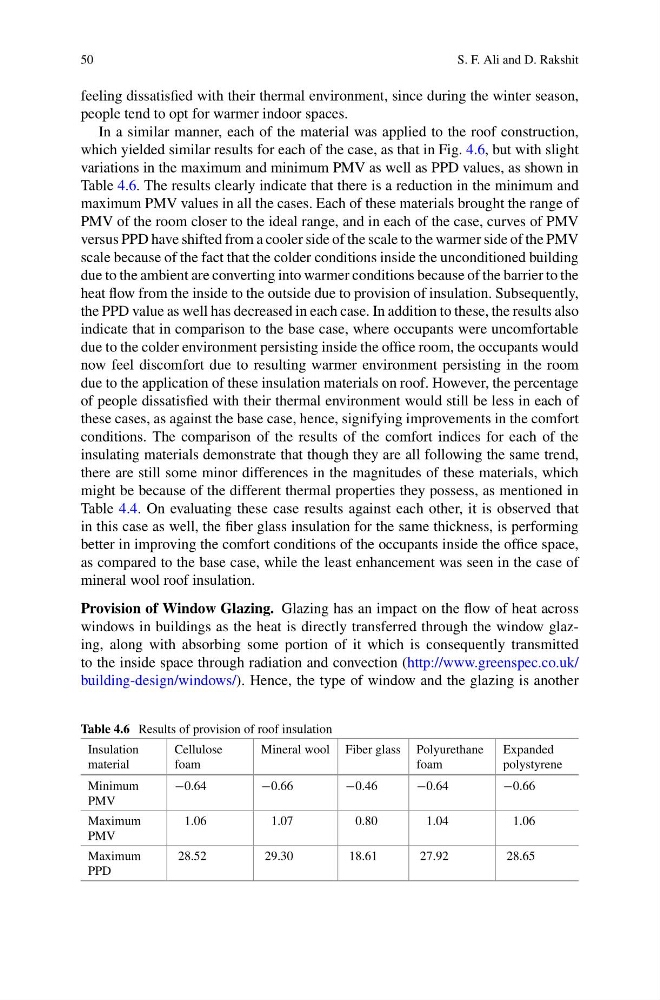
In a similar manner, each of the material was applied to the roof construction,
which yielded similar results for each of the case, as that in Fig. 4.6, but with slight
variations in the maximum and minimum PMV as well as PPD values, as shown in
Table 4.6. The results clearly indicate that there is a reduction in the minimum and
maximum PMV values in all the cases. Each of these materials brought the range of
PMV of the room closer to the ideal range, and in each of the case, curves of PMV
versus PPD have shifted from a cooler side of the scale to the warmer side of the PMV
scale because of the fact that the colder conditions inside the unconditioned building
due to the ambient are converting into warmer conditions because of the barrier to the
heat flow from the inside to the outside due to provision of insulation. Subsequently,
the PPD value as well has decreased in each case. In addition to these, the results also
indicate that in comparison to the base case, where occupants were uncomfortable
due to the colder environment persisting inside the office room, the occupants would
now feel discomfort due to resulting warmer environment persisting in the room
due to the application of these insulation materials on roof. However, the percentage
of people dissatisfied with their thermal environment would still be less in each of
these cases, as against the base case, hence, signifying improvements in the comfort
conditions. The comparison of the results of the comfort indices for each of the
insulating materials demonstrate that though they are all following the same trend,
there are still some minor differences in the magnitudes of these materials, which
might be because of the different thermal properties they possess, as mentioned in
Table 4.4. On evaluating these case results against each other, it is observed that
in this case as well, the fiber glass insulation for the same thickness, is performing
better in improving the comfort conditions of the occupants inside the office space,
as compared to the base case, while the least enhancement was seen in the case of
mineral wool roof insulation.
Provision of Window Glazing. Glazing has an impact on the flow of heat across
windows in buildings as the heat is directly transferred through the window glazing, along with absorbing some portion of it which is consequently transmitted
to the inside space through radiation and convection (http://www.greenspec.co.uk/
building-design/windows/). Hence, the type of window and the glazing is another
Table 4.6 Results of provision of roof insulation
Insulation
material
Cellulose
foam
Mineral wool Fiber glass Polyurethane
foam
Expanded
polystyrene
Minimum
PMV
−0.64
−0.66
−0.46
−0.64
−0.66
Maximum
PMV
1.06
1.07
0.80
1.04
1.06
Maximum
PPD
28.52
29.30
18.61
27.92
28.65
S. F. Ali and D. Rakshit
feeling dissatisfied with their thermal environment, since during the winter season,
people tend to opt for warmer indoor spaces.
In a similar manner, each of the material was applied to the roof construction,
which yielded similar results for each of the case, as that in Fig. 4.6, but with slight
variations in the maximum and minimum PMV as well as PPD values, as shown in
Table 4.6. The results clearly indicate that there is a reduction in the minimum and
maximum PMV values in all the cases. Each of these materials brought the range of
PMV of the room closer to the ideal range, and in each of the case, curves of PMV
versus PPD have shifted from a cooler side of the scale to the warmer side of the PMV
scale because of the fact that the colder conditions inside the unconditioned building
due to the ambient are converting into warmer conditions because of the barrier to the
heat flow from the inside to the outside due to provision of insulation. Subsequently,
the PPD value as well has decreased in each case. In addition to these, the results also
indicate that in comparison to the base case, where occupants were uncomfortable
due to the colder environment persisting inside the office room, the occupants would
now feel discomfort due to resulting warmer environment persisting in the room
due to the application of these insulation materials on roof. However, the percentage
of people dissatisfied with their thermal environment would still be less in each of
these cases, as against the base case, hence, signifying improvements in the comfort
conditions. The comparison of the results of the comfort indices for each of the
insulating materials demonstrate that though they are all following the same trend,
there are still some minor differences in the magnitudes of these materials, which
might be because of the different thermal properties they possess, as mentioned in
Table 4.4. On evaluating these case results against each other, it is observed that
in this case as well, the fiber glass insulation for the same thickness, is performing
better in improving the comfort conditions of the occupants inside the office space,
as compared to the base case, while the least enhancement was seen in the case of
mineral wool roof insulation.
Provision of Window Glazing. Glazing has an impact on the flow of heat across
windows in buildings as the heat is directly transferred through the window glazing, along with absorbing some portion of it which is consequently transmitted
to the inside space through radiation and convection (http://www.greenspec.co.uk/
building-design/windows/). Hence, the type of window and the glazing is another
Table 4.6 Results of provision of roof insulation
Insulation
material
Cellulose
foam
Mineral wool Fiber glass Polyurethane
foam
Expanded
polystyrene
Minimum
PMV
−0.64
−0.66
−0.46
−0.64
−0.66
Maximum
PMV
1.06
1.07
0.80
1.04
1.06
Maximum
PPD
28.52
29.30
18.61
27.92
28.65