

412
A. Mishra
showed the best PCE with 9.2% with PTB7–Th:PC 71 BM using 0.1 mg/mL CBSA.
However, with increasing the concentration of CBSA the performance were reduces
to 7.7% for 1.0 mg/mL. All other derivatives gave best performance with 1.0 mg/mL
of surface modifiers. Considering the acidic nature of CBSA the authors also prepared
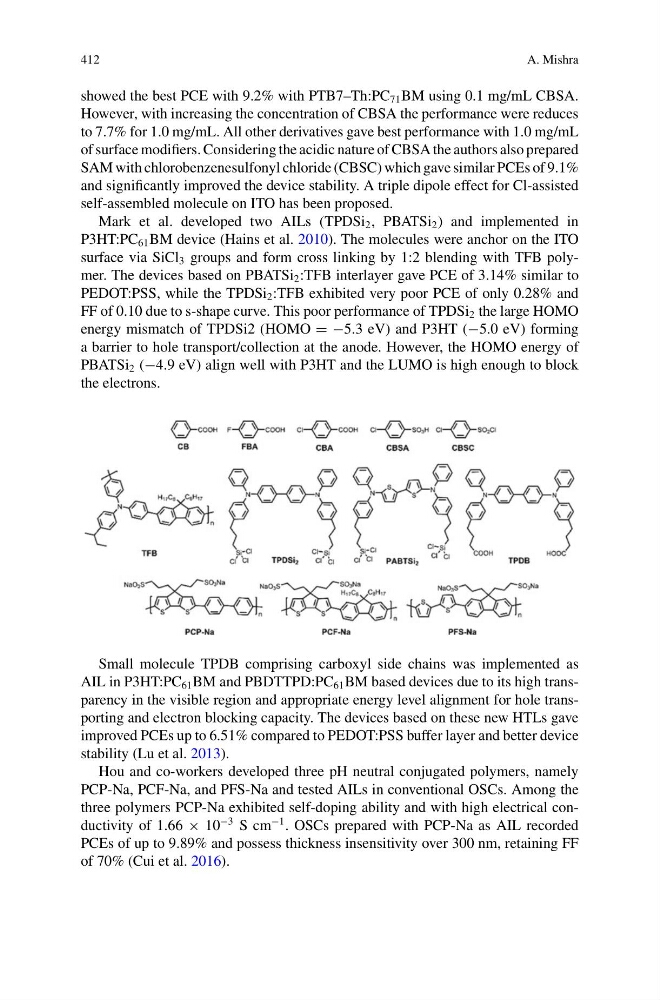
SAM with chlorobenzenesulfonyl chloride (CBSC) which gave similar PCEs of 9.1%
and significantly improved the device stability. A triple dipole effect for Cl-assisted
self-assembled molecule on ITO has been proposed.
Mark et al. developed two AILs (TPDSi 2 , PBATSi 2 ) and implemented in
P3HT:PC 61 BM device (Hains et al. 2010). The molecules were anchor on the ITO
surface via SiCl 3 groups and form cross linking by 1:2 blending with TFB polymer. The devices based on PBATSi 2 :TFB interlayer gave PCE of 3.14% similar to
PEDOT:PSS, while the TPDSi 2 :TFB exhibited very poor PCE of only 0.28% and
FF of 0.10 due to s-shape curve. This poor performance of TPDSi 2 the large HOMO
energy mismatch of TPDSi2 (HOMO = −5.3 eV) and P3HT (−5.0 eV) forming
a barrier to hole transport/collection at the anode. However, the HOMO energy of
PBATSi 2 (−4.9 eV) align well with P3HT and the LUMO is high enough to block
the electrons.
Small molecule TPDB comprising carboxyl side chains was implemented as
AIL in P3HT:PC 61 BM and PBDTTPD:PC 61 BM based devices due to its high transparency in the visible region and appropriate energy level alignment for hole transporting and electron blocking capacity. The devices based on these new HTLs gave
improved PCEs up to 6.51% compared to PEDOT:PSS buffer layer and better device
stability (Lu et al. 2013).
Hou and co-workers developed three pH neutral conjugated polymers, namely
PCP-Na, PCF-Na, and PFS-Na and tested AILs in conventional OSCs. Among the
three polymers PCP-Na exhibited self-doping ability and with high electrical conductivity of 1.66 × 10
−3 S cm
−1 . OSCs prepared with PCP-Na as AIL recorded
PCEs of up to 9.89% and possess thickness insensitivity over 300 nm, retaining FF
of 70% (Cui et al. 2016).
A. Mishra
showed the best PCE with 9.2% with PTB7–Th:PC 71 BM using 0.1 mg/mL CBSA.
However, with increasing the concentration of CBSA the performance were reduces
to 7.7% for 1.0 mg/mL. All other derivatives gave best performance with 1.0 mg/mL
of surface modifiers. Considering the acidic nature of CBSA the authors also prepared
SAM with chlorobenzenesulfonyl chloride (CBSC) which gave similar PCEs of 9.1%
and significantly improved the device stability. A triple dipole effect for Cl-assisted
self-assembled molecule on ITO has been proposed.
Mark et al. developed two AILs (TPDSi 2 , PBATSi 2 ) and implemented in
P3HT:PC 61 BM device (Hains et al. 2010). The molecules were anchor on the ITO
surface via SiCl 3 groups and form cross linking by 1:2 blending with TFB polymer. The devices based on PBATSi 2 :TFB interlayer gave PCE of 3.14% similar to
PEDOT:PSS, while the TPDSi 2 :TFB exhibited very poor PCE of only 0.28% and
FF of 0.10 due to s-shape curve. This poor performance of TPDSi 2 the large HOMO
energy mismatch of TPDSi2 (HOMO = −5.3 eV) and P3HT (−5.0 eV) forming
a barrier to hole transport/collection at the anode. However, the HOMO energy of
PBATSi 2 (−4.9 eV) align well with P3HT and the LUMO is high enough to block
the electrons.
Small molecule TPDB comprising carboxyl side chains was implemented as
AIL in P3HT:PC 61 BM and PBDTTPD:PC 61 BM based devices due to its high transparency in the visible region and appropriate energy level alignment for hole transporting and electron blocking capacity. The devices based on these new HTLs gave
improved PCEs up to 6.51% compared to PEDOT:PSS buffer layer and better device
stability (Lu et al. 2013).
Hou and co-workers developed three pH neutral conjugated polymers, namely
PCP-Na, PCF-Na, and PFS-Na and tested AILs in conventional OSCs. Among the
three polymers PCP-Na exhibited self-doping ability and with high electrical conductivity of 1.66 × 10
−3 S cm
−1 . OSCs prepared with PCP-Na as AIL recorded
PCEs of up to 9.89% and possess thickness insensitivity over 300 nm, retaining FF
of 70% (Cui et al. 2016).