

408
A. Mishra
dipole by the electron pair present in the pendant nitrogen atoms which facilitates
electron collection and transport to the ITO cathode (van Reenen et al. 2014; Lee
et al. 2018). The PNDIT10 N also acts as hole blocking layer due to its low lying
HOMO energy level.
18.2.2 Hole Transport Materials as Anode Interface Layers
For materials to be used as AIL, the WF should be high enough to match with
the HOMO of the donor for efficient hole extraction. An efficient hole transport
led to reduction in the series resistance. The AIL materials should possess high
optical transparency, good chemical stability, good optical transmittance, a high
ionization potential and suitable electron blocking ability. AIL has similar importance
as CIL in order to obtain high performance devices (Xu and Hou 2018). The reaction
between the active layer and metal electrode due to diffusion of metal ion resulted
in detrimental effect on device performance forming interfacial dipole barrier and
defect states. Earlier, it has been shown that the s-shape current density-voltage (JV ) curve resulted from the interfacial barrier (Trost et al. 2013; Tress et al. 2011).
Variation of hole selective layer can strongly affect the s-shape in the device. Sims
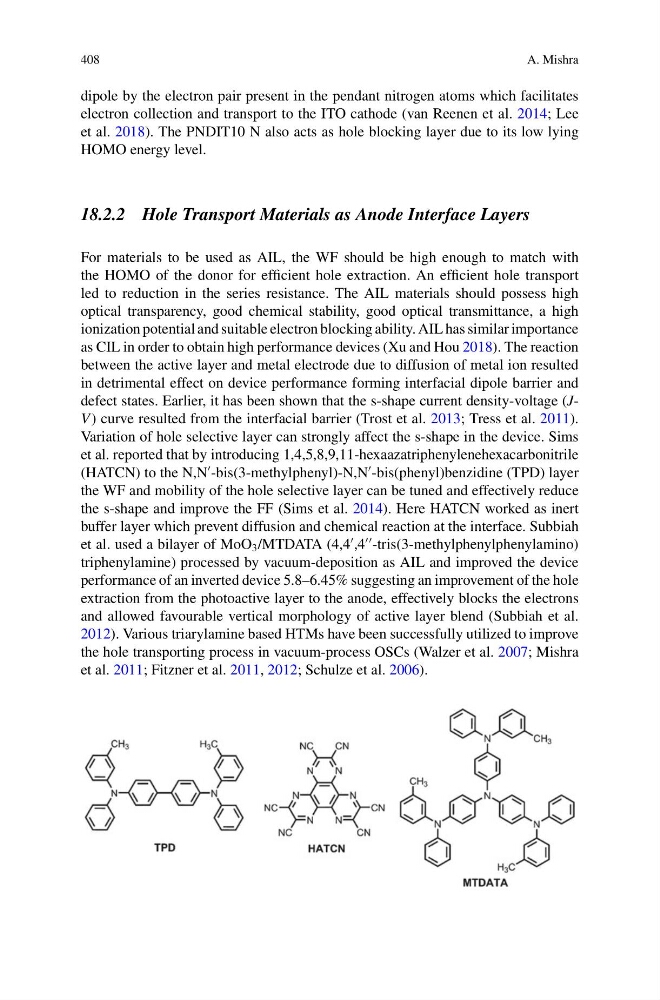
et al. reported that by introducing 1,4,5,8,9,11-hexaazatriphenylenehexacarbonitrile
(HATCN) to the N,N
-bis(3-methylphenyl)-N,N
-bis(phenyl)benzidine (TPD) layer
the WF and mobility of the hole selective layer can be tuned and effectively reduce
the s-shape and improve the FF (Sims et al. 2014). Here HATCN worked as inert
buffer layer which prevent diffusion and chemical reaction at the interface. Subbiah
et al. used a bilayer of MoO 3 /MTDATA (4,4
,4
-tris(3-methylphenylphenylamino)
triphenylamine) processed by vacuum-deposition as AIL and improved the device
performance of an inverted device 5.8–6.45% suggesting an improvement of the hole
extraction from the photoactive layer to the anode, effectively blocks the electrons
and allowed favourable vertical morphology of active layer blend (Subbiah et al.
2012). Various triarylamine based HTMs have been successfully utilized to improve
the hole transporting process in vacuum-process OSCs (Walzer et al. 2007; Mishra
et al. 2011; Fitzner et al. 2011, 2012; Schulze et al. 2006).
A. Mishra
dipole by the electron pair present in the pendant nitrogen atoms which facilitates
electron collection and transport to the ITO cathode (van Reenen et al. 2014; Lee
et al. 2018). The PNDIT10 N also acts as hole blocking layer due to its low lying
HOMO energy level.
18.2.2 Hole Transport Materials as Anode Interface Layers
For materials to be used as AIL, the WF should be high enough to match with
the HOMO of the donor for efficient hole extraction. An efficient hole transport
led to reduction in the series resistance. The AIL materials should possess high
optical transparency, good chemical stability, good optical transmittance, a high
ionization potential and suitable electron blocking ability. AIL has similar importance
as CIL in order to obtain high performance devices (Xu and Hou 2018). The reaction
between the active layer and metal electrode due to diffusion of metal ion resulted
in detrimental effect on device performance forming interfacial dipole barrier and
defect states. Earlier, it has been shown that the s-shape current density-voltage (JV ) curve resulted from the interfacial barrier (Trost et al. 2013; Tress et al. 2011).
Variation of hole selective layer can strongly affect the s-shape in the device. Sims
et al. reported that by introducing 1,4,5,8,9,11-hexaazatriphenylenehexacarbonitrile
(HATCN) to the N,N
-bis(3-methylphenyl)-N,N
-bis(phenyl)benzidine (TPD) layer
the WF and mobility of the hole selective layer can be tuned and effectively reduce
the s-shape and improve the FF (Sims et al. 2014). Here HATCN worked as inert
buffer layer which prevent diffusion and chemical reaction at the interface. Subbiah
et al. used a bilayer of MoO 3 /MTDATA (4,4
,4
-tris(3-methylphenylphenylamino)
triphenylamine) processed by vacuum-deposition as AIL and improved the device
performance of an inverted device 5.8–6.45% suggesting an improvement of the hole
extraction from the photoactive layer to the anode, effectively blocks the electrons
and allowed favourable vertical morphology of active layer blend (Subbiah et al.
2012). Various triarylamine based HTMs have been successfully utilized to improve
the hole transporting process in vacuum-process OSCs (Walzer et al. 2007; Mishra
et al. 2011; Fitzner et al. 2011, 2012; Schulze et al. 2006).