

18 Interfacial Materials for Organic Solar Cells
403
using PTB7-Th:IEICO-4F active layer and the protonated PEIE interfacial layer
exhibited an excellent PCE of 13.2%, which is higher than the reference devices
with ZnO interlayer (12.6%). Also the device processed from water eliminates further thermal annealing treatment (Xiong et al. 2019). It is important to note that the
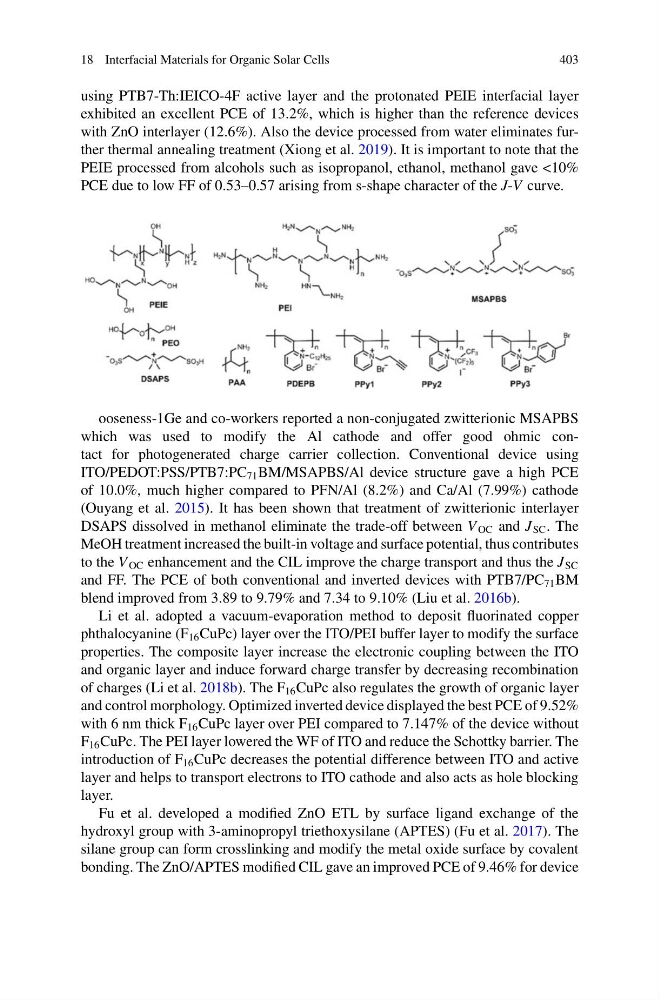
PEIE processed from alcohols such as isopropanol, ethanol, methanol gave <10%
PCE due to low FF of 0.53–0.57 arising from s-shape character of the J-V curve.
ooseness-1Ge and co-workers reported a non-conjugated zwitterionic MSAPBS
which was used to modify the Al cathode and offer good ohmic contact for photogenerated charge carrier collection. Conventional device using
ITO/PEDOT:PSS/PTB7:PC 71 BM/MSAPBS/Al device structure gave a high PCE
of 10.0%, much higher compared to PFN/Al (8.2%) and Ca/Al (7.99%) cathode
(Ouyang et al. 2015). It has been shown that treatment of zwitterionic interlayer
DSAPS dissolved in methanol eliminate the trade-off between V OC and J SC . The
MeOH treatment increased the built-in voltage and surface potential, thus contributes
to the V OC enhancement and the CIL improve the charge transport and thus the J SC
and FF. The PCE of both conventional and inverted devices with PTB7/PC 71 BM
blend improved from 3.89 to 9.79% and 7.34 to 9.10% (Liu et al. 2016b).
Li et al. adopted a vacuum-evaporation method to deposit fluorinated copper
phthalocyanine (F 16 CuPc) layer over the ITO/PEI buffer layer to modify the surface
properties. The composite layer increase the electronic coupling between the ITO
and organic layer and induce forward charge transfer by decreasing recombination
of charges (Li et al. 2018b). The F 16 CuPc also regulates the growth of organic layer
and control morphology. Optimized inverted device displayed the best PCE of 9.52%
with 6 nm thick F 16 CuPc layer over PEI compared to 7.147% of the device without
F 16 CuPc. The PEI layer lowered the WF of ITO and reduce the Schottky barrier. The
introduction of F 16 CuPc decreases the potential difference between ITO and active
layer and helps to transport electrons to ITO cathode and also acts as hole blocking
layer.
Fu et al. developed a modified ZnO ETL by surface ligand exchange of the
hydroxyl group with 3-aminopropyl triethoxysilane (APTES) (Fu et al. 2017). The
silane group can form crosslinking and modify the metal oxide surface by covalent
bonding. The ZnO/APTES modified CIL gave an improved PCE of 9.46% for device
403
using PTB7-Th:IEICO-4F active layer and the protonated PEIE interfacial layer
exhibited an excellent PCE of 13.2%, which is higher than the reference devices
with ZnO interlayer (12.6%). Also the device processed from water eliminates further thermal annealing treatment (Xiong et al. 2019). It is important to note that the
PEIE processed from alcohols such as isopropanol, ethanol, methanol gave <10%
PCE due to low FF of 0.53–0.57 arising from s-shape character of the J-V curve.
ooseness-1Ge and co-workers reported a non-conjugated zwitterionic MSAPBS
which was used to modify the Al cathode and offer good ohmic contact for photogenerated charge carrier collection. Conventional device using
ITO/PEDOT:PSS/PTB7:PC 71 BM/MSAPBS/Al device structure gave a high PCE
of 10.0%, much higher compared to PFN/Al (8.2%) and Ca/Al (7.99%) cathode
(Ouyang et al. 2015). It has been shown that treatment of zwitterionic interlayer
DSAPS dissolved in methanol eliminate the trade-off between V OC and J SC . The
MeOH treatment increased the built-in voltage and surface potential, thus contributes
to the V OC enhancement and the CIL improve the charge transport and thus the J SC
and FF. The PCE of both conventional and inverted devices with PTB7/PC 71 BM
blend improved from 3.89 to 9.79% and 7.34 to 9.10% (Liu et al. 2016b).
Li et al. adopted a vacuum-evaporation method to deposit fluorinated copper
phthalocyanine (F 16 CuPc) layer over the ITO/PEI buffer layer to modify the surface
properties. The composite layer increase the electronic coupling between the ITO
and organic layer and induce forward charge transfer by decreasing recombination
of charges (Li et al. 2018b). The F 16 CuPc also regulates the growth of organic layer
and control morphology. Optimized inverted device displayed the best PCE of 9.52%
with 6 nm thick F 16 CuPc layer over PEI compared to 7.147% of the device without
F 16 CuPc. The PEI layer lowered the WF of ITO and reduce the Schottky barrier. The
introduction of F 16 CuPc decreases the potential difference between ITO and active
layer and helps to transport electrons to ITO cathode and also acts as hole blocking
layer.
Fu et al. developed a modified ZnO ETL by surface ligand exchange of the
hydroxyl group with 3-aminopropyl triethoxysilane (APTES) (Fu et al. 2017). The
silane group can form crosslinking and modify the metal oxide surface by covalent
bonding. The ZnO/APTES modified CIL gave an improved PCE of 9.46% for device