

304
J. B. Liyanage et al.
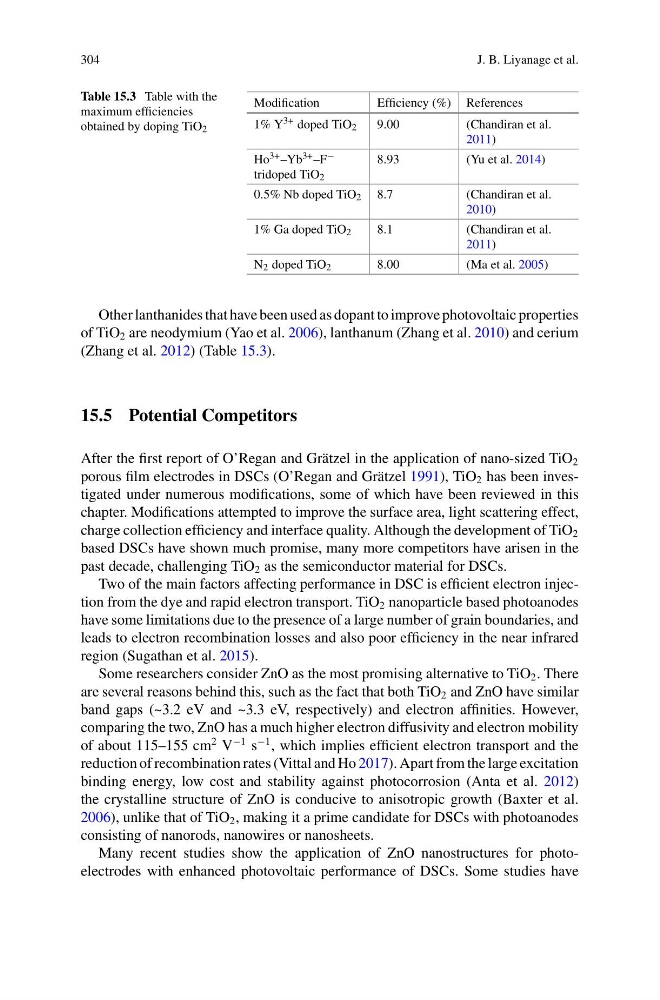
Table 15.3 Table with the
maximum efficiencies
obtained by doping TiO 2
Modification
Efficiency (%) References
1% Y 3+ doped TiO 2
9.00
(Chandiran et al.
2011)
Ho 3+ –Yb 3+ –F −
tridoped TiO 2
8.93
(Yu et al. 2014)
0.5% Nb doped TiO 2 8.7
(Chandiran et al.
2010)
1% Ga doped TiO 2
8.1
(Chandiran et al.
2011)
N 2 doped TiO 2
8.00
(Ma et al. 2005)
Other lanthanides that have been used as dopant to improve photovoltaic properties
of TiO 2 are neodymium (Yao et al. 2006), lanthanum (Zhang et al. 2010) and cerium
(Zhang et al. 2012) (Table 15.3).
15.5 Potential Competitors
After the first report of O’Regan and Grätzel in the application of nano-sized TiO 2
porous film electrodes in DSCs (O’Regan and Grätzel 1991), TiO 2 has been investigated under numerous modifications, some of which have been reviewed in this
chapter. Modifications attempted to improve the surface area, light scattering effect,
charge collection efficiency and interface quality. Although the development of TiO 2
based DSCs have shown much promise, many more competitors have arisen in the
past decade, challenging TiO 2 as the semiconductor material for DSCs.
Two of the main factors affecting performance in DSC is efficient electron injection from the dye and rapid electron transport. TiO 2 nanoparticle based photoanodes
have some limitations due to the presence of a large number of grain boundaries, and
leads to electron recombination losses and also poor efficiency in the near infrared
region (Sugathan et al. 2015).
Some researchers consider ZnO as the most promising alternative to TiO 2 . There
are several reasons behind this, such as the fact that both TiO 2 and ZnO have similar
band gaps (~3.2 eV and ~3.3 eV, respectively) and electron affinities. However,
comparing the two, ZnO has a much higher electron diffusivity and electron mobility
of about 115–155 cm
2 V
−1 s
−1 , which implies efficient electron transport and the
reduction of recombination rates (Vittal and Ho 2017). Apart from the large excitation
binding energy, low cost and stability against photocorrosion (Anta et al. 2012)
the crystalline structure of ZnO is conducive to anisotropic growth (Baxter et al.
2006), unlike that of TiO 2 , making it a prime candidate for DSCs with photoanodes
consisting of nanorods, nanowires or nanosheets.
Many recent studies show the application of ZnO nanostructures for photoelectrodes with enhanced photovoltaic performance of DSCs. Some studies have
J. B. Liyanage et al.
Table 15.3 Table with the
maximum efficiencies
obtained by doping TiO 2
Modification
Efficiency (%) References
1% Y 3+ doped TiO 2
9.00
(Chandiran et al.
2011)
Ho 3+ –Yb 3+ –F −
tridoped TiO 2
8.93
(Yu et al. 2014)
0.5% Nb doped TiO 2 8.7
(Chandiran et al.
2010)
1% Ga doped TiO 2
8.1
(Chandiran et al.
2011)
N 2 doped TiO 2
8.00
(Ma et al. 2005)
Other lanthanides that have been used as dopant to improve photovoltaic properties
of TiO 2 are neodymium (Yao et al. 2006), lanthanum (Zhang et al. 2010) and cerium
(Zhang et al. 2012) (Table 15.3).
15.5 Potential Competitors
After the first report of O’Regan and Grätzel in the application of nano-sized TiO 2
porous film electrodes in DSCs (O’Regan and Grätzel 1991), TiO 2 has been investigated under numerous modifications, some of which have been reviewed in this
chapter. Modifications attempted to improve the surface area, light scattering effect,
charge collection efficiency and interface quality. Although the development of TiO 2
based DSCs have shown much promise, many more competitors have arisen in the
past decade, challenging TiO 2 as the semiconductor material for DSCs.
Two of the main factors affecting performance in DSC is efficient electron injection from the dye and rapid electron transport. TiO 2 nanoparticle based photoanodes
have some limitations due to the presence of a large number of grain boundaries, and
leads to electron recombination losses and also poor efficiency in the near infrared
region (Sugathan et al. 2015).
Some researchers consider ZnO as the most promising alternative to TiO 2 . There
are several reasons behind this, such as the fact that both TiO 2 and ZnO have similar
band gaps (~3.2 eV and ~3.3 eV, respectively) and electron affinities. However,
comparing the two, ZnO has a much higher electron diffusivity and electron mobility
of about 115–155 cm
2 V
−1 s
−1 , which implies efficient electron transport and the
reduction of recombination rates (Vittal and Ho 2017). Apart from the large excitation
binding energy, low cost and stability against photocorrosion (Anta et al. 2012)
the crystalline structure of ZnO is conducive to anisotropic growth (Baxter et al.
2006), unlike that of TiO 2 , making it a prime candidate for DSCs with photoanodes
consisting of nanorods, nanowires or nanosheets.
Many recent studies show the application of ZnO nanostructures for photoelectrodes with enhanced photovoltaic performance of DSCs. Some studies have