

294
J. B. Liyanage et al.
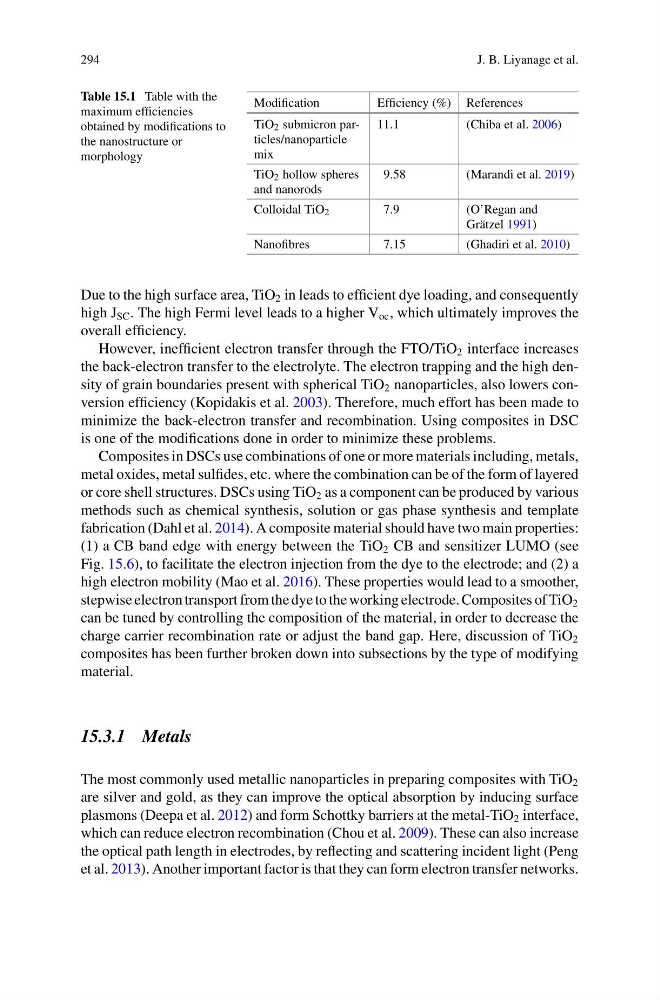
Table 15.1 Table with the
maximum efficiencies
obtained by modifications to
the nanostructure or
morphology
Modification
Efficiency (%) References
TiO 2 submicron particles/nanoparticle
mix
11.1
(Chiba et al. 2006)
TiO 2 hollow spheres
and nanorods
9.58
(Marandi et al. 2019)
Colloidal TiO 2
7.9
(O’Regan and
Grätzel 1991)
Nanofibres
7.15
(Ghadiri et al. 2010)
Due to the high surface area, TiO 2 in leads to efficient dye loading, and consequently
high J SC . The high Fermi level leads to a higher V oc , which ultimately improves the
overall efficiency.
However, inefficient electron transfer through the FTO/TiO 2 interface increases
the back-electron transfer to the electrolyte. The electron trapping and the high density of grain boundaries present with spherical TiO 2 nanoparticles, also lowers conversion efficiency (Kopidakis et al. 2003). Therefore, much effort has been made to
minimize the back-electron transfer and recombination. Using composites in DSC
is one of the modifications done in order to minimize these problems.
Composites in DSCs use combinations of one or more materials including, metals,
metal oxides, metal sulfides, etc. where the combination can be of the form of layered
or core shell structures. DSCs using TiO 2 as a component can be produced by various
methods such as chemical synthesis, solution or gas phase synthesis and template
fabrication (Dahl et al. 2014). A composite material should have two main properties:
(1) a CB band edge with energy between the TiO 2 CB and sensitizer LUMO (see
Fig. 15.6), to facilitate the electron injection from the dye to the electrode; and (2) a
high electron mobility (Mao et al. 2016). These properties would lead to a smoother,
stepwise electron transport from the dye to the working electrode. Composites of TiO 2
can be tuned by controlling the composition of the material, in order to decrease the
charge carrier recombination rate or adjust the band gap. Here, discussion of TiO 2
composites has been further broken down into subsections by the type of modifying
material.
15.3.1 Metals
The most commonly used metallic nanoparticles in preparing composites with TiO 2
are silver and gold, as they can improve the optical absorption by inducing surface
plasmons (Deepa et al. 2012) and form Schottky barriers at the metal-TiO 2 interface,
which can reduce electron recombination (Chou et al. 2009). These can also increase
the optical path length in electrodes, by reflecting and scattering incident light (Peng
et al. 2013). Another important factor is that they can form electron transfer networks.
J. B. Liyanage et al.
Table 15.1 Table with the
maximum efficiencies
obtained by modifications to
the nanostructure or
morphology
Modification
Efficiency (%) References
TiO 2 submicron particles/nanoparticle
mix
11.1
(Chiba et al. 2006)
TiO 2 hollow spheres
and nanorods
9.58
(Marandi et al. 2019)
Colloidal TiO 2
7.9
(O’Regan and
Grätzel 1991)
Nanofibres
7.15
(Ghadiri et al. 2010)
Due to the high surface area, TiO 2 in leads to efficient dye loading, and consequently
high J SC . The high Fermi level leads to a higher V oc , which ultimately improves the
overall efficiency.
However, inefficient electron transfer through the FTO/TiO 2 interface increases
the back-electron transfer to the electrolyte. The electron trapping and the high density of grain boundaries present with spherical TiO 2 nanoparticles, also lowers conversion efficiency (Kopidakis et al. 2003). Therefore, much effort has been made to
minimize the back-electron transfer and recombination. Using composites in DSC
is one of the modifications done in order to minimize these problems.
Composites in DSCs use combinations of one or more materials including, metals,
metal oxides, metal sulfides, etc. where the combination can be of the form of layered
or core shell structures. DSCs using TiO 2 as a component can be produced by various
methods such as chemical synthesis, solution or gas phase synthesis and template
fabrication (Dahl et al. 2014). A composite material should have two main properties:
(1) a CB band edge with energy between the TiO 2 CB and sensitizer LUMO (see
Fig. 15.6), to facilitate the electron injection from the dye to the electrode; and (2) a
high electron mobility (Mao et al. 2016). These properties would lead to a smoother,
stepwise electron transport from the dye to the working electrode. Composites of TiO 2
can be tuned by controlling the composition of the material, in order to decrease the
charge carrier recombination rate or adjust the band gap. Here, discussion of TiO 2
composites has been further broken down into subsections by the type of modifying
material.
15.3.1 Metals
The most commonly used metallic nanoparticles in preparing composites with TiO 2
are silver and gold, as they can improve the optical absorption by inducing surface
plasmons (Deepa et al. 2012) and form Schottky barriers at the metal-TiO 2 interface,
which can reduce electron recombination (Chou et al. 2009). These can also increase
the optical path length in electrodes, by reflecting and scattering incident light (Peng
et al. 2013). Another important factor is that they can form electron transfer networks.