

14 Fabrication and Thermal Performance Evaluation …
279
Kumar et al. 2016). In this study, authors have investigated the thermal performance
of PCM heat packs containing 300 g PCM at ambient temperature ~0 °C and the
results are compared with an identical water heat pack.
14.2 Materials and Methods
Ethylene glycol (EG) and Sodium acetate trihydrate (grade excel R) are procured
from Alfa Assar and used without any modification to prepare a metastable supercooled liquid PCM for fabricating a heat pack. SAT, EG and deionized (DI) water are
mixed in 92:5:3 weight fractions, respectively. The mixture is heated up to 80 °C and
stirred for 25–30 min using magnetic stirrer. After homogeneous mixing of samples,
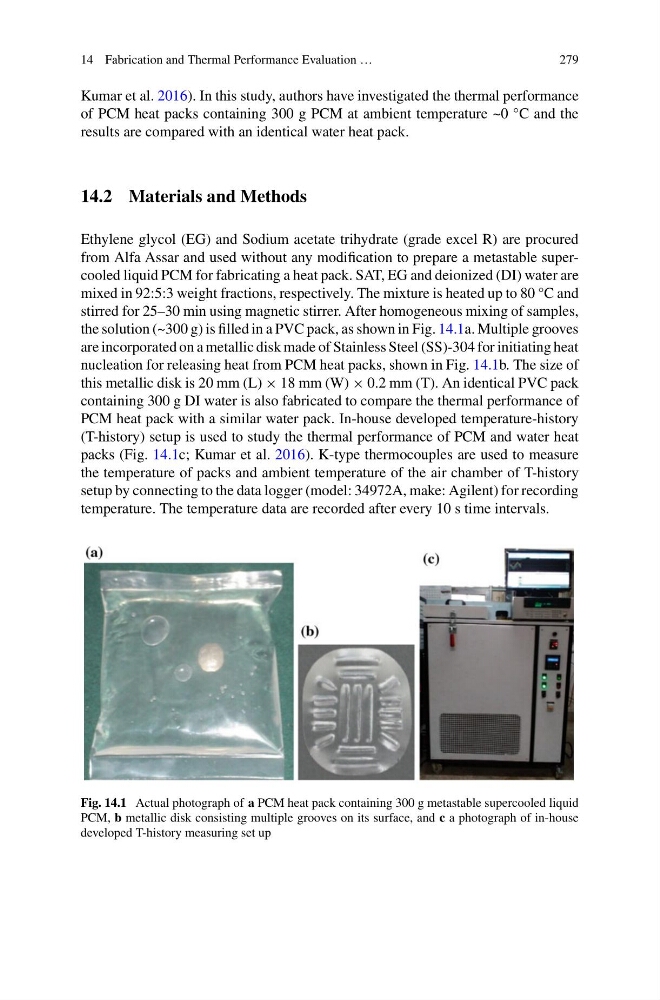
the solution (~300 g) is filled in a PVC pack, as shown in Fig. 14.1a. Multiple grooves
are incorporated on a metallic disk made of Stainless Steel (SS)-304 for initiating heat
nucleation for releasing heat from PCM heat packs, shown in Fig. 14.1b. The size of
this metallic disk is 20 mm (L) × 18 mm (W) × 0.2 mm (T). An identical PVC pack
containing 300 g DI water is also fabricated to compare the thermal performance of
PCM heat pack with a similar water pack. In-house developed temperature-history
(T-history) setup is used to study the thermal performance of PCM and water heat
packs (Fig. 14.1c; Kumar et al. 2016). K-type thermocouples are used to measure
the temperature of packs and ambient temperature of the air chamber of T-history
setup by connecting to the data logger (model: 34972A, make: Agilent) for recording
temperature. The temperature data are recorded after every 10 s time intervals.
Fig. 14.1 Actual photograph of a PCM heat pack containing 300 g metastable supercooled liquid
PCM, b metallic disk consisting multiple grooves on its surface, and c a photograph of in-house
developed T-history measuring set up
279
Kumar et al. 2016). In this study, authors have investigated the thermal performance
of PCM heat packs containing 300 g PCM at ambient temperature ~0 °C and the
results are compared with an identical water heat pack.
14.2 Materials and Methods
Ethylene glycol (EG) and Sodium acetate trihydrate (grade excel R) are procured
from Alfa Assar and used without any modification to prepare a metastable supercooled liquid PCM for fabricating a heat pack. SAT, EG and deionized (DI) water are
mixed in 92:5:3 weight fractions, respectively. The mixture is heated up to 80 °C and
stirred for 25–30 min using magnetic stirrer. After homogeneous mixing of samples,
the solution (~300 g) is filled in a PVC pack, as shown in Fig. 14.1a. Multiple grooves
are incorporated on a metallic disk made of Stainless Steel (SS)-304 for initiating heat
nucleation for releasing heat from PCM heat packs, shown in Fig. 14.1b. The size of
this metallic disk is 20 mm (L) × 18 mm (W) × 0.2 mm (T). An identical PVC pack
containing 300 g DI water is also fabricated to compare the thermal performance of
PCM heat pack with a similar water pack. In-house developed temperature-history
(T-history) setup is used to study the thermal performance of PCM and water heat
packs (Fig. 14.1c; Kumar et al. 2016). K-type thermocouples are used to measure
the temperature of packs and ambient temperature of the air chamber of T-history
setup by connecting to the data logger (model: 34972A, make: Agilent) for recording
temperature. The temperature data are recorded after every 10 s time intervals.
Fig. 14.1 Actual photograph of a PCM heat pack containing 300 g metastable supercooled liquid
PCM, b metallic disk consisting multiple grooves on its surface, and c a photograph of in-house
developed T-history measuring set up