

238
D. Moudgil and V. Khullar
set-ups have been designed, which are similar in all respects except that one simulates the surface heating i.e. the conventional charging mechanism and the other
simulates the optical charging mode. Subsequently, charging rate of nano PCM at
different concentrations have been carefully measured under optical charging mode.
12.2 Experimental Materials and Methods
In order to clearly understand the heat transfer mechanisms involved during thermal
and optical heating two sets of experiments have been carefully designed. In the
present work paraffin wax has been used as PCM and amorphous carbon nanoparticles (<100 nm SIGMA ALDRICH) of desired amount have been dispersed into PCM
to form nano-PCM. All materials have been used without any further purification. For
temperature measurements, K-type thermocouples were employed. In experiments
glass and solar selective surface (black chrome coated copper sheet, 0.019 cm thick,
Solchrome) were used as interface in two set-ups. Various nano-PCMs containing
paraffin wax (10 g) and amorphous carbon nanoparticles (ACNs) with different mass
fractions have been prepared and thermal conductivity has been measured using heat
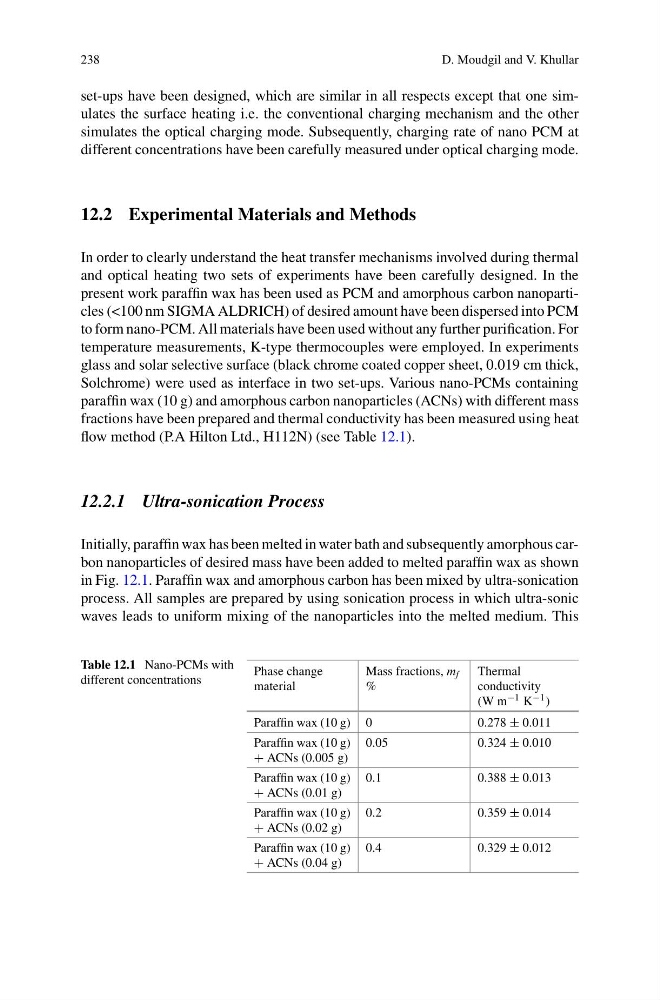
flow method (P.A Hilton Ltd., H112N) (see Table 12.1).
12.2.1 Ultra-sonication Process
Initially, paraffin wax has been melted in water bath and subsequently amorphous carbon nanoparticles of desired mass have been added to melted paraffin wax as shown
in Fig. 12.1. Paraffin wax and amorphous carbon has been mixed by ultra-sonication
process. All samples are prepared by using sonication process in which ultra-sonic
waves leads to uniform mixing of the nanoparticles into the melted medium. This
Table 12.1 Nano-PCMs with
different concentrations
Phase change
material
Mass fractions, m f
%
Thermal
conductivity
(W m −1 K −1 )
Paraffin wax (10 g) 0
0.278 ± 0.011
Paraffin wax (10 g)
+ ACNs (0.005 g)
0.05
0.324 ± 0.010
Paraffin wax (10 g)
+ ACNs (0.01 g)
0.1
0.388 ± 0.013
Paraffin wax (10 g)
+ ACNs (0.02 g)
0.2
0.359 ± 0.014
Paraffin wax (10 g)
+ ACNs (0.04 g)
0.4
0.329 ± 0.012
D. Moudgil and V. Khullar
set-ups have been designed, which are similar in all respects except that one simulates the surface heating i.e. the conventional charging mechanism and the other
simulates the optical charging mode. Subsequently, charging rate of nano PCM at
different concentrations have been carefully measured under optical charging mode.
12.2 Experimental Materials and Methods
In order to clearly understand the heat transfer mechanisms involved during thermal
and optical heating two sets of experiments have been carefully designed. In the
present work paraffin wax has been used as PCM and amorphous carbon nanoparticles (<100 nm SIGMA ALDRICH) of desired amount have been dispersed into PCM
to form nano-PCM. All materials have been used without any further purification. For
temperature measurements, K-type thermocouples were employed. In experiments
glass and solar selective surface (black chrome coated copper sheet, 0.019 cm thick,
Solchrome) were used as interface in two set-ups. Various nano-PCMs containing
paraffin wax (10 g) and amorphous carbon nanoparticles (ACNs) with different mass
fractions have been prepared and thermal conductivity has been measured using heat
flow method (P.A Hilton Ltd., H112N) (see Table 12.1).
12.2.1 Ultra-sonication Process
Initially, paraffin wax has been melted in water bath and subsequently amorphous carbon nanoparticles of desired mass have been added to melted paraffin wax as shown
in Fig. 12.1. Paraffin wax and amorphous carbon has been mixed by ultra-sonication
process. All samples are prepared by using sonication process in which ultra-sonic
waves leads to uniform mixing of the nanoparticles into the melted medium. This
Table 12.1 Nano-PCMs with
different concentrations
Phase change
material
Mass fractions, m f
%
Thermal
conductivity
(W m −1 K −1 )
Paraffin wax (10 g) 0
0.278 ± 0.011
Paraffin wax (10 g)
+ ACNs (0.005 g)
0.05
0.324 ± 0.010
Paraffin wax (10 g)
+ ACNs (0.01 g)
0.1
0.388 ± 0.013
Paraffin wax (10 g)
+ ACNs (0.02 g)
0.2
0.359 ± 0.014
Paraffin wax (10 g)
+ ACNs (0.04 g)
0.4
0.329 ± 0.012