

214
A. Bhattacharya
the metal foam and PCM are in local thermal equilibrium and thus a single nodal
temperature variable can specify the temperature evolution of the system. All the
properties at the discretized nodes are calculated based on volume averaging the
foam and PCM properties. For these models, a single energy balance equation in
terms of the average temperature is sufficient to simulate the system. The volume
averaged energy equation for this case can be written as
ρ av
∂(C pav T + ε f l L)
∂t
+ ερ PC M ∇.(
UC p PC M T ) = ∇.(k e f f ∇T )
(11.1)
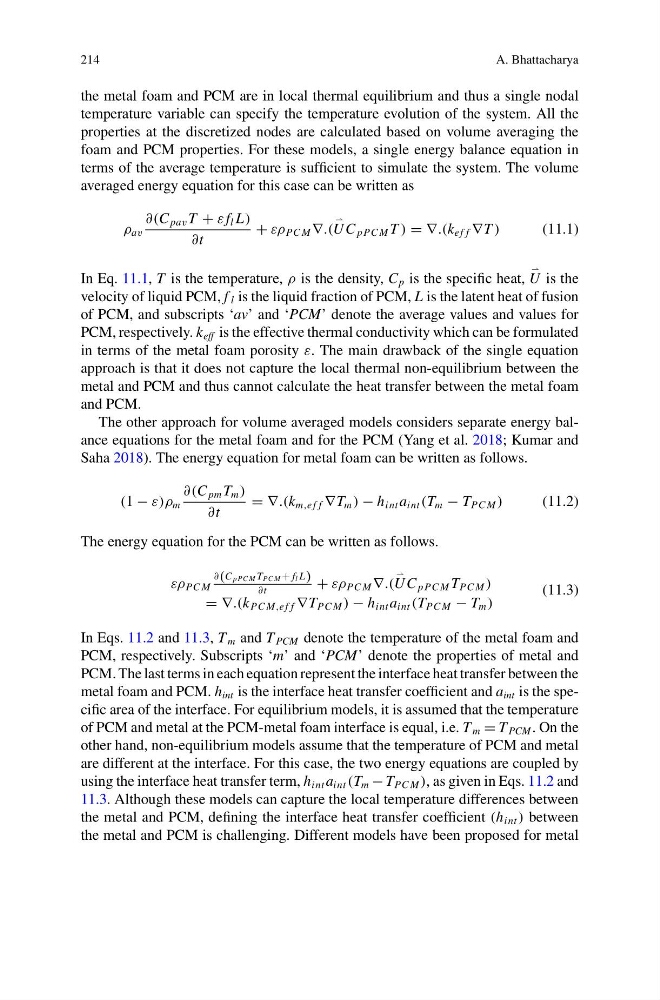
In Eq. 11.1, T is the temperature, ρ is the density, C p is the specific heat,
U is the
velocity of liquid PCM, f l is the liquid fraction of PCM, L is the latent heat of fusion
of PCM, and subscripts ‘av’ and ‘PCM’ denote the average values and values for
PCM, respectively. k eff is the effective thermal conductivity which can be formulated
in terms of the metal foam porosity ε. The main drawback of the single equation
approach is that it does not capture the local thermal non-equilibrium between the
metal and PCM and thus cannot calculate the heat transfer between the metal foam
and PCM.
The other approach for volume averaged models considers separate energy balance equations for the metal foam and for the PCM (Yang et al. 2018; Kumar and
Saha 2018). The energy equation for metal foam can be written as follows.
(1 − ε)ρ m
∂(C pm T m )
∂t
= ∇.(k m,e f f ∇T m ) − h int a int (T m − T PC M )
(11.2)
The energy equation for the PCM can be written as follows.
ερ PC M
∂(C pPC M T PC M + f l L)
∂t
+ ερ PC M ∇.(
U C p PC M T PC M )
= ∇.(k PC M,e f f ∇T PC M ) − h int a int (T PC M − T m )
(11.3)
In Eqs. 11.2 and 11.3, T m and T PCM denote the temperature of the metal foam and
PCM, respectively. Subscripts ‘m’ and ‘PCM’ denote the properties of metal and
PCM. The last terms in each equation represent the interface heat transfer between the
metal foam and PCM. h int is the interface heat transfer coefficient and a int is the specific area of the interface. For equilibrium models, it is assumed that the temperature
of PCM and metal at the PCM-metal foam interface is equal, i.e. T m = T PCM . On the
other hand, non-equilibrium models assume that the temperature of PCM and metal
are different at the interface. For this case, the two energy equations are coupled by
using the interface heat transfer term, h int a int (T m − T PC M ), as given in Eqs. 11.2 and
11.3. Although these models can capture the local temperature differences between
the metal and PCM, defining the interface heat transfer coefficient (h int ) between
the metal and PCM is challenging. Different models have been proposed for metal
A. Bhattacharya
the metal foam and PCM are in local thermal equilibrium and thus a single nodal
temperature variable can specify the temperature evolution of the system. All the
properties at the discretized nodes are calculated based on volume averaging the
foam and PCM properties. For these models, a single energy balance equation in
terms of the average temperature is sufficient to simulate the system. The volume
averaged energy equation for this case can be written as
ρ av
∂(C pav T + ε f l L)
∂t
+ ερ PC M ∇.(
UC p PC M T ) = ∇.(k e f f ∇T )
(11.1)
In Eq. 11.1, T is the temperature, ρ is the density, C p is the specific heat,
U is the
velocity of liquid PCM, f l is the liquid fraction of PCM, L is the latent heat of fusion
of PCM, and subscripts ‘av’ and ‘PCM’ denote the average values and values for
PCM, respectively. k eff is the effective thermal conductivity which can be formulated
in terms of the metal foam porosity ε. The main drawback of the single equation
approach is that it does not capture the local thermal non-equilibrium between the
metal and PCM and thus cannot calculate the heat transfer between the metal foam
and PCM.
The other approach for volume averaged models considers separate energy balance equations for the metal foam and for the PCM (Yang et al. 2018; Kumar and
Saha 2018). The energy equation for metal foam can be written as follows.
(1 − ε)ρ m
∂(C pm T m )
∂t
= ∇.(k m,e f f ∇T m ) − h int a int (T m − T PC M )
(11.2)
The energy equation for the PCM can be written as follows.
ερ PC M
∂(C pPC M T PC M + f l L)
∂t
+ ερ PC M ∇.(
U C p PC M T PC M )
= ∇.(k PC M,e f f ∇T PC M ) − h int a int (T PC M − T m )
(11.3)
In Eqs. 11.2 and 11.3, T m and T PCM denote the temperature of the metal foam and
PCM, respectively. Subscripts ‘m’ and ‘PCM’ denote the properties of metal and
PCM. The last terms in each equation represent the interface heat transfer between the
metal foam and PCM. h int is the interface heat transfer coefficient and a int is the specific area of the interface. For equilibrium models, it is assumed that the temperature
of PCM and metal at the PCM-metal foam interface is equal, i.e. T m = T PCM . On the
other hand, non-equilibrium models assume that the temperature of PCM and metal
are different at the interface. For this case, the two energy equations are coupled by
using the interface heat transfer term, h int a int (T m − T PC M ), as given in Eqs. 11.2 and
11.3. Although these models can capture the local temperature differences between
the metal and PCM, defining the interface heat transfer coefficient (h int ) between
the metal and PCM is challenging. Different models have been proposed for metal