

210
A. Bhattacharya
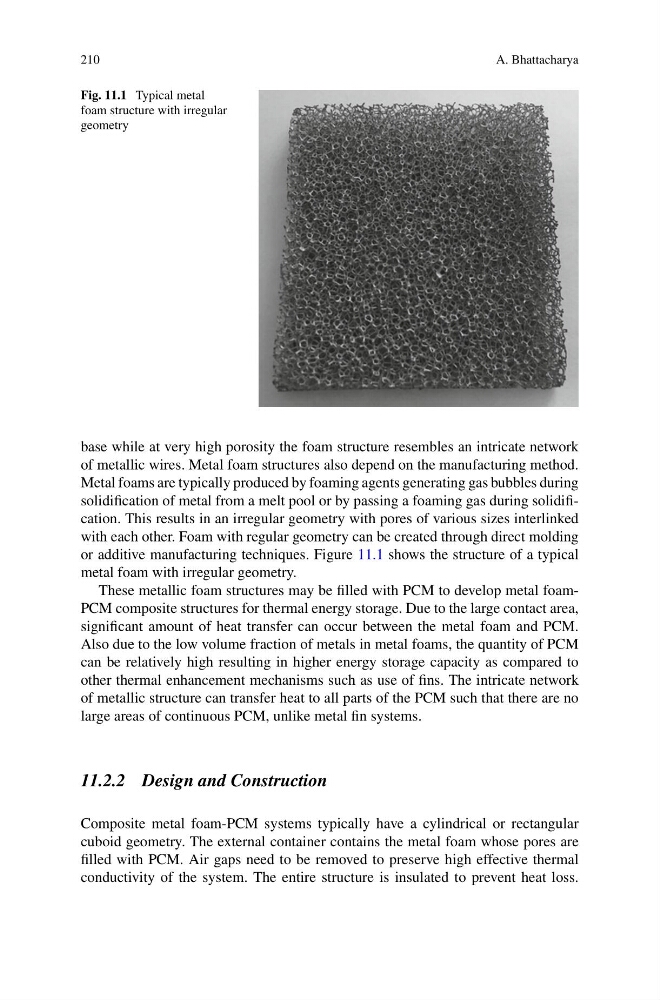
Fig. 11.1 Typical metal
foam structure with irregular
geometry
base while at very high porosity the foam structure resembles an intricate network
of metallic wires. Metal foam structures also depend on the manufacturing method.
Metal foams are typically produced by foaming agents generating gas bubbles during
solidification of metal from a melt pool or by passing a foaming gas during solidification. This results in an irregular geometry with pores of various sizes interlinked
with each other. Foam with regular geometry can be created through direct molding
or additive manufacturing techniques. Figure 11.1 shows the structure of a typical
metal foam with irregular geometry.
These metallic foam structures may be filled with PCM to develop metal foamPCM composite structures for thermal energy storage. Due to the large contact area,
significant amount of heat transfer can occur between the metal foam and PCM.
Also due to the low volume fraction of metals in metal foams, the quantity of PCM
can be relatively high resulting in higher energy storage capacity as compared to
other thermal enhancement mechanisms such as use of fins. The intricate network
of metallic structure can transfer heat to all parts of the PCM such that there are no
large areas of continuous PCM, unlike metal fin systems.
11.2.2 Design and Construction
Composite metal foam-PCM systems typically have a cylindrical or rectangular
cuboid geometry. The external container contains the metal foam whose pores are
filled with PCM. Air gaps need to be removed to preserve high effective thermal
conductivity of the system. The entire structure is insulated to prevent heat loss.
A. Bhattacharya
Fig. 11.1 Typical metal
foam structure with irregular
geometry
base while at very high porosity the foam structure resembles an intricate network
of metallic wires. Metal foam structures also depend on the manufacturing method.
Metal foams are typically produced by foaming agents generating gas bubbles during
solidification of metal from a melt pool or by passing a foaming gas during solidification. This results in an irregular geometry with pores of various sizes interlinked
with each other. Foam with regular geometry can be created through direct molding
or additive manufacturing techniques. Figure 11.1 shows the structure of a typical
metal foam with irregular geometry.
These metallic foam structures may be filled with PCM to develop metal foamPCM composite structures for thermal energy storage. Due to the large contact area,
significant amount of heat transfer can occur between the metal foam and PCM.
Also due to the low volume fraction of metals in metal foams, the quantity of PCM
can be relatively high resulting in higher energy storage capacity as compared to
other thermal enhancement mechanisms such as use of fins. The intricate network
of metallic structure can transfer heat to all parts of the PCM such that there are no
large areas of continuous PCM, unlike metal fin systems.
11.2.2 Design and Construction
Composite metal foam-PCM systems typically have a cylindrical or rectangular
cuboid geometry. The external container contains the metal foam whose pores are
filled with PCM. Air gaps need to be removed to preserve high effective thermal
conductivity of the system. The entire structure is insulated to prevent heat loss.