

9 TEWI Assessment of Conventional and Solar Powered Cooling Systems
165
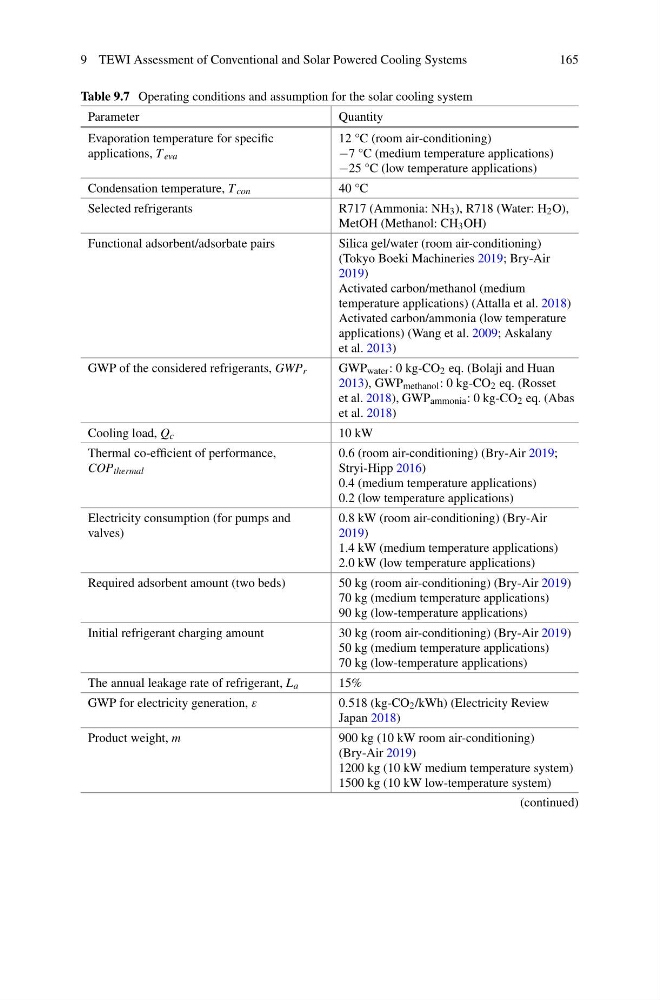
Table 9.7 Operating conditions and assumption for the solar cooling system
Parameter
Quantity
Evaporation temperature for specific
applications, T eva
12 °C (room air-conditioning)
−7 °C (medium temperature applications)
−25 °C (low temperature applications)
Condensation temperature, T con
40 °C
Selected refrigerants
R717 (Ammonia: NH 3 ), R718 (Water: H 2 O),
MetOH (Methanol: CH 3 OH)
Functional adsorbent/adsorbate pairs
Silica gel/water (room air-conditioning)
(Tokyo Boeki Machineries 2019; Bry-Air
2019)
Activated carbon/methanol (medium
temperature applications) (Attalla et al. 2018)
Activated carbon/ammonia (low temperature
applications) (Wang et al. 2009; Askalany
et al. 2013)
GWP of the considered refrigerants, GWP r
GWP water : 0 kg-CO 2 eq. (Bolaji and Huan
2013), GWP methanol : 0 kg-CO 2 eq. (Rosset
et al. 2018), GWP ammonia : 0 kg-CO 2 eq. (Abas
et al. 2018)
Cooling load, Q c
10 kW
Thermal co-efficient of performance,
COP thermal
0.6 (room air-conditioning) (Bry-Air 2019;
Stryi-Hipp 2016)
0.4 (medium temperature applications)
0.2 (low temperature applications)
Electricity consumption (for pumps and
valves)
0.8 kW (room air-conditioning) (Bry-Air
2019)
1.4 kW (medium temperature applications)
2.0 kW (low temperature applications)
Required adsorbent amount (two beds)
50 kg (room air-conditioning) (Bry-Air 2019)
70 kg (medium temperature applications)
90 kg (low-temperature applications)
Initial refrigerant charging amount
30 kg (room air-conditioning) (Bry-Air 2019)
50 kg (medium temperature applications)
70 kg (low-temperature applications)
The annual leakage rate of refrigerant, L a
15%
GWP for electricity generation, ε
0.518 (kg-CO 2 /kWh) (Electricity Review
Japan 2018)
Product weight, m
900 kg (10 kW room air-conditioning)
(Bry-Air 2019)
1200 kg (10 kW medium temperature system)
1500 kg (10 kW low-temperature system)
(continued)
165
Table 9.7 Operating conditions and assumption for the solar cooling system
Parameter
Quantity
Evaporation temperature for specific
applications, T eva
12 °C (room air-conditioning)
−7 °C (medium temperature applications)
−25 °C (low temperature applications)
Condensation temperature, T con
40 °C
Selected refrigerants
R717 (Ammonia: NH 3 ), R718 (Water: H 2 O),
MetOH (Methanol: CH 3 OH)
Functional adsorbent/adsorbate pairs
Silica gel/water (room air-conditioning)
(Tokyo Boeki Machineries 2019; Bry-Air
2019)
Activated carbon/methanol (medium
temperature applications) (Attalla et al. 2018)
Activated carbon/ammonia (low temperature
applications) (Wang et al. 2009; Askalany
et al. 2013)
GWP of the considered refrigerants, GWP r
GWP water : 0 kg-CO 2 eq. (Bolaji and Huan
2013), GWP methanol : 0 kg-CO 2 eq. (Rosset
et al. 2018), GWP ammonia : 0 kg-CO 2 eq. (Abas
et al. 2018)
Cooling load, Q c
10 kW
Thermal co-efficient of performance,
COP thermal
0.6 (room air-conditioning) (Bry-Air 2019;
Stryi-Hipp 2016)
0.4 (medium temperature applications)
0.2 (low temperature applications)
Electricity consumption (for pumps and
valves)
0.8 kW (room air-conditioning) (Bry-Air
2019)
1.4 kW (medium temperature applications)
2.0 kW (low temperature applications)
Required adsorbent amount (two beds)
50 kg (room air-conditioning) (Bry-Air 2019)
70 kg (medium temperature applications)
90 kg (low-temperature applications)
Initial refrigerant charging amount
30 kg (room air-conditioning) (Bry-Air 2019)
50 kg (medium temperature applications)
70 kg (low-temperature applications)
The annual leakage rate of refrigerant, L a
15%
GWP for electricity generation, ε
0.518 (kg-CO 2 /kWh) (Electricity Review
Japan 2018)
Product weight, m
900 kg (10 kW room air-conditioning)
(Bry-Air 2019)
1200 kg (10 kW medium temperature system)
1500 kg (10 kW low-temperature system)
(continued)