

9 TEWI Assessment of Conventional and Solar Powered Cooling Systems
163
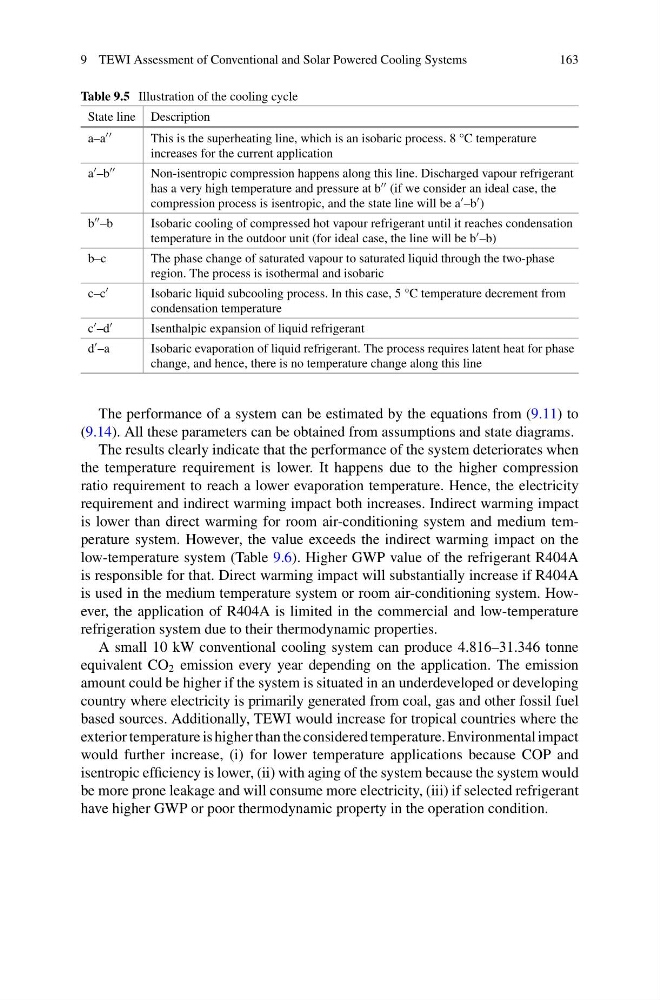
Table 9.5 Illustration of the cooling cycle
State line Description
a–a
This is the superheating line, which is an isobaric process. 8 °C temperature
increases for the current application
a –b
Non-isentropic compression happens along this line. Discharged vapour refrigerant
has a very high temperature and pressure at b (if we consider an ideal case, the
compression process is isentropic, and the state line will be a –b )
b –b
Isobaric cooling of compressed hot vapour refrigerant until it reaches condensation
temperature in the outdoor unit (for ideal case, the line will be b –b)
b–c
The phase change of saturated vapour to saturated liquid through the two-phase
region. The process is isothermal and isobaric
c–c
Isobaric liquid subcooling process. In this case, 5 °C temperature decrement from
condensation temperature
c –d
Isenthalpic expansion of liquid refrigerant
d –a
Isobaric evaporation of liquid refrigerant. The process requires latent heat for phase
change, and hence, there is no temperature change along this line
The performance of a system can be estimated by the equations from (9.11) to
(9.14). All these parameters can be obtained from assumptions and state diagrams.
The results clearly indicate that the performance of the system deteriorates when
the temperature requirement is lower. It happens due to the higher compression
ratio requirement to reach a lower evaporation temperature. Hence, the electricity
requirement and indirect warming impact both increases. Indirect warming impact
is lower than direct warming for room air-conditioning system and medium temperature system. However, the value exceeds the indirect warming impact on the
low-temperature system (Table 9.6). Higher GWP value of the refrigerant R404A
is responsible for that. Direct warming impact will substantially increase if R404A
is used in the medium temperature system or room air-conditioning system. However, the application of R404A is limited in the commercial and low-temperature
refrigeration system due to their thermodynamic properties.
A small 10 kW conventional cooling system can produce 4.816–31.346 tonne
equivalent CO 2 emission every year depending on the application. The emission
amount could be higher if the system is situated in an underdeveloped or developing
country where electricity is primarily generated from coal, gas and other fossil fuel
based sources. Additionally, TEWI would increase for tropical countries where the
exterior temperature is higher than the considered temperature. Environmental impact
would further increase, (i) for lower temperature applications because COP and
isentropic efficiency is lower, (ii) with aging of the system because the system would
be more prone leakage and will consume more electricity, (iii) if selected refrigerant
have higher GWP or poor thermodynamic property in the operation condition.
163
Table 9.5 Illustration of the cooling cycle
State line Description
a–a
This is the superheating line, which is an isobaric process. 8 °C temperature
increases for the current application
a –b
Non-isentropic compression happens along this line. Discharged vapour refrigerant
has a very high temperature and pressure at b (if we consider an ideal case, the
compression process is isentropic, and the state line will be a –b )
b –b
Isobaric cooling of compressed hot vapour refrigerant until it reaches condensation
temperature in the outdoor unit (for ideal case, the line will be b –b)
b–c
The phase change of saturated vapour to saturated liquid through the two-phase
region. The process is isothermal and isobaric
c–c
Isobaric liquid subcooling process. In this case, 5 °C temperature decrement from
condensation temperature
c –d
Isenthalpic expansion of liquid refrigerant
d –a
Isobaric evaporation of liquid refrigerant. The process requires latent heat for phase
change, and hence, there is no temperature change along this line
The performance of a system can be estimated by the equations from (9.11) to
(9.14). All these parameters can be obtained from assumptions and state diagrams.
The results clearly indicate that the performance of the system deteriorates when
the temperature requirement is lower. It happens due to the higher compression
ratio requirement to reach a lower evaporation temperature. Hence, the electricity
requirement and indirect warming impact both increases. Indirect warming impact
is lower than direct warming for room air-conditioning system and medium temperature system. However, the value exceeds the indirect warming impact on the
low-temperature system (Table 9.6). Higher GWP value of the refrigerant R404A
is responsible for that. Direct warming impact will substantially increase if R404A
is used in the medium temperature system or room air-conditioning system. However, the application of R404A is limited in the commercial and low-temperature
refrigeration system due to their thermodynamic properties.
A small 10 kW conventional cooling system can produce 4.816–31.346 tonne
equivalent CO 2 emission every year depending on the application. The emission
amount could be higher if the system is situated in an underdeveloped or developing
country where electricity is primarily generated from coal, gas and other fossil fuel
based sources. Additionally, TEWI would increase for tropical countries where the
exterior temperature is higher than the considered temperature. Environmental impact
would further increase, (i) for lower temperature applications because COP and
isentropic efficiency is lower, (ii) with aging of the system because the system would
be more prone leakage and will consume more electricity, (iii) if selected refrigerant
have higher GWP or poor thermodynamic property in the operation condition.